
How to Organize a DJ Library
A DJ library is organized in two layers: a plain folder tree on disk, then the playlists, tags, ratings, and colors inside your DJ app. This guide shows how to organize your DJ library in rekordbox, Serato, Traktor, or Engine DJ without breaking a single file path.
Quick Answer
That split is the part most guides skip. Folders answer where a file lives. The app answers what a track is for. Once you separate the two, how to organize your DJ music library stops being a matter of taste and becomes two short jobs, each with a clear finish line.
Why a DJ Library Needs a System
A library only gets messy in one direction. New music arrives faster than you file it, the folder that was meant to be temporary becomes the biggest one you own, and search still works, so nothing feels broken. The bill arrives later, in the eight bars where you need one specific track and cannot picture where it is.
That is also why answers to how to organize dj library reddit threads never agree. A wedding DJ reading a request slip needs different access than a techno DJ planning an hour of build. What they share is not a folder layout, it is a small number of rules they never break.
- You can find a track by what it does, not only by its title
- New music gets processed once, instead of being re-judged at every gig
- Backups and a new laptop become one copy operation
- Rule-based playlists can build themselves, because the data underneath is consistent
- Preparing a set starts from a shortlist instead of from the whole collection
How to Organize DJ Music Library Files on Disk
Keep one root music folder and put every track inside it. One root is what turns backup, sync, and moving to a new machine into a single operation instead of a hunt across three drives and a desktop.
A good dj folder structure is boring on purpose. Two levels are enough for almost everyone: a broad category, then where the file came from or when it landed. Tracks bought on Beatport, pulled from a record pool, or ripped from your own drives all fit the same shape.
- One root folder for all music, on a drive you actually back up
- Level one is a category you would never rename: House, Techno, Hip Hop, Edits, Classics
- Level two is the source or the month it arrived, not a sub-genre you will argue with in a year
- No folders per gig, per mood, or per set: that work belongs in the app, where a track can be in many lists at once
- One filename order for everything, usually artist then title, with nothing else glued on
| App | How a moved file appears | How to fix it |
|---|---|---|
| rekordbox 7 | An exclamation mark next to the track in Collection | File menu, Display All Missing Files, then Auto Relocate or Relocate |
| Serato DJ Pro 4 | The track turns orange and reads as not found | Relocate Lost Files in the Files panel, or Relocate from folder |
| Engine DJ 5 | The track name shows in red text | Right-click the track, Relocate Missing File, or Auto Relocate All |
Checked against the rekordbox 7.2 manual, Serato's Relocate Lost Files article, and the Engine DJ 5.0 user guide.
The App Layer: Playlists, Tags, Ratings, Colors
Everything from here is metadata. A track can sit in twenty playlists and carry five tags without a single file moving on disk, which is exactly why this layer carries the detail and the folder tree stays dumb.
The Best Way to Organize Music Library DJ Workflows Actually Use
Four layers, in this order, because each one narrows the search for the next.
- Category, so you know which lane you are in
- Energy or function, so you know which part of the night a track is for: warm-up, builder, peak, reset, closer
- Key and BPM, so you can pick what fits next
- A short tag list for the odd cases: acapella, long intro, radio edit, request bait
Then let the software do the filing. Every current DJ app has rule-based lists that fill themselves from those fields, so you tag once and the lists stay current. Details on the pattern live in smart playlist creation.
| App | Rule-based list | Where you create it |
|---|---|---|
| rekordbox 7 | Intelligent Playlist | Right-click Playlists in the tree view, Create New Intelligent Playlist |
| Serato DJ Pro 4 | Smart Crate | Add Smart Crate button on the left, then Add Rule |
| Traktor Pro 4 | Smartlist | Right-click the Playlists folder in the Browser Tree, Create Smartlist |
| Engine DJ 5 | Smartlist | The gear plus icon next to the Collection header, or right-click the Collection pane |
The rule fields differ: Engine DJ can match a key that is compatible with another, Traktor exposes Color and a second comment field, Serato matches Grouping and Comment, rekordbox offers ranges and is in the last for dates.
Tags are where a library is won or lost. rekordbox has a dedicated My Tag panel: you build your own tag names, tick them per track, filter with AND or OR, and optionally copy the tags into the Comments field. Serato and Traktor have no tag panel, so DJs press Grouping, Comment, and color into service and then build rule-based crates on top of them.
That is also the answer behind how to organise rekordbox library questions: the folders in the tree view hold playlists, not files. Nothing you rearrange there moves anything on your drive, so you can restructure the app side as often as you like without touching the disk side.
The Steps, Inside Your DJ App
One pass, in this order. Steps one to three happen on disk, the rest happen in the app.
- 1
Back up first
Copy your music folder and your app's library backup to a second drive. Everything after this rewrites a database, and a copy is the only undo you get.
- 2
Pull everything into one root folder
Collect the loose downloads, the desktop stragglers, and the second drive into a single music folder. Do not sort them yet.
- 3
Settle names and folders
Apply the two-level structure and one filename order, then stop. This is the last moment you can move files cheaply.
- 4
Import the root folder once
Point your DJ app at the root and import. From here the app knows a path for every track, so further moves on disk cost you a relocate.
- 5
Analyze the whole collection
Run analysis so BPM, key, and waveform data exist for every track. Rule-based lists are only as good as the fields behind them. More on that in track analysis.
- 6
Remove duplicates
rekordbox lists tracks that share a title and artist under File, Display All Duplicated Files, and can merge them into one. Do this before tagging, so you never tag the same track twice.
- 7
Tag by function
Go through the collection in batches and tag what a track does, not how it feels. Warm-up, builder, peak, reset, closer, plus the odd cases. Ratings and colors are part of this pass, not a separate one.
- 8
Add rule-based playlists last
Build Intelligent Playlists, Smart Crates, or Smartlists on top of the tags you just wrote. Built last, they stay correct on their own as new music arrives.
Streaming Playlists Are Not a DJ Library
Sorting a streaming account is a different job with a different ending. The Organize Your Music Spotify tool drops a saved collection into bins by genre, mood, decade, and popularity and can save the result back as a new playlist, and a spotify playlist organizer by mood does the same thing for feel alone.
Creative ways to organize spotify playlists are genuinely useful for listening and for deciding what to buy, but a stream is a license, not a file. None of that sorting is written into audio you own. Phone-side sorting is its own island too: how to organize apple music library on iphone is a question about playlists in the Music app, and none of it reaches your DJ software. There is more on that split in organizing a streaming library.
One bridge does exist, and it only carries files you own. In the macOS Music app, File, Library, Export Library writes an XML file, and rekordbox reads it under Preferences, Advanced, Database, iTunes Library File, which brings your tracks and playlists into the tree view.
DJ Music Organizer Software: What Actually Helps
This class of tool sits between your files and your DJ app. It reads the app's library, edits tags, ratings, and playlists in bulk, and writes the result back, which is the work DJ apps make slow one track at a time.
Most organize music library software falls into three groups: tag editors that fix metadata on the files, players that manage a listening library, and DJ tools that speak rekordbox, Serato, Traktor, and Engine DJ. Only the third group helps here. Sheet music library software, the kind that catalogs scores for bands and churches, shares the words and none of the job.
Free dj library management already ships with your gear. rekordbox has a Free plan that AlphaTheta presents as a way to start managing your music, with some features held back for paid plans, and Serato DJ Lite handles crates. Tools that automatically organize music library files by tag, folder, or BPM save real hours, but they still need a rule you chose, so decide the four layers first.
The Faster Way with Vibes
The slow part of all this is never the folder tree. It is tagging a few thousand tracks by hand and keeping those tags consistent a year later, which is where most systems quietly die.
Vibes is a desktop app for that middle step. Smart Import detects your DJ app and pulls in a library from rekordbox, Serato, Traktor, Engine DJ, an Apple Music or iTunes Library.xml, or plain folders. It analyzes BPM, key, energy, and track sections, tags tracks into vibes with Vibe Sort hotkeys, by combination, or with Auto-Tagging, finds duplicates across exact, metadata, and audio-similarity layers, and exports playlists and vibes back to your DJ app as a folder tree, with optional Camelot key or BPM sub-folders.
What it does not do matters as much. Vibes has no decks, no mixing, and no recording, it does not touch streaming catalogs, and it works on files you own. Your DJ app stays the thing you play on. Vibes just does the prep pass faster.
Continue readingVibe Sort and Auto-TaggingHow Vibes tags a library and exports the result back to rekordbox, Serato, Traktor, or Engine DJThe visual way to organize your DJ library
Tag tracks by vibe. See everything at once. Export to rekordbox, Serato, Traktor or Engine DJ.
14-day free trial. Full access, no strings attached.
or see how it works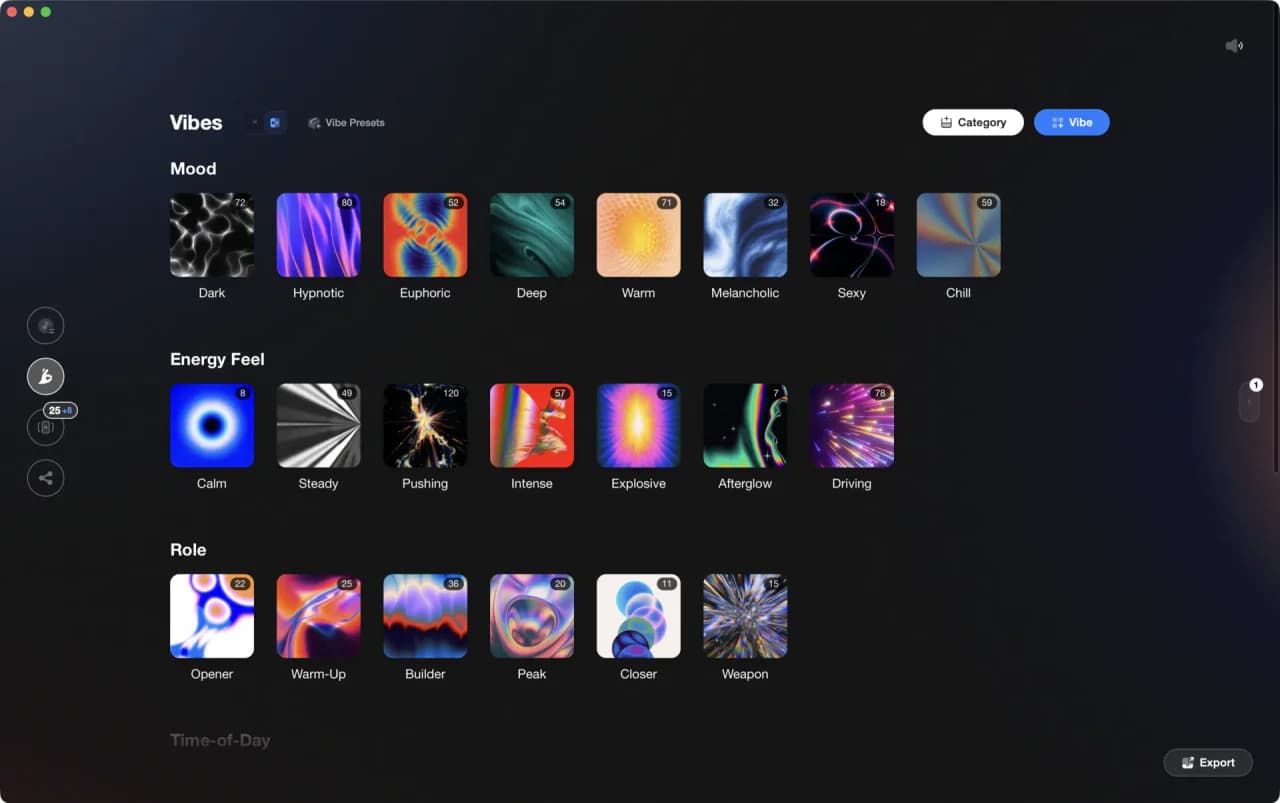
Frequently Asked Questions

Hey, it's Ben Modigell 👋
I DJ and produce as so I so: downtempo, minimal, dub house, tech house, and techno (releases on Spotify and SoundCloud, links above). Everything I write here comes from my own gigs, studio sessions, and library cleanups: the rules I follow, the failure modes I have actually hit, and the workflow I use when nobody is watching. If a technique did not earn its place in my own sets, it does not make it into a tutorial.