
DJ File Naming Convention
One pattern for every track: artist, title, version in brackets, nothing else. The file name is the backup copy of your metadata, so it has to survive drives, USB sticks and a rebuilt library database.
Quick Answer
What the file name is actually for
In the booth you never read a file name. The browser shows the title and artist tags, your crates come from the app database, and the file could be called untitledfinal2 without changing a single thing on screen. That is exactly why DJs get told naming does not matter, and it is half right.
The name earns its keep everywhere else. It is what you see when you search the drive at soundcheck, what tells you two copies are the same track before you delete one, what a promoter can read on a USB stick, and what is left when a library database is corrupted or rebuilt. Tags are the primary source. The name is the backup copy that never needs an app to be readable.
The pattern that works
Almost every working library lands on the same shape, because it sorts usefully and reads fast:
- Artist first. The drive sorts alphabetically, so artist first groups a producer together without a folder per artist. Multiple artists get separated by a comma, not by an ampersand or a slash.
- Then a space, a hyphen, a space, then the track title exactly as the label released it. No inventive capitalization, no ALL CAPS.
- Then the version in round brackets: (Original Mix), (Extended Mix), (Someone Remix), (Radio Edit), (Acappella). If there is no version, leave the brackets off rather than typing Original Mix everywhere.
- Nothing else. No key, no tempo, no rating, no store order number, no download date.
| Do this | Not this | Why |
|---|---|---|
| Roisin Murphy - Incapable (Extended Mix).aiff | 03 incapable EXTENDED 124 8A.aiff | Tempo and key change after re-analysis, and the track number belongs to an album you do not own |
| Kerri Chandler - Rain (Original Mix).mp3 | Kerri Chandler-Rain(Original Mix).mp3 | Consistent spacing around the hyphen keeps the split point readable and machine parseable |
| Peggy Gou, Lenny Kravitz - I Believe In Love Again.wav | Peggy Gou & Lenny Kravitz - I Believe In Love Again.wav | Ampersands are legal but read badly in scripts and in some export tools; a comma is safer |
| Overmono - So U Kno.flac | overmonosouknoFINAL_v2.flac | Underscores and version suffixes are studio habits, not library habits |
The same four tracks, named well and named badly.
The one rule behind all of it: the pattern has to be describable in a single sentence. If you cannot tell a friend how your files are named without adding an exception, the pattern is already broken and you will drift away from it within a month.
Characters to avoid
File names travel between a Mac, a Windows laptop, a USB stick formatted for club players, and whatever cloud backup you use. Characters that are fine in one of those places get silently mangled or refused in another.
- Never use a slash, a backslash, a colon, an asterisk, a question mark, a quote mark, angle brackets or a pipe. These are reserved by Windows and the colon has meaning on macOS.
- Avoid accented and non Latin characters if you export to older club media players, and avoid emoji everywhere.
- Do not start or end a name with a space or a period. Both get stripped or hidden depending on the system.
- Keep the whole path short. Deep folders plus a long name can push a file past the path length limits on Windows, and it always breaks at the worst moment, mid copy to the USB stick.
- Pick spaces or hyphens as your word separator and never mix them with underscores. Consistency matters more than which one you choose.
- 1
Back up first
Copy the whole music folder to a second drive before you touch a single name. This step is not optional: a bulk rename is one undo step you will not get back, and a copy costs nothing but time.
- 2
Fix the tags before the names
Correct the artist, title and version tags first, because the tags are what your DJ software actually shows and what a rename tool should read from. Names built from wrong tags are just wrong names, applied faster.
- 3
Write the pattern down
Decide the exact shape, including how you handle featured artists, multiple remixers, acappellas and edits you made yourself. Write it in a note next to your library. Every future download gets checked against it.
- 4
Rename in bulk, from the tags
Use a tag editor or a batch rename tool that builds the file name out of the tag fields, so the two can never disagree. Run it on a test folder of twenty tracks and check the result before you touch the whole library.
- 5
Relocate inside the DJ app
Open your DJ software and let it find the renamed files again. In Serato DJ Pro that is Relocate Lost Files in the Files panel. Do this on the same day, not next month, so you are relocating a change you still remember making.
- 6
Guard the front door
Name every new download the moment it lands, in the inbox folder, before it is imported or analyzed. A library only stays consistent if nothing enters it half named.
File name or tag: which field holds what
Belongs in the file name
- Artist, title, and the version in brackets.
- Facts about the release that never change.
- This is the human readable, app independent copy, so it stays short and stable and never needs editing again once it is right.
Belongs in the tags only
- -Key, tempo, energy, rating, genre, mood, comments and your own labels.
- -Every one of these changes as you re-analyze or reconsider a track, and tags can be edited in bulk and searched inside the app.
- -Putting them in the name means renaming files every time your opinion changes.
There is a practical reason too. Serato DJ Pro lets you edit tag fields directly in the library by double clicking, but the file name, length, size and bit rate are not editable there, because they belong to the file itself. Anything you want to change from inside your DJ software has to live in a tag. See how to tag your music library for the fields worth filling in.
The faster way with Vibes
The naming pass itself is a tag editor job. What eats the evening is everything around it: getting the library in one place, fixing the metadata the names are built from, finding the duplicates that inconsistent naming created, and writing a clean structure back out to your DJ app. That is the part Vibes handles.
- Import Wizard with Smart Import auto-detects rekordbox, Serato, Traktor, Engine DJ, an Apple Music or iTunes Library XML file, or a plain folder, so the whole collection comes in as it stands.
- Track Inspector edits per-track metadata, so artist, title and version are correct before you build names from them, with bulk re-analyze when the data is stale.
- The duplicate finder works in layers: exact matches, metadata matches, and audio similarity, which catches the same track sitting under two different names.
- Auto-Tagging and Vibe Sort fill the fields that should never be in a file name, and track analysis supplies BPM, key in Camelot, musical or Open Key display, an energy curve and the track sections.
- Export writes playlists and vibes back to rekordbox, Serato, Traktor or Engine DJ as a folder tree, optionally with Camelot key or BPM sub-folders, and watched folders keep new downloads flowing in.
Where Vibes stops: it is a preparation tool, not a DJ app, so there are no decks, no mixing and no recording. It works on files you own rather than on streaming libraries, and playback to your gear still happens through your DJ software after the export. See import your library and export to DJ software. Download Vibes, point it at your music folder, and see what the metadata behind your names actually looks like.
The visual way to organize your DJ library
Tag tracks by vibe. See everything at once. Export to rekordbox, Serato, Traktor or Engine DJ.
14-day free trial. Full access, no strings attached.
or see how it works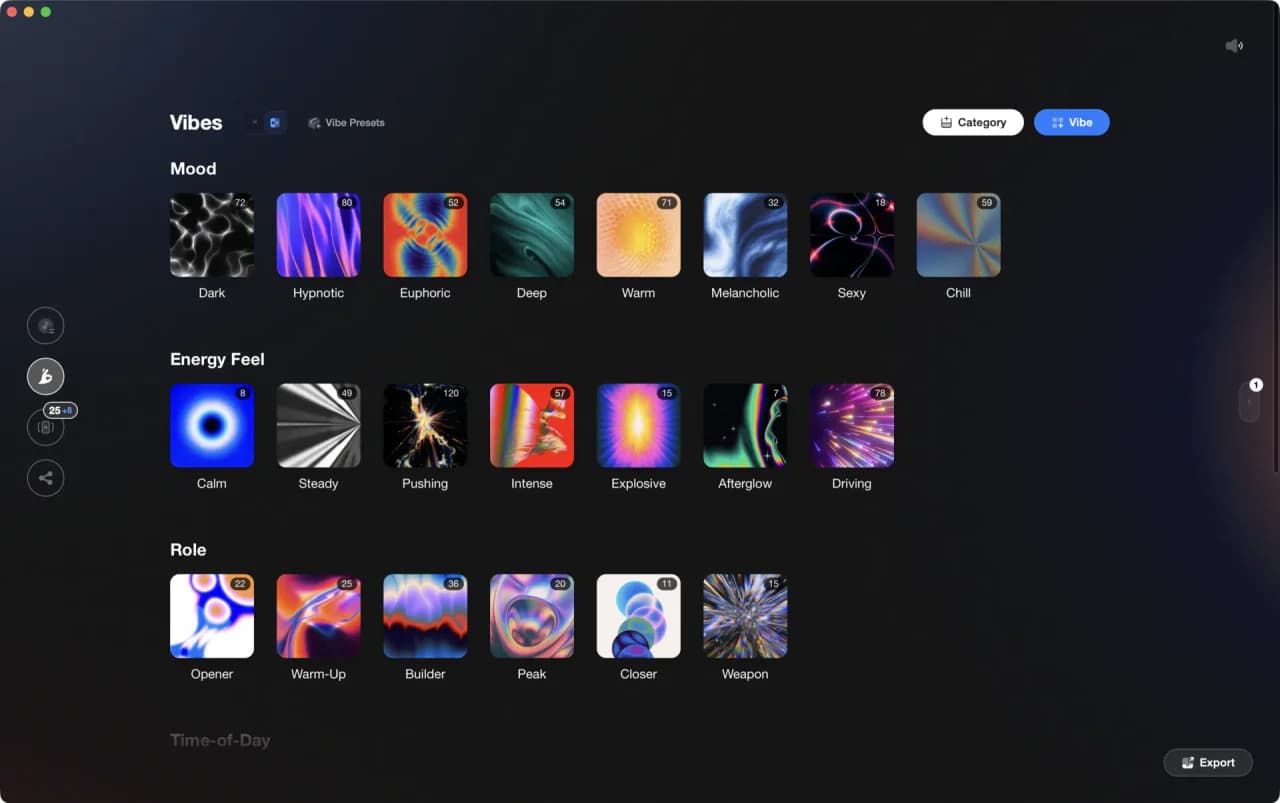
Frequently Asked Questions

Hey, it's Ben Modigell 👋
I DJ and produce as so I so: downtempo, minimal, dub house, tech house, and techno (releases on Spotify and SoundCloud, links above). Everything I write here comes from my own gigs, studio sessions, and library cleanups: the rules I follow, the failure modes I have actually hit, and the workflow I use when nobody is watching. If a technique did not earn its place in my own sets, it does not make it into a tutorial.