
Best Audio Format for DJs
MP3 320, MP3 V0, AAC, FLAC and WAV compared for DJ use: what each format costs in disk space, what rekordbox, Serato, Traktor and Engine DJ actually load, and which one is worth buying.
Quick Answer
Is MP3 320 better than MP3 V0?
No, not in any way you will hear through a PA. The whole MP3 320 vs V0 argument turns on one fact: both settings come out of the same LAME encoder, and both are tuned to be transparent. Hydrogenaudio's LAME reference lists -V 0 at about 245 kbps and states that to date nobody has produced ABX results showing CBR 320 sounding better than the top variable presets. Serato still names 320 kbps CBR joint stereo as the standard for the best a lossy format can give, so 320 stays the safe default when it is free.
MP3 V0 vs 320 for DJ work has one wrinkle that has nothing to do with your ears: constant bitrate files are simpler for old hardware and basic editors to seek through. Current DJ software does not care. Serato documents that fixed and variable bit rate files are both supported, and the rekordbox manual lists CBR and VBR under MP3 and AAC alike.
MP3 320 (CBR)
- Every second uses 320 kbps, the maximum the MP3 format allows.
- About 12 MB for a five minute stereo track.
- Seeks predictably in older hardware and simple editors.
- The right pick when a store offers it at the same price.
MP3 V0 (VBR)
- -LAME's top variable preset, documented at around 245 kbps average.
- -About 9 MB for the same track, roughly a quarter smaller.
- -Spends bits on dense passages and saves them on sparse ones.
- -Transparent in blind listening, exactly like 320.
What does "MP3 V0" mean?
V0 is the top quality setting of the LAME encoder's variable bitrate mode, written -V 0 on the command line. Instead of locking every frame to one rate, LAME raises the bitrate for complex passages and lowers it for simple ones, landing near 245 kbps across a typical track. Hydrogenaudio puts -V 0 through -V 3 in the transparent band, where audible differences are rare. The matching question, what is MP3 320, has a duller answer: every frame is encoded at 320 kbps no matter what the music is doing.
You meet both names at checkout rather than in your DJ app. Bandcamp's download menu offers MP3 V0, MP3 320, FLAC, AAC, Ogg Vorbis, ALAC, WAV and AIFF for the same purchase, which is why the question keeps coming up.
Is 320kbps the highest quality audio?
No. 320 kbps is the ceiling for MP3, not for audio. Above it sit the lossless formats, FLAC, ALAC, WAV and AIFF, which decode back to the exact samples they were made from. Serato's encoding guide splits the world the same way: uncompressed, compressed lossless, and compressed lossy, with MP3, AAC and WMA on the lossy side.
For a DJ, flac vs mp3 320 is a storage and future proofing decision rather than a sound one. Keep lossless for anything you might re-encode later, because every lossy pass discards data permanently. The same logic answers mp3 v0 vs flac: FLAC wins as an archive, V0 wins on a full USB stick, and neither changes how a transition lands.
256 kbps AAC vs lossless only becomes a real gap when the file is a source rather than a final copy. Serato is blunt about why: re-encoding one lossy format into another is transcoding, the original artifacts survive and new ones are added, and you cannot recover quality by encoding again at a higher setting.
Which is better, 320kbps MP3 or WAV?
WAV wins on paper and ties in the booth. A 16 bit 44.1 kHz WAV runs 1,411 kbps and about 53 MB for five minutes, more than four times the size of the same track at MP3 320. Algoriddim's guidance for djay lands where most working DJs do: use MP3 at 320 kbps stereo or a lossless format such as WAV or AIFF, and avoid anything under 192 kbps.
The size ranking for aac vs mp3 vs wav is short: AAC is smallest, MP3 sits just above it, WAV is several times either. Tag handling is the quieter difference. Fields like artist, title and key travel more consistently in MP3, AIFF, FLAC and M4A than in WAV, so a WAV heavy library tends to shed metadata as it moves between apps.
AAC vs MP3 for a DJ library
AAC is the newer codec and generally does more with the same bits. Serato's encoding guide describes AAC as the intended successor to MP3 and the default encoder in Apple's iTunes, and Algoriddim notes that AAC files can sound comparable at a lower bitrate because the compression is more efficient. That is the whole of aac vs mp3 which is better: at matched bitrates AAC usually wins, and at the settings people actually buy the gap collapses.
So mp3 320 vs aac is really a question about which AAC. 256kbps aac vs 320kbps mp3 is close to a tie, and it is the exact pairing Apple Music hands you, since its High Quality download setting is AAC at 256 kbps. Drop AAC to 128 kbps and 320 wins easily, which is why aac vs mp3 320 gets answered both ways online.
Compatibility is the tiebreak, and it favors MP3. rekordbox plays AAC as .m4a and .mp4 up to 320 kbps, the Traktor manual lists M4A (AAC), and Engine DJ lists AAC/M4A, but Serato DJ Pro supports the bare .AAC extension on macOS only. mp3 v0 vs aac inside a working library therefore usually goes to the MP3: it loads everywhere and needs no thought at load-in.
itunes aac vs mp3 carries one extra trap. Serato documents that locally downloaded DRM protected Apple Music files are not supported, and that Apple Lossless downloads at 48 kHz or higher arrive as .movpkg files it cannot read; the fix is to set the Music app back to High Quality AAC at 256 kbps and download again. mp3 vs aac vs wma is simpler: WMA sits on Serato's lossy list but on none of the four DJ apps' supported file lists, so keep it out.
File sizes: what each format actually costs
aac vs mp3 file size is the one part of this that is arithmetic instead of opinion. Bitrate times duration gives you the file, so a five minute stereo track works out like this.
| Format | Bitrate | Five minute track | 3,000 track library |
|---|---|---|---|
| WAV or AIFF, 16 bit 44.1 kHz | 1,411 kbps | about 53 MB | about 160 GB |
| FLAC or ALAC | varies with the music | about 25 to 35 MB | about 90 GB |
| MP3 320 (CBR) | 320 kbps | about 12 MB | about 36 GB |
| AAC 256 (Apple Music High Quality) | 256 kbps | about 10 MB | about 29 GB |
| MP3 V0 (VBR) | about 245 kbps average | about 9 MB | about 28 GB |
Bitrates are documented by the vendors and by the LAME reference. Sizes are the arithmetic for a five minute stereo track; FLAC varies with the material.
What your DJ software will actually load
Every current DJ app plays both MP3 flavors and at least one lossless format, so format choice is about storage and tags rather than compatibility. The exceptions are worth knowing before a gig.
| App | Lossy formats | Lossless formats | Documented limits |
|---|---|---|---|
| rekordbox 7.2 | MP3 (CBR and VBR, 32 to 320 kbps), AAC (.m4a, .mp4, up to 320 kbps) | WAV, AIFF, Apple Lossless, FLAC | Copyright protected files may not load |
| Serato DJ Pro 4.0 | MP3, OGG, M4A, MP4, AAC (macOS only) | WAV, AIF/AIFF, FLAC, ALAC | Fixed and variable bit rate both supported; locally stored DRM protected files are not |
| Traktor Pro 4 | MP3, M4A (AAC), OGG Vorbis | WAV, AIFF, FLAC | DRM protected files are not supported |
| Engine DJ (Engine OS players) | MP3 (32 to 320 kbps), AAC/M4A, Ogg Vorbis | WAV, AIF/AIFF, FLAC, ALAC | WAV and AIFF documented at 44.1 to 192 kHz, 16 to 32 bit |
Taken from each vendor's published format list, checked August 2026.
Audit the formats you already own
Choosing a format for future purchases is the easy half. The harder half is the twenty year old rips already sitting in your collection, which is where the low bitrate files hide.
- 1
Show the file facts
In Serato DJ Pro, open the library column list and switch on Bitrate. In rekordbox, right-click the track list header to add columns, and read the INFO panel of a loaded track, which shows File type, File size, Sample rate and Bit rate.
- 2
Sort low to high
Click the Bitrate header to sort, then pull out everything under 192 kbps. Algoriddim's djay guidance is to avoid files below that line, and on a loud system those are the ones that give you away.
- 3
Confirm before you delete
A file can report 320 kbps and still be an upscaled 128 kbps rip, because re-encoding rewrites the header without restoring the lost frequencies. Check the frequency cutoff instead of trusting the number.
- 4
Replace, do not re-encode
Serato states that transcoding keeps the old artifacts and adds new ones, and that a track cannot be upsampled to a higher bit rate. Buy the file again from the store instead of converting it.
- 5
Set one buying rule
MP3 320 for everything you play, lossless only for tracks you may edit or archive. One rule beats a library where every third file was a separate decision.
Step three is where a spectrogram earns its keep: the Audio Quality Checker reads the frequency cutoff and flags fake lossless files, and the Spectrogram Analyzer shows the same thing as a picture. It is a faster flac vs mp3 test than any listening session, and it pairs well with a wider library clean-up.
The faster way with Vibes
That audit is the slow version, one file at a time. Vibes runs it over a whole collection at once: the Import Wizard pulls your library straight out of rekordbox, Serato, Traktor, Engine DJ, an Apple Music or iTunes Library.xml file, or a plain folder, and the duplicate finder then matches tracks on exact files, on metadata and on audio similarity. That last layer catches the same song sitting in your library twice, once as an old low bitrate MP3 and once as the lossless copy you bought later.
Watched folders keep new downloads flowing in, and bulk re-analyze regenerates BPM, key and energy data for anything you replaced, so the tags follow the better file. Vibes does not convert or encode audio, and it has no decks, mixing or recording: cleaned playlists leave through the export back into your DJ app. See track analysis for what it reads from each file.
The visual way to organize your DJ library
Tag tracks by vibe. See everything at once. Export to rekordbox, Serato, Traktor or Engine DJ.
14-day free trial. Full access, no strings attached.
or see how it works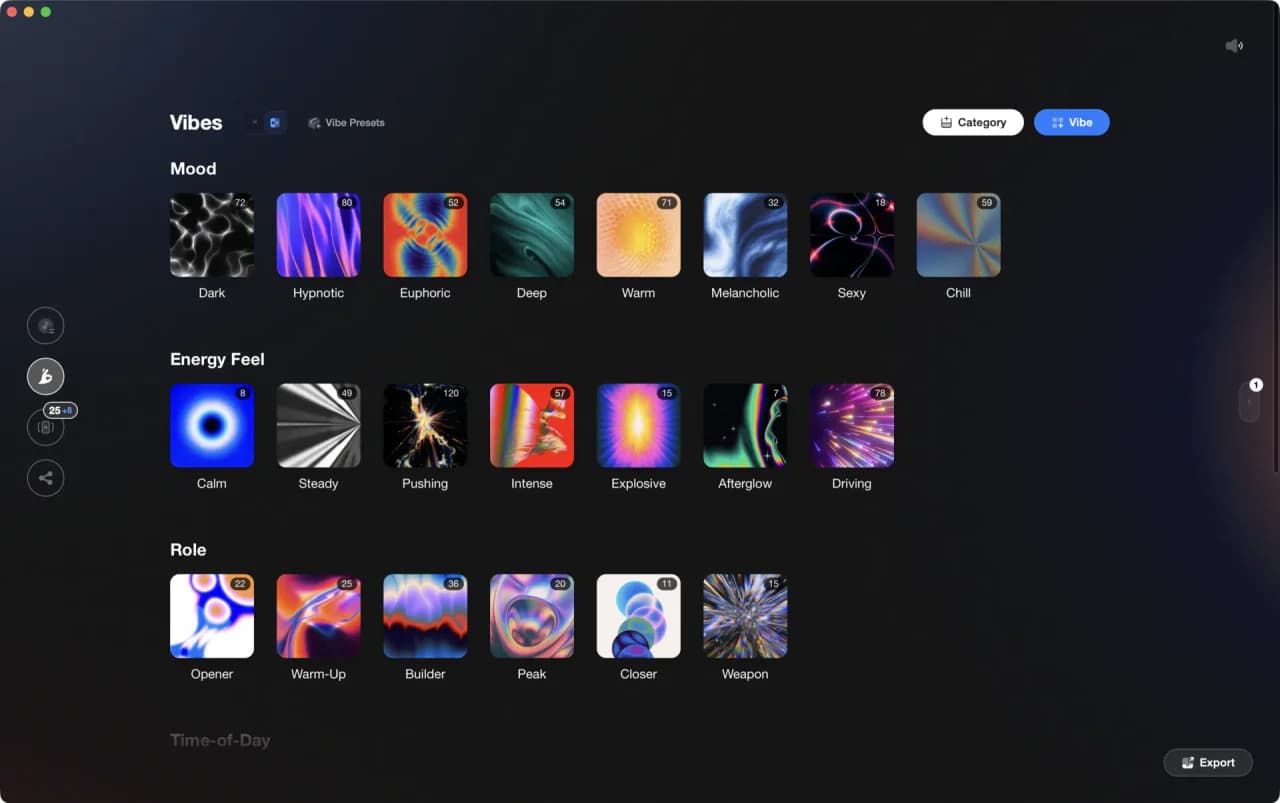
Frequently Asked Questions

Hey, it's Ben Modigell 👋
I DJ and produce as so I so: downtempo, minimal, dub house, tech house, and techno (releases on Spotify and SoundCloud, links above). Everything I write here comes from my own gigs, studio sessions, and library cleanups: the rules I follow, the failure modes I have actually hit, and the workflow I use when nobody is watching. If a technique did not earn its place in my own sets, it does not make it into a tutorial.