

Refresh your iTunes library in Serato DJ.
In Serato DJ Pro or Serato DJ Lite, open Setup, go to the Library + Display tab, and uncheck then recheck Show iTunes Library: the list reloads and your new tracks and playlists appear. If they still do not show, the fault is the file, because Serato reads the library file that Music or iTunes exports rather than the live app, and that file only changes when the app rewrites it.
$49$79USD one-time purchase. First 250 licenses at this price. 14-day free trial.
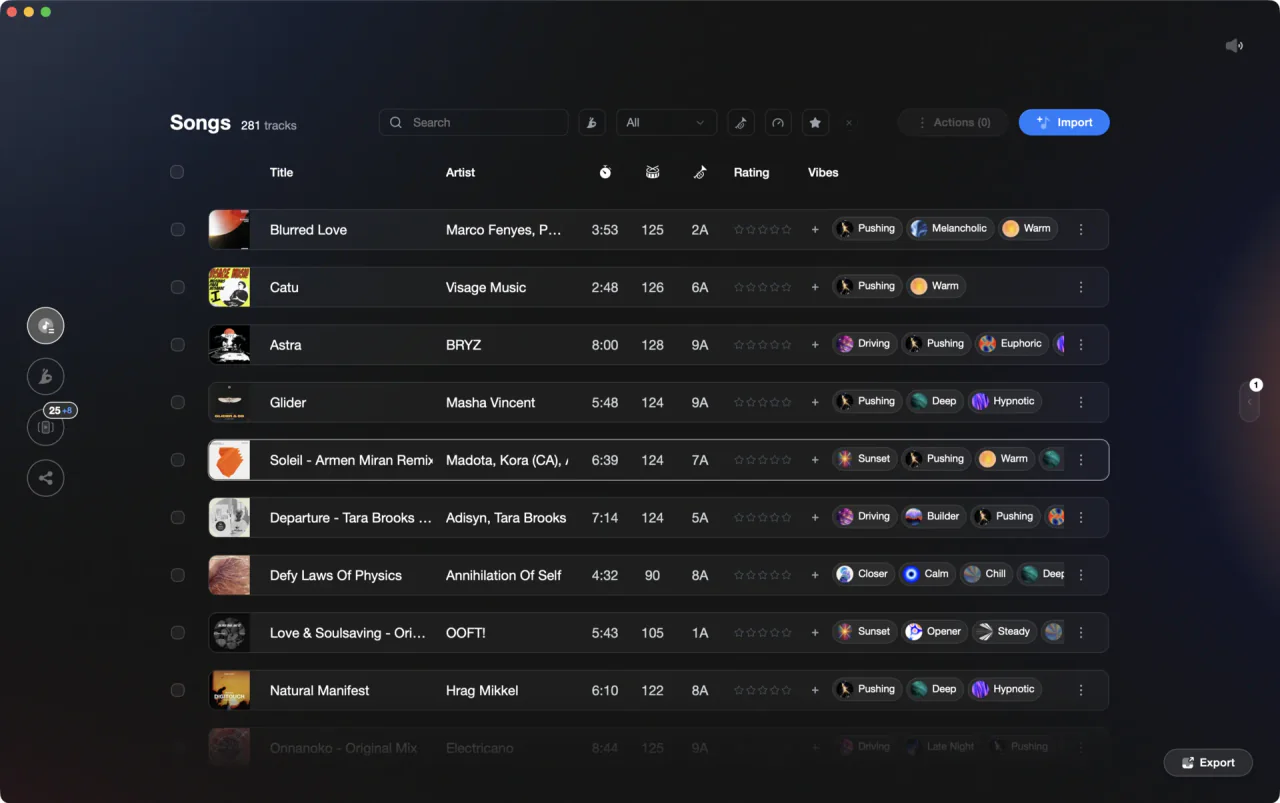
Bring the same library into Vibes once, tag it, then export clean crates back to your DJ app.
Refresh iTunes library in Serato DJ, step by step.
Serato does not watch the Music or iTunes app live. It reads a snapshot file that Apple writes, so a refresh means making both apps rewrite and reread that file. There are two ways to get music on Serato DJ Pro, the Files panel and this iTunes integration, and only the second one ever needs refreshing.
Switch on Show iTunes Library
Open Setup in Serato DJ Pro, go to the Library + Display tab, and check Show iTunes Library. Your locally imported Music or iTunes tracks and playlists then appear in an iTunes area inside the library panel. The same checkbox sits in the same tab in the free edition, so to add iTunes to Serato DJ Lite you use exactly this setting.
Give macOS permission to share the library
On macOS the Music app holds the local library, and the system asks before another app may read it. Open System Settings, Security and Privacy, then Media and Apple Music, and enable Serato DJ Pro or Serato DJ Lite; use the plus button to add the app if it is not listed. This is a software setting, identical on a controller or on a Serato DJ Pro mixer setup.
Toggle the checkbox to force a reload
When newly added tracks are missing, you do not need to restart the app. Go back to Setup, Library + Display, uncheck Show iTunes Library, then recheck it. Serato drops the list and reads it in fresh, which takes a moment on a large collection. Once it is back, you play music on Serato DJ Lite or Pro the same way: drag a track from that list onto a deck.
Make Music or iTunes rewrite its library file
If the toggle changes nothing, the file itself is stale. Quit Serato, open Music or iTunes, click Songs under Library, select everything with command A or control A, right-click, choose Get Info, confirm Edit Items, then click OK. That forces the tags back out into the library file. On Windows, also enable Share iTunes Library XML with other applications in Edit, Preferences, Advanced.
Check the file name and where it lives
Serato looks for a file called iTunes Music Library.xml in the iTunes folder inside your Music folder. Apple sometimes writes it as iTunes Library.xml instead, and renaming it to iTunes Music Library.xml makes Serato find it. On Windows, Serato reads only the default path at C:\Users\your name\Music\iTunes, so a library parked on an external drive never shows up.
Rebuild the file if it is bloated or corrupt
Quit iTunes, then drag iTunes Music Library.xml to your desktop or rename it. Reopen the app, play a track or two, and quit: a fresh file is written, usually much smaller. Serato support puts a healthy file at roughly 20 to 25 MB for a 20,000 song library, so anything far larger than that ratio is worth rebuilding before you load it again.
Move the tracks you keep into crates
The lasting fix is to stop depending on that file. Click Library to expand your iTunes playlists, create a crate per playlist with the Add Crate button, select a playlist's tracks with command A or control A, and drag them across. Drag one crate onto another to build Serato subcrates. Your Serato DJ Pro music library then points straight at the files, and the checkbox can go off.
The catch
Most iTunes-Serato problems trace back to that single file. It is a snapshot, so tags you edit inside Serato are never written back into it, and the older values reappear the next time the library loads.


The faster way
Bring the library across once, then stop refreshing it.
Vibes reads the same iTunes Library.xml through the Import Wizard, and Smart Import detects it for you. Your tracks and playlists land in Vibes, where you tag them into vibes, analyze BPM, key and energy, and correct metadata track by track. Then export those playlists back to Serato as crates, so Serato loads real crates from disk instead of waiting on a file Apple rewrites.
See how it worksOrganize in Vibes, export to Serato DJ.
Your playlists, tags, ratings, and cue points travel back to the gear you play on, so nothing you do in Vibes is locked away.

Track 001
Artist A
Afterhours Mysterious
 Introspective
Track 002
Artist B
 Cozy FloorPeaceful
 Home
Home
Track 003
Artist C
Rave Aggressive
 Festival
 Build & Release
Frequently asked questions
The honest answers, including the trade-offs.
From a Vibes customer
The import worked perfectly. Have created several sets now and my life is so much easier
One-time purchase
Get Vibes with a single payment. No subscription.
Vibes is the step before you open your DJ software, not a replacement for it.
First 250 licenses at this price, then $79.
14 days • Full access
No strings attached
Secure checkout with Stripe
Already have Companion Pro? Upgrade instead

Methodology
How we keep this honest.

Verified against the app
Every step is checked against the current version of Serato DJ.
We own our bias
We make Vibes. We show the native way first and honestly, then where Vibes genuinely helps, and we say when it does not.
Live pricing
The Vibes price shown comes straight from our checkout, never a hardcoded marketing number.
Kept current
Last reviewed September 2026.
Keep exploring
Compare Vibes
DJ apps head to head
Works with your software
Vibes for DJs
Vibes features
How-to guides
Best DJ software
Move between apps
Learn to DJ