

Export crates to USB in Serato DJ.
Open the Files panel, click the crate you want, drag it onto your USB drive inside that panel, and choose Copy when the prompt appears. The detail that matters: Serato also writes a hidden _Serato_ folder onto the drive, and that folder, not the audio, is what carries the crate name, the cue points and the beatgrids to the next laptop.
$49$79USD one-time purchase. First 250 licenses at this price. 14-day free trial.
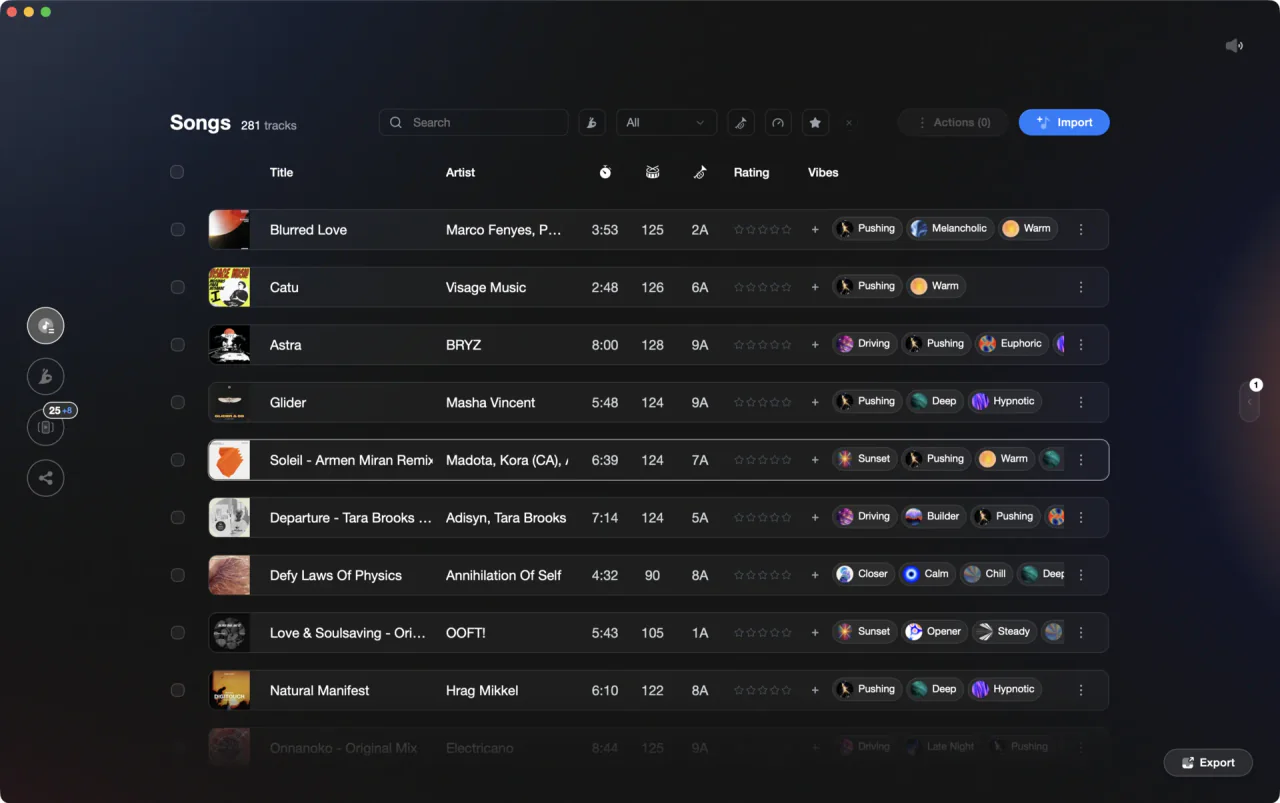
Decide what goes on the stick in Vibes, export the crate to Serato, then drag it to the drive.
Export crates to USB in Serato DJ, step by step.
Serato copies crates from inside the app, not from Finder or File Explorer. Here is how to export Serato crates to USB so the crate, its audio files and its analysis all land on the drive together.
Check the drive can be written to
Serato writes cue points, loops and overviews back to the drive, so it has to be writable by the computer you plug it into. macOS can read the Windows NTFS format but cannot write to it, which is the usual reason tag data silently disappears. Right-click the drive and choose Properties on Windows or Get Info on macOS to see the file system before you start.
Analyze the tracks first
In Serato, click the Analyze Files button with Set Auto BPM and Set Beat Grid checked, and let it finish. Analysis data lives in the Serato library, so anything you copy before it runs arrives on the drive without a BPM or a grid. On a large library this takes a while, so do it the day before, not in the taxi.
Open the Files panel
Click the Files button to the left of the search bar. The Files panel lists common locations plus every drive currently connected, so your USB stick shows up there by name. Any external drive that is not plugged in when Serato starts will not appear, and neither will the tracks you added from it.
Drag the crate onto the drive and choose Copy
Click the crate you want in the crate panel, then drag it onto your USB drive in the Files panel. Serato prompts you with Copy, Move and Cancel. Choose Copy: your library keeps pointing at the original files and the drive gets its own set. Move would repoint every crate at the stick, which breaks your library the moment you unplug it. Subcrates drag across the same way.
Wait for the progress bar to finish
A progress bar appears in the lower right of the software. Click it to open a status window, where you can also cancel the transfer. Do not unplug the drive while it runs. When it is done, eject the drive the way you normally would, so the database Serato just wrote is flushed properly.
Test it on the other laptop
Plug the drive into a second computer running Serato DJ and open the app. Serato stores the library information for files on an external drive on the drive itself, so the crates and their tracks appear in the library on their own, with cue points and grids intact. Eject when you are done and nothing is left behind on that machine.
The catch
Smart crates cannot be transferred to a portable library, so anything built from rules has to become a normal crate before it will travel. Serato also creates a separate _Serato_ folder on every drive you pull music from, so a stick that already has one needs the two merged, not overwritten, or you lose crates.


The faster way
Decide what goes on the stick before you open Serato.
The drag itself takes a minute. Choosing which forty tracks deserve the drive is the part that eats an evening. Vibes imports your existing Serato library, analyzes BPM, key, energy and sections, and tags everything into vibes with Auto-Tagging or by hand in Vibe Sort, so a gig crate becomes a filter instead of an hour of scrolling. Build the running order in Set Designer, export it back to Serato as a crate, then do the drag above.
See how it worksOrganize in Vibes, export to Serato DJ.
Your playlists, tags, ratings, and cue points travel back to the gear you play on, so nothing you do in Vibes is locked away.
Track 001
Artist A
Afterhours Mysterious
 Introspective
Track 002
Artist B
 Cozy FloorPeaceful
 Home
Home
Track 003
Artist C
Rave Aggressive
 Festival
 Build & Release
Frequently asked questions
The honest answers, including the trade-offs.
From a Vibes customer
The import worked perfectly. Have created several sets now and my life is so much easier
One-time purchase
Get Vibes with a single payment. No subscription.
Vibes is the step before you open your DJ software, not a replacement for it.
First 250 licenses at this price, then $79.
14 days • Full access
No strings attached
Secure checkout with Stripe
Already have Companion Pro? Upgrade instead

Methodology
How we keep this honest.

Verified against the app
Every step is checked against the current version of Serato DJ.
We own our bias
We make Vibes. We show the native way first and honestly, then where Vibes genuinely helps, and we say when it does not.
Live pricing
The Vibes price shown comes straight from our checkout, never a hardcoded marketing number.
Kept current
Last reviewed September 2026.
Keep exploring
DJ apps head to head
Works with your software
Vibes for DJs
Vibes features
How-to guides
Best DJ software
Move between apps
Learn to DJ