
Stems in DJing
Stems are a finished song split into a few grouped parts: vocals, drums, bass and the rest. Here is what that means for a DJ, how each app separates a track, and why the same word turns up in botany, biology and slang.
Quick Answer
What are stems in music?
In a studio, a stem is a group of related recordings bounced down to one file. A record might start life as sixty separate channels: eight microphones on the drum kit, two bass signals, a stack of vocal takes. The engineer groups them, keeps the EQ, compression and panning from the final mix, and prints four files instead of sixty. Play those four together and you hear the record exactly as released.
The stem parts nearly every tool produces are vocals, drums, bass and one catch-all for the rest, labelled melody, instruments, other or INST depending on who wrote the software. A few tools offer a three way split instead, folding the bass back into the instrumental. That is the whole idea: fewer, bigger, already mixed pieces, not the raw session.
Stems, tracks and multitracks are not the same
A track is one recording: the snare mic, one vocal take, one synth line. A multitrack is the full set of those raw recordings with no group processing applied, which is what a mix engineer needs. A stem sits in the middle: related tracks summed together and printed with the mix processing baked in. Confusing the two is the most common mistake when people ask a producer for files.
Stem
- A grouped submix, usually four files per song.
- Processing from the final mix is already applied.
- Made for remixers, live playback, mastering and sync.
- Small enough to hand over and hard to get wrong.
Multitrack
- -Every raw channel from the session, often dozens of files, with no bus processing.
- -Made for a mix engineer who is going to rebuild the balance from zero.
- -Large, fragile, and rarely what a DJ wants.
How DJ software makes stems
No DJ app ships with the original studio files. Each one runs a separation model over the audio you already own and produces the parts itself. The difference between the apps is when that work happens: some do it live as the track plays, some render it in advance and store the result.
| App | When separation happens | Parts it produces |
|---|---|---|
| Serato DJ Pro | In real time, at the click of a button | Vocals, bass, melody, drums |
| rekordbox | Switched on in Preferences, Extensions category, STEMS tab | 3 stems (VOCAL, INST, DRUMS) or 4 stems (VOCAL, INST, BASS, DRUMS) |
| Traktor | Generate Stems on a track in the collection, before you play | Drums, bass, other, vocals |
| Engine DJ Desktop | Create Stems renders first, then Sync Manager packs the drive | Four part stems, plus instant acapella and instrumental on the hardware |
| VirtualDJ | Real time on capable hardware, or prepared at home in advance | Vocals, instruments, drums, bass, hi-hat |
| djay Pro | Neural Mix, in real time | Vocals, drums, instruments |
Stem separation as each vendor documents it. Feature names and modes change between versions, so check the current manual before a gig.
The timing matters more than the marketing. Traktor's manual puts stem generation at between one and two thirds of the track's playing time, so a full crate is an evening of computer work, not something you start while a record is ending. VirtualDJ documents real time separation on modern discrete graphics or Apple Silicon and recommends preparing stems at home when you are not playing live. Engine DJ advises against rendering an entire library in one go for the same reason.
- 1
Prepare the tracks you will actually play
If your app renders stems ahead of playback, run the render at home on the tracks you have shortlisted for the night. Real time separation on stage is a CPU gamble you do not need to take.
- 2
Find where the vocal really sits
Note the bars where the lead vocal starts and stops. A vocal stem is only useful over a section of the other track that has room for it, which usually means a groove with no competing melody.
- 3
Move one part, not four
Cut the drums out of the outgoing track, or bring only the vocal of the incoming one. Two or three simultaneous stem changes sound like a fault, not an idea.
- 4
Never stack two vocals
If you bring in a vocal stem, kill the vocal on the other deck first. Two lead vocals in different keys is the fastest way to clear a floor.
- 5
Return to the full mix
Bring the muted parts back within eight to sixteen bars. Stems are an effect, and an effect that never resolves stops reading as a choice.
Stems from AI music tools
Text to music services put the word in front of a much larger audience. Suno AI and Udio AI both build songs from a written prompt, and several of them offer some form of stem export, usually on a paid tier. A Suno AI music generator export is a set of parts from audio the model just made, which is not the same thing as the master parts of a commercial release, and it never gives you the stems of a record you bought.
Questions about the Suno AI app, a Suno AI login, the Suno AI free tier and Suno AI pricing belong on the vendor's own site, because plans change often. None of it affects how your DJ software splits a track, which works on the file, not on the account.
The other things people mean by stems
One short word covers four unrelated subjects, which is why search results for it look so strange. In LGBTQ slang, stem describes someone between stud and femme. If you came from stud meaning, femme meaning, fem meaning, femme vs fem or femme fatale meaning, those are questions about identity and language, and a glossary written by that community will answer them better than an audio guide.
In botany, the stem is the part of a plant that carries water and nutrients and holds the leaves up. In biology and medicine, stem cells are unspecialized cells that can turn into other cell types. Searches for embryonic stem cells, the types of stem cells, where are stem cells found, what do stem cells do, or a list of diseases treated by stem cells are medical questions, and they deserve a medical source rather than a DJ site. This page only covers the audio meaning.
Where Vibes fits
Vibes does not separate stems. There is no vocal isolation, no acapella extraction and no remix creation in it: the separation stays in your DJ app, exactly as described above. What Vibes does is everything around it. Track analysis marks BPM, key, an energy curve, the sections of a track (intro, buildup, drop, breakdown, outro) and the lead and vocal regions, so you know where a vocal actually lives before you try to fly one over another record.
That is also what makes stem work practical. Rendering separation over a whole library is slow, so it pays to know which tracks are worth it. Tagging, star ratings and energy values narrow a big collection down to the handful you will really play, Set Designer arranges those into an order, and the result exports back to rekordbox, Serato, Traktor or Engine DJ, where the stem buttons live. If your library is not that tidy yet, start with organizing it.
The visual way to organize your DJ library
Tag tracks by vibe. See everything at once. Export to rekordbox, Serato, Traktor or Engine DJ.
14-day free trial. Full access, no strings attached.
or see how it works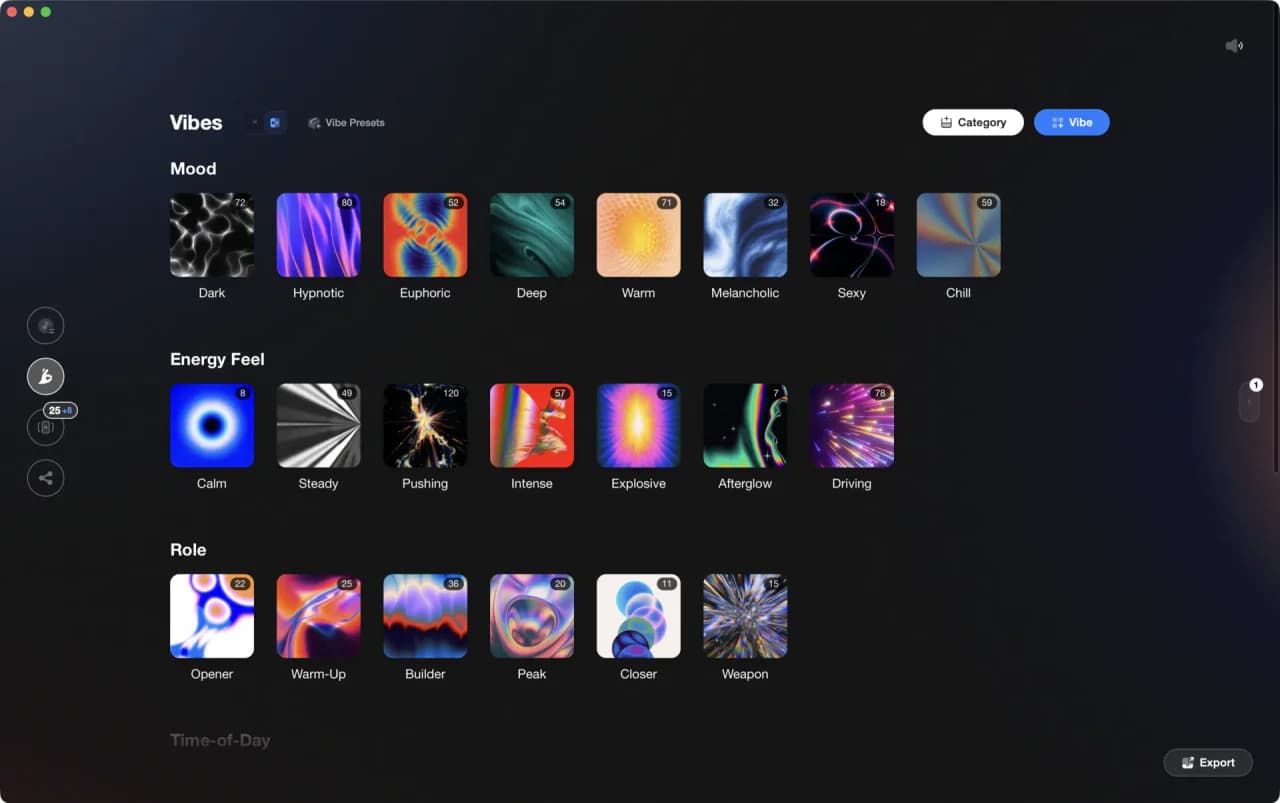
Frequently Asked Questions

Hey, it's Ben Modigell 👋
I DJ and produce as so I so: downtempo, minimal, dub house, tech house, and techno (releases on Spotify and SoundCloud, links above). Everything I write here comes from my own gigs, studio sessions, and library cleanups: the rules I follow, the failure modes I have actually hit, and the workflow I use when nobody is watching. If a technique did not earn its place in my own sets, it does not make it into a tutorial.