
Hot Cue vs Memory Cue
A hot cue is a trigger and a memory cue is a marker: one starts the track the moment you press it, the other moves the playhead and waits. Here is what each does in rekordbox, how many of each a track holds, and what the other DJ apps do instead.
Quick Answer
What is a hot cue?
A hot cue is a saved point that plays. Press the pad and the track runs from that position, with no second step and no waiting. Rekordbox gives you 8 hot cue slots per track in EXPORT mode, labelled A to H, and 16 in PERFORMANCE mode, labelled A to P. Serato DJ Pro and Engine DJ Desktop both store 8 per track on pads 1 to 8. djay Pro stores 16 cue points and splits them into two banks of eight.
Because it fires instantly, a hot cue belongs on the points you need under pressure: the first beat you would ever mix from, the drop, a vocal you want to drag back in, a saved loop. Hot cues are also the layer club hardware exposes. Rekordbox's manual says plainly that hot cues can be called out and played on DJ equipment, and that how many you can reach depends on the equipment.
What is a memory cue? Rekordbox and the 10-slot pool
A memory cue is a saved point that does not play. Call it and, in rekordbox's own words, the playback position jumps to the cue point and pauses. You decide when the track starts. One track holds up to 10 saved cue points, and saved loops come out of the same 10 slots, so a track carrying four memory loops has six memory cue slots left.
You can also step through them in order from wherever the playhead sits, forward or backward, which is what turns a handful of markers into a map. The search box version of the question, "what is memory cue", rekordbox answers in its own manual under the MEMORY CUE panel: saved cue and loop points, each with a time, an optional comment and a marker on the waveform.
Memory cues travel, too. Save them in rekordbox, export the track to a USB drive, and the saved cue points come with it for your performance on the DJ player. That is why so much club prep lives in this layer instead of in the pads.
Memory cue vs hot cue: what each one does in rekordbox
| Compare | Hot cue | Memory cue |
|---|---|---|
| What pressing it does | Playback starts from the point | The playhead jumps there and pauses |
| Slots per track | 8 in EXPORT mode (A to H), 16 in PERFORMANCE mode (A to P) | 10, shared with saved loops |
| Where you reach it | Performance pads, and the pads on your controller or player | The MEMORY CUE panel, or stepped through forward and backward |
| Comments and color | Right-click the pad to add a comment and pick a color | Right-click the saved time to add a comment; the marker color is set in the panel |
| Best job | Live triggering, hot loops, jumping back after a mistake | Mix-in, breakdown, drop and mix-out markers you read while prepping |
| Deleting one | Point at the pad and click the X on it | Point at the saved cue and click the X on it |
Behavior as documented in the rekordbox 7.2 manual.
The practical difference is not speed, it is intent. A hot cue is a decision you have already made and might act on in two seconds. A memory cue is a note to yourself about how the track is built.
The same job in other DJ apps
Outside rekordbox the two-layer idea mostly disappears. Serato DJ Pro saves 8 cue points per track and every one of them is triggered from a pad; its temp cue is the closest thing to a marker you do not play, and that one is deliberately not saved to the file. Traktor Pro 4 keeps 8 hotcue slots, but a stored point can be given a type: a Load point sends the deck straight there when the track loads, and Fade In and Fade Out points drive automated mixing. VirtualDJ keeps everything in a POI editor, where a hot cue is one type among Load Points, Remix Points, Automix Points and saved loops.
| App | Cue slots per track | A second, non-triggering layer? |
|---|---|---|
| rekordbox 7.2 | 8 hot cues in EXPORT mode, 16 in PERFORMANCE mode | Yes: 10 memory cues or loops per track |
| Serato DJ Pro 4 | 8 cue points | None documented. Every saved cue is triggered from a pad |
| Traktor Pro 4 | 8 hotcue buttons | Not a separate layer, but a point can be typed Load, Fade In or Fade Out |
| Engine DJ Desktop 5 | 8 hot cue pads | None documented. One deck cue point plus the 8 pads |
| VirtualDJ 2025 | 8 hot cues in the default skin | In effect yes: the POI editor also holds Load Points, Remix Points and Automix Points |
| djay Pro 5 | 16 cue points, in two banks of eight | None documented |
Hot cue vs memory cue: rekordbox, Serato DJ Pro, Traktor Pro 4, Engine DJ, VirtualDJ and djay Pro, from each vendor's current documentation.
So if you prep in one app and play in another, expect the memory layer to be the part that does not survive the trip. Anything you want to keep should exist as a hot cue somewhere.
Setting one of each, in practice
The order matters more than the clicks. Map the structure first, then decide which of those points you would ever press mid-mix. For the full click path with screenshots, see set cue points in rekordbox.
- 1
Pause on the beat you want
During playback, pause the deck, then click CUE in the JOG panel. The paused position becomes the deck's cue point and an orange marker appears on the enlarged waveform.
- 2
Save it as a memory cue
Select MEMORY CUE on the performance pad and click MEMORY. The time appears in the MEMORY CUE panel. Repeat for the mix-in phrase, the breakdown, the drop and the safest exit, up to 10 saved points per track.
- 3
Turn quantize on before the fast ones
With quantize on, a cue snaps to the nearest beat in the grid, so a point set on the fly still lands on the beat.
- 4
Promote the performance points to hot cues
Select HOT CUE on the performance pad, then click an empty pad at the point you want. A pad that already holds a hot cue will not take a new one, so clear it first.
- 5
Name and color them
Right-click a hot cue pad to enter a comment and change its color. Right-click a saved time in the MEMORY CUE panel to comment on that one. Unlabelled markers stop being useful about thirty tracks in.
- 6
Reuse the prep
Right-click a track and choose Convert Memory Cues to Hot Cues to fill the unset pads in order, or Sort Hot Cues by Time to put A to P back in chronological order. Sorting cannot be undone, so run it once you are happy with the placement.
Changing hot cue colors
Color is what makes a pad readable in a dark booth. In rekordbox, right-click a hot cue pad to type a comment and pick a color, and right-click a saved time in the MEMORY CUE panel to comment on that one. Preferences also carry a global HOT CUE color scheme: CDJ shows hot cues in green and hot loops in amber, COLD1 uses blue and green, COLD2 a blue gradation, and COLORFUL a multicolor set.
Serato DJ Pro lets you name and color cue points the same way. Engine DJ colors them by right-clicking the pad. Traktor Pro 4 colors by type rather than by choice: the floating cue point is white, a stored cue point is blue, Fade In and Fade Out are orange, and a loop is green.
- One color for the point you would load and mix from, on every track
- One for the drop, so it is the same pad position in your head every time
- One for vocal entries, if you cut and drop vocals live
- Nothing decorative. A color that means two things means nothing
Where the name comes from: memory cues in psychology
The DJ term is borrowed. In psychology, retrieval is the process of bringing stored information back into conscious thought, and retrieval cues are the prompts that set it off. The standard retrieval psychology example is the tip of the tongue moment: the name is in there, but nothing is pointing at it until somebody gives you the first letter.
Two ideas from the retrieval cues psychology literature map onto track prep neatly. Retrieval cues priming describes an early prompt making later recall faster, which is what a mix-in marker does to a transition you have not played yet. Retrieval cue failure is the opposite: the information is stored, nothing points at it, and you end up scrubbing a waveform with a full floor watching.
A memory cue definition that fits both fields: a stored signal that points back at something you already know. In memory cues psychology the types of memory cues are usually grouped as context, state and semantic, meaning where you were, how you felt, and what the idea connects to. A retrieval cue example from outside the booth is a smell that returns a whole childhood kitchen. A DJ memory cue example is narrower and far more useful: a marker at 1:32 carrying the comment 'vocal in'.
Where Vibes fits
Vibes does not set cue points, and it does not play to DJ hardware; export goes through your DJ app. What it does is the part that happens before the markers. It analyzes BPM, key and the energy curve, and it detects sections such as intro, buildup, drop, breakdown and outro, plus lead and vocal regions. Open a track in rekordbox with that structure already known and you are placing memory cues at points you can name, instead of hunting for them. See track analysis.
The visual way to organize your DJ library
Tag tracks by vibe. See everything at once. Export to rekordbox, Serato, Traktor or Engine DJ.
14-day free trial. Full access, no strings attached.
or see how it works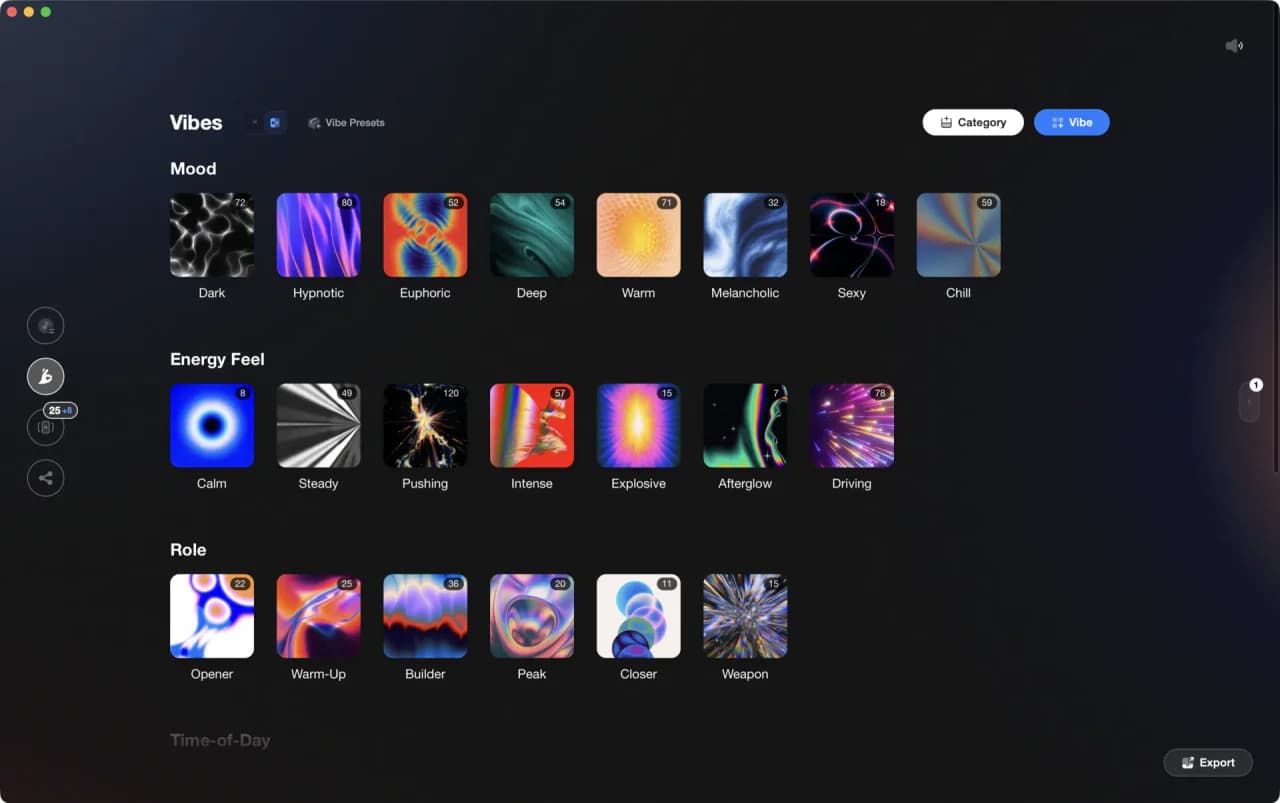
Frequently Asked Questions

Hey, it's Ben Modigell 👋
I DJ and produce as so I so: downtempo, minimal, dub house, tech house, and techno (releases on Spotify and SoundCloud, links above). Everything I write here comes from my own gigs, studio sessions, and library cleanups: the rules I follow, the failure modes I have actually hit, and the workflow I use when nobody is watching. If a technique did not earn its place in my own sets, it does not make it into a tutorial.