
Clean up your library in Engine DJ.
In Engine DJ Desktop, click the Preferences icon in the toolbar, open the Library tab, scroll to System, and click Run Cleanup next to Library Optimization. That clears unneeded information out of the database and fixes slow search on Engine OS hardware, but it is a database job, not a way to delete tracks. The tidying comes first: relocate the red missing files, remove the track entries you no longer play, and prune the playlists left over from old gigs.
$49$79USD one-time purchase. First 250 licenses at this price. 14-day free trial.
Sort the collection first, run the database optimization last.
Clean up your library in Engine DJ, step by step.
Here is how to clean up Engine DJ library data in Engine DJ Desktop 5.0, in the order that keeps your cues, loops, and beat grids intact. Back up before you remove anything, because the built-in restore only covers the library on your computer.
Back up the Engine Library first
Click the Preferences icon in the toolbar, open the Library tab, and scroll to System. Under Library Backup, click Backup and leave Engine DJ open until it finishes. Restore overwrites the current library with the latest backup. Only your computer's database is covered here, so for an external drive, copy its Engine Library folder somewhere safe by hand.
Bring the red tracks back, or let them go
Tracks whose files have moved show in red text and will not load. Right-click one and choose Relocate Missing File to point Engine DJ at the new path, or Auto Relocate All to scan your Desktop, Music, and Documents folders plus connected drives. Cues, loops, and beat grid information survive a relocate. Anything that stays red is a candidate for removal.
Remove the tracks you no longer play
Ctrl-click on Windows or Command-click on macOS to select the entries you want gone, then right-click and choose carefully. Remove from Collection drops the track from the Engine DJ database and leaves the audio file where it is. Remove from Playlist affects that one playlist. Remove from Drive is the destructive option: it deletes the track data and the audio file from that external drive.
Prune stale playlists and folders
Right-click a playlist and choose Remove. Removing a playlist from the Engine Library collection removes it from every connected external drive, while removing it from a drive touches that drive only. Double-click a playlist to rename it. If you want a record of a set before it goes, right-click and choose Export to save it as a CSV, M3U, or JSON file.
Fill the analysis gaps
Sort the collection by BPM or Key and look for blank cells. Select those tracks, right-click, and choose Analyze: Get missing analysis data. Then set Auto Analysis to On under Preferences, Library, so anything you add later is analyzed on import. Key Notation lives in the same panel if you would rather read Camelot than sharps or flats.
Run Library Optimization on the computer library
Back in Preferences, Library, System, click Run Cleanup next to Library Optimization. Do not close Engine DJ or shut off the computer while it runs. This clears the database of unneeded information, which is what cures slow search and lagging waveforms on Engine OS devices. The user guide recommends doing it regularly, and always after a backup.
Repeat it on the drive, then resync
Connect your Engine DJ drive. If the drive sits in your hardware's SATA bay, connect the unit by USB and enter Computer Mode. Run the same cleanup with the drive attached, then open Sync Manager from the bottom-left corner and re-export your playlists. Sync to Engine pulls cue points, loops, hot cues, beat grids, star ratings, BPM, and key back from the players.
The catch
Engine DJ has no duplicate finder. The version 5.0.0 user guide documents no duplicate detection tool, and Run Cleanup optimizes the database rather than comparing tracks against each other, so duplicates have to be spotted by sorting the collection on title, artist, or file name and removed one right-click at a time.


The faster way
Do the sorting once, then push a clean library back into Engine DJ.
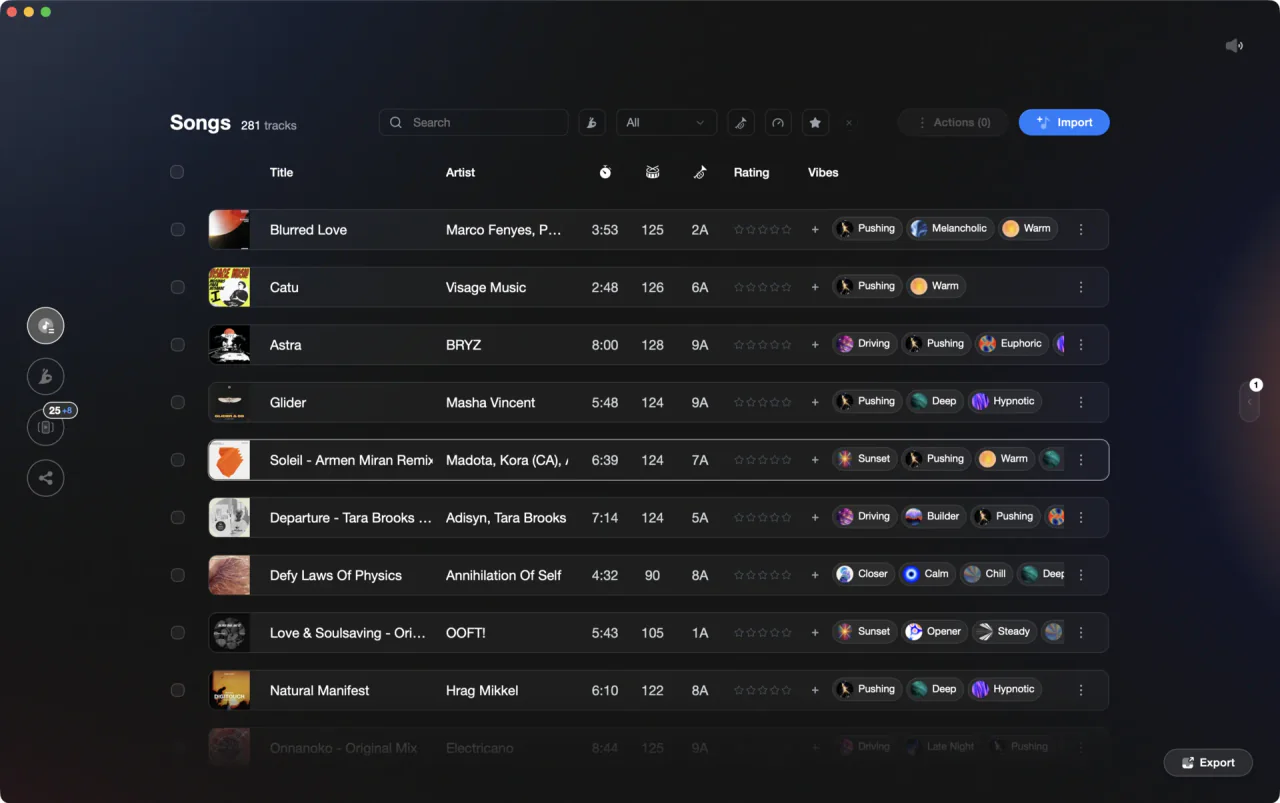
Vibes reads your Engine DJ collection through the Import Wizard, then handles the tedious part in one place: a duplicate finder with exact, metadata, and audio-similarity layers, per-track metadata editing in Track Inspector, star ratings, and energy from 1 to 10. Watched folders pick up new files so you are not re-importing by hand every week. When the library is tidy, export playlists and vibes back to Engine DJ as a folder tree, with optional Camelot key or BPM sub-folders.
See how it worksOrganize in Vibes, export to Engine DJ.
Your playlists, tags, ratings, and cue points travel back to the gear you play on, so nothing you do in Vibes is locked away.

Track 001
Artist A
Afterhours Mysterious
 Introspective
Track 002
Artist B
 Cozy FloorPeaceful
 Home
Home
Track 003
Artist C
Rave Aggressive
 Festival
 Build & Release
Frequently asked questions
The honest answers, including the trade-offs.
From a Vibes customer
The import worked perfectly. Have created several sets now and my life is so much easier
One-time purchase
Get Vibes with a single payment. No subscription.
Vibes is the step before you open your DJ software, not a replacement for it.
First 250 licenses at this price, then $79.
14 days • Full access
No strings attached
Secure checkout with Stripe
Already have Companion Pro? Upgrade instead

Methodology
How we keep this honest.

Verified against the app
Every step is checked against the current version of Engine DJ.
We own our bias
We make Vibes. We show the native way first and honestly, then where Vibes genuinely helps, and we say when it does not.
Live pricing
The Vibes price shown comes straight from our checkout, never a hardcoded marketing number.
Kept current
Last reviewed September 2026.
Keep exploring
DJ apps head to head
Works with your software
Vibes for DJs
Vibes features
How-to guides
Best DJ software
Move between apps
Learn to DJ