

Sort by key in Engine DJ.
Click the Key column header in the Engine DJ track list and the list reorders by musical key straight away. Hold Shift and click a second header to sort by BPM and key at once, and inside a playlist right-click a track and choose Re-number track order so the sorted order is saved as the playlist's own play order.
$49$79USD one-time purchase. First 250 licenses at this price. 14-day free trial.
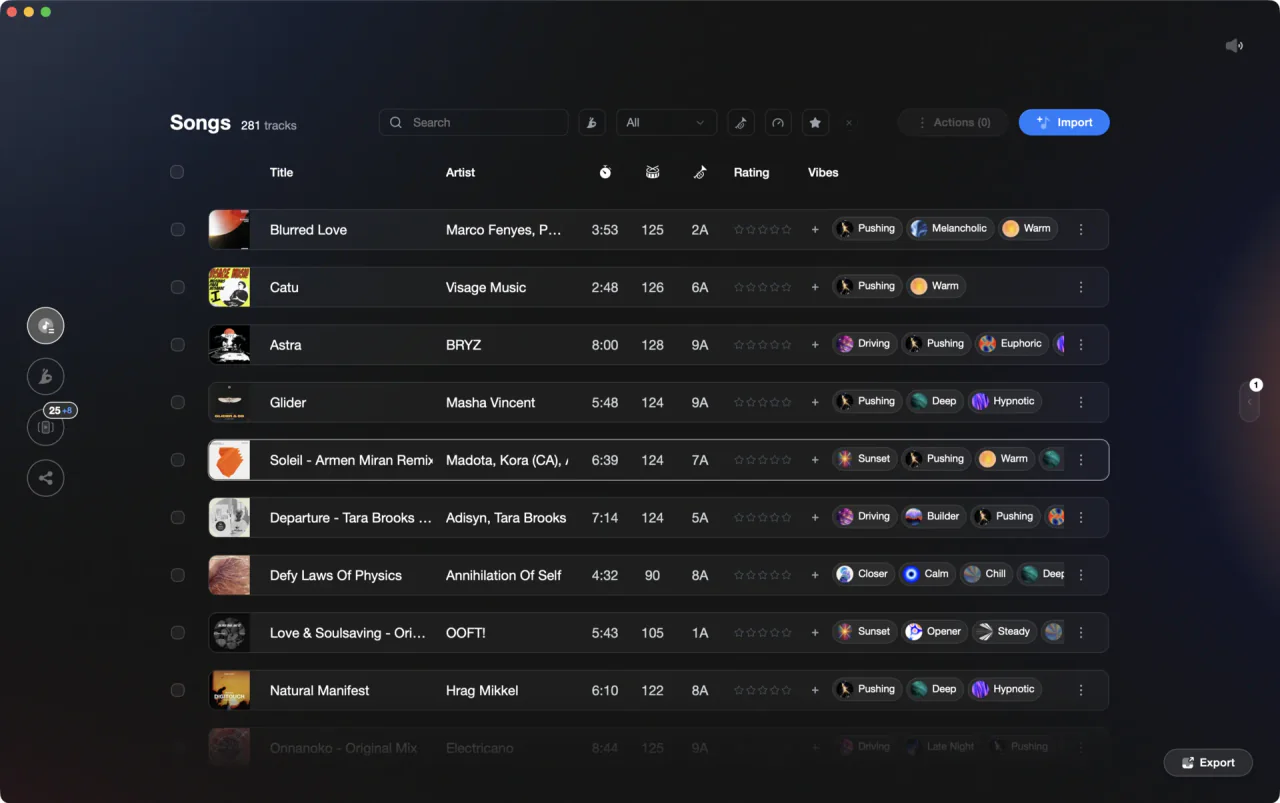
Sort on a key you can trust, then send the finished order to Engine DJ.
Sort tracks by key in Engine DJ, step by step.
Engine DJ reorders the track list by whichever column you click, so key sorting comes down to three things: an analyzed key, a visible Key column, and a way to keep the order once you have it. Here is the whole run, on the desktop and on the player.
Analyze the tracks first
Engine DJ works out the key during analysis, so an unanalyzed file has nothing to sort on. Click the Preferences icon in the toolbar, open the Library tab, and set Auto Analysis to On so new files are handled as you add them. For files already in the collection, select them, right-click, and choose Analyze: Get missing analysis data.
Show the Key column
Right-click any column header in the track list to open the list of available columns, then pick Key. BPM is worth showing at the same time. Drag a column header sideways, or drag its name inside that menu, to park Key next to BPM so both are in view before you start sorting.
Pick a key notation
Open Preferences again and stay on the Library tab. Under Analysis, set Key Notation. Engine DJ can write the key as all Sharps, all Flats, Open Key, or Camelot. Camelot is the one most DJs read fastest, and it is what Engine OS players use by default. The setting changes the label only, not the key that was detected.
Click the Key column header
Click the top of the Key column and the track list reorders by key. The list always reflects the collection or playlist you have selected, so do this inside the playlist you are preparing when you only care about one set. A few columns, such as Preview, Directory, and SoundSwitch File, cannot be used to sort at all.
Sort by BPM and key at once
Key on its own puts 90 BPM and 140 BPM tracks side by side. Hold Shift and click a second column header to sort by more than one column at a time: click BPM first, then Shift-click Key, and tempo leads with key as the tiebreaker. Each column keeps its own ascending or descending direction.
Save the order inside a playlist
A column sort is a view of the list, not a stored order. Playlists carry their own play order in the # column, and dragging tracks by hand only works while that column is the active sort. Once the key order looks right, right-click any track and choose Re-number track order, which rewrites the playlist to match what you are looking at.
Filter by key instead of sorting
Sorting shows everything in order; filtering hides what you do not want. Click Filters in the upper-right of the Collection Pane to show the five filter columns: Genre, Artist, Album, BPM, and Key. Click a key to keep only those tracks. Key Compatibility decides whether the filter shows the same key only (Match) or harmonically compatible keys too (Compatible).
Take the order to the player
Drag the finished playlist onto the external drive's Collection in the Drives pane, or send it across with Sync Manager. On an Engine OS player, tap the Sort By icon in the upper-right of the track list and tap Key, then use the arrow beside it for ascending or descending. Profile, then Library, sets the notation there.
The catch
A column sort is only a view of the list. Inside a playlist nothing is saved until you right-click a track and choose Re-number track order, and that replaces the play order you built by dragging tracks into position.

Track 001
Artist A
Afterhours Mysterious
 Introspective
Track 001
Artist A
AfterhoursMysteriousIntrospective
Track 002
Artist B
 Cozy FloorPeaceful
 Home
HomeTrack 002
Artist B
Cozy FloorPeacefulHome
Track 003
Artist C
Rave Aggressive
 Festival
 Build & Release
Track 003
Artist C
RaveAggressiveFestivalBuild & ReleaseThe faster way
A key worth sorting on, for every track you own.
Vibes analyzes the files you own and gives each track a key you can trust, shown as Camelot, musical, or Open Key. Find Compatible narrows the library to harmonic neighbours inside a BPM window, half and double time aware, and Set Designer can order a set along a key path or an energy curve. When the order is right, export it back to Engine DJ as a playlist, with optional Camelot key sub-folders.
See how it worksOrganize in Vibes, export to Engine DJ.
Your playlists, tags, ratings, and cue points travel back to the gear you play on, so nothing you do in Vibes is locked away.
Track 001
Artist A
AfterhoursMysteriousIntrospectiveTrack 002
Artist B
Cozy FloorPeacefulHomeTrack 003
Artist C
RaveAggressiveFestivalBuild & Release
Frequently asked questions
The honest answers, including the trade-offs.
From a Vibes customer
The import worked perfectly. Have created several sets now and my life is so much easier
One-time purchase
Get Vibes with a single payment. No subscription.
Vibes is the step before you open your DJ software, not a replacement for it.
First 250 licenses at this price, then $79.
14 days • Full access
No strings attached
Secure checkout with Stripe
Already have Companion Pro? Upgrade instead

Methodology
How we keep this honest.

Verified against the app
Every step is checked against the current version of Engine DJ.
We own our bias
We make Vibes. We show the native way first and honestly, then where Vibes genuinely helps, and we say when it does not.
Live pricing
The Vibes price shown comes straight from our checkout, never a hardcoded marketing number.
Kept current
Last reviewed September 2026.
Keep exploring
Compare Vibes
DJ apps head to head
Works with your software
Vibes for DJs
Vibes features
How-to guides
Best DJ software
Move between apps
Learn to DJ