
How to Transition Between Genres
Genre changes work when the exit point, the tempo relationship and the energy step are decided before you touch the crossfader. This guide covers the transition points that work between any two styles, the tempo math behind them, and the library prep that makes them findable live.
Quick Answer
Why Genre Changes Fall Apart
A failed genre switch is rarely a beatmatching problem. It fails because three things move at once: the tempo, the key, and the energy. Fix them one at a time and almost any pair of tracks can meet.
- Tempo. A hip-hop record at 92 and a house record at 126 will never ride the same beatgrid, but 92 doubled is 184, and half of 126 is 63, so one of them can carry the other.
- Key. Two tracks from different genres often share no melodic material at all, so a clashing key is more obvious than it would be inside one genre.
- Energy. Genres carry their own default intensity. Moving from a warm disco groove into peak time techno is an energy jump, not just a genre jump.
- Drum feel. Straight four to the floor against swung or broken drums is the one gap EQ cannot hide. That is what makes a cut better than a blend.
How to Transition Between Genres: DJ Set Basics
Work in this order every time: choose the exit point, choose the tempo relationship, then choose the tool that covers the seam. Picking the tool first is what produces the long, muddy blends that make a genre change sound accidental.
| Gap | Why it breaks the mix | What closes it |
|---|---|---|
| Tempo | Beatgrids will not line up across a wide gap | Half time or double time counting, a tempo ramp over a few phrases, or a cut with no overlap |
| Key | Melodies and basslines clash more across genres than inside one | Camelot neighbours, or removing the melodic content with EQ before the swap |
| Energy | The floor reads a sudden drop as the end of the set | Move one step at a time on a 1 to 10 energy scale, up or down |
| Drum feel | Straight and swung drums fight each other | Transition in a breakdown, an intro, or an acapella where the drums are already gone |
The three gaps in a genre change and what closes each one
The Steps, Inside Your DJ App
Analyze the tracks first. In Serato DJ Pro, analyzing files builds the waveform overviews and, when enabled, calculates BPM and key values and creates beatgrids, and Serato DJ 4.0 analyzes newly imported files on import by default Serato support. Every other major DJ app has the same step under a different name, and a genre change built on a wrong beatgrid will drift no matter how good the transition is.
- 1
Set the exit cue
On the outgoing track, place a cue at the last point where the drums thin out or stop: a breakdown, a bridge, or the start of the outro. That is where the genre change belongs.
- 2
Set the entry cue
On the incoming track, place a cue on the first downbeat of the intro, or on the drop if you want the change to feel deliberate rather than smooth.
- 3
Decide the tempo relationship
Same tempo, half time, or double time. If the two numbers are within a few percent of each other after halving or doubling, you can blend. If they are not, plan a cut.
- 4
Turn on key lock
Key lock holds the pitch of a track while you move its tempo. Serato calls it Keylock and describes it as keeping the song in its key when the tempo is changed, so a pulled-down track does not sound slurred.
- 5
Count the phrase
Count in groups of 8 beats and start the incoming track at the top of a 32 beat phrase. This is the single change that makes cross-genre mixes sound intentional.
- 6
Swap the low end
Cut the bass on the outgoing track before the incoming bass arrives. Two basslines from two genres will never sit together.
- 7
Cover the seam
Use one tool, not three: a high pass filter sweep, an echo tail on the outgoing track, or a hard cut on the 1. Effects stacked on top of each other read as panic.
- 8
Check the energy landed
The incoming track should arrive at the same energy as the outgoing one or one step above it. If it lands below, follow it fast with something that climbs back.
Five Transitions That Work Between Any Two Genres
- The breakdown swap. Start the incoming track under the outgoing breakdown and let the new drums arrive as the old ones would have. This is the smoothest option and the one that needs the least tempo work.
- The filter or echo out. Sweep a high pass filter across the outgoing track over 8 or 16 beats, or throw an echo on the last beat and kill the channel. The tail buys you time to start anything.
- The double time blend. Treat the slower track as half the speed of the faster one, so a 85 BPM track and a 170 BPM track share a downbeat every other bar. Hip-hop into drum and bass lives here.
- The hard cut on the 1. No overlap at all. The outgoing track stops on the last beat of a phrase and the new one starts on the next 1. Open format DJs use this far more than beginners expect.
- The acapella bridge. Ride an acapella over the outgoing outro, then bring the new genre in under the same vocal. The voice carries the room across the gap.
Which Genres Pair Up, And How
Genres pair through their tempo relationship, not through their labels. Anything that halves or doubles cleanly into your current tempo is a candidate, which is why the same track can bridge in two directions on different nights.
| Pairing | Typical tempo relationship | The easiest transition |
|---|---|---|
| Disco into house | Close enough to ride the same grid | Long breakdown swap with a bass cut |
| Hip-hop into drum and bass | Double time | Cut or acapella bridge on the phrase |
| Reggaeton into house | Roughly half time feel | Filter out, then drop on the 1 |
| Pop into tech house | Blend after an intro edit | Acapella or instrumental bridge |
| House into techno | Same range, higher intensity | Straight phrase blend with an energy step up |
Common cross-genre pairings and the relationship that makes them work
Prepare the Library Before the Gig
Every decision above is faster if the answer is already in the track's metadata. Live, you have about 30 seconds to find the next record. That is not enough time to work out a key and a tempo relationship from scratch, so the work moves to the prep session.
- Store the key in one notation across the whole library, so a compatible key is a glance and not a conversion.
- Give every track an energy value on a fixed scale. Genre labels do not carry energy: a 1 to 10 number does.
- Tag the bridge tracks: acapellas, instrumentals, edits with long intros, and anything with a big breakdown. These are the records that let you leave a genre.
- Keep a small crate of tested pairs. Two records that you know cross cleanly are worth more at 1am than a thousand unsorted tracks.
The Faster Way With Vibes
The slow part of all this is not the mixing, it is finding the candidate. Vibes analyzes your files for BPM, key, energy curve and sections, then Find Compatible shows the harmonic Camelot neighbours within a BPM window, half and double time aware, which is exactly the shortlist a genre change needs. Auto-Tagging and Vibe Sort put your bridge tracks, acapellas and edits into vibes you can recall by name, and Set Designer with Energy Flow orders a set ascending, descending, or as an arc so the energy step across a genre change is chosen and not accidental.
Vibes is a preparation tool, not a performance one. It has no decks, does no mixing or recording, and it works on the files you own rather than on streaming libraries. When the prep is done you export the playlists and vibes back to rekordbox, Serato, Traktor or Engine DJ, optionally as a folder tree with Camelot key or BPM sub-folders, and you play the set in the DJ app you already use.
Finding the bridge live
- Scroll the library, guess at the tempo relationship, hope the key fits, and commit with a few seconds left on the outgoing track.
Finding it in prep
- -The compatible tracks are already a filtered list, the bridge tracks are already tagged, and the energy order of the set is already decided.
The visual way to organize your DJ library
Tag tracks by vibe. See everything at once. Export to rekordbox, Serato, Traktor or Engine DJ.
14-day free trial. Full access, no strings attached.
or see how it works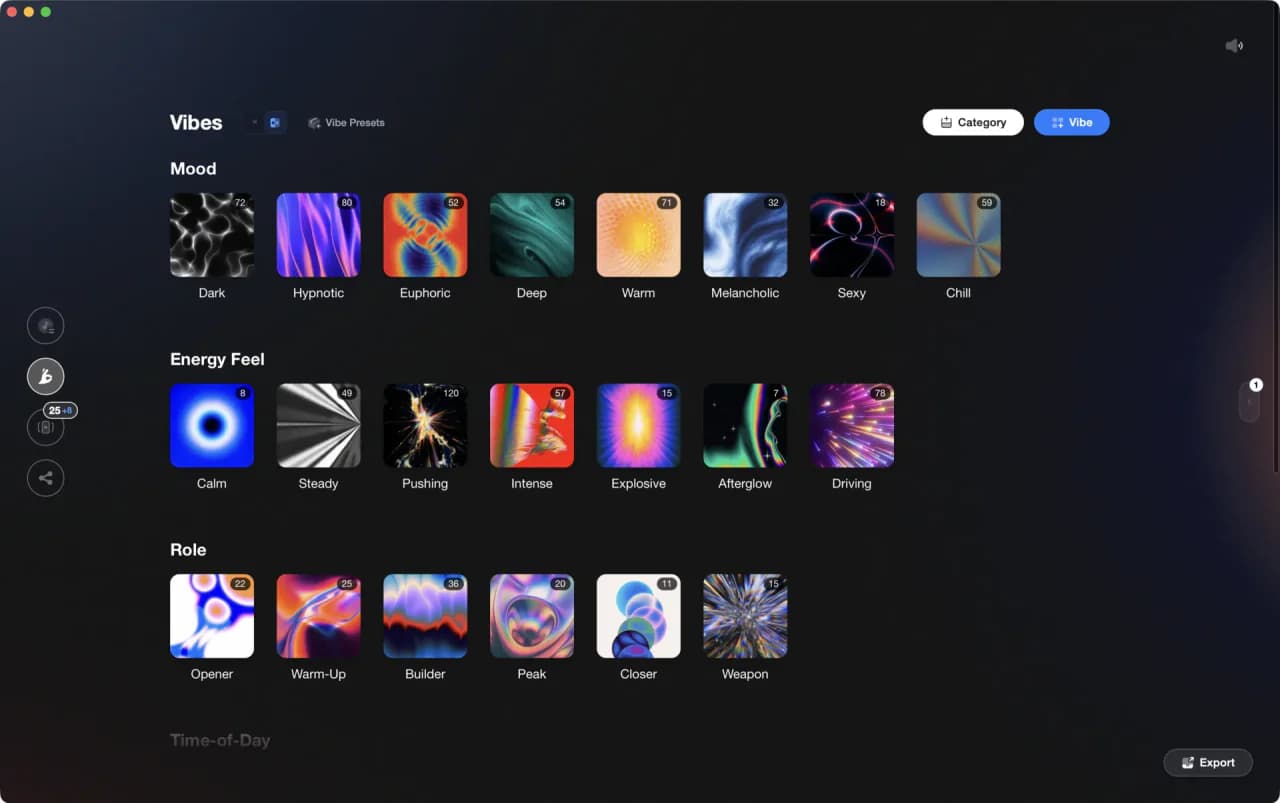
Frequently Asked Questions

Hey, it's Ben Modigell 👋
I DJ and produce as so I so: downtempo, minimal, dub house, tech house, and techno (releases on Spotify and SoundCloud, links above). Everything I write here comes from my own gigs, studio sessions, and library cleanups: the rules I follow, the failure modes I have actually hit, and the workflow I use when nobody is watching. If a technique did not earn its place in my own sets, it does not make it into a tutorial.