Serato Crate Reader
Serato crate workspace
Inspect paths and export crate contents without Serato.
Import crates
Load individual files or select the entire _Serato_/Subcrates folder.
Import a crate to inspect its track paths and export portable lists.
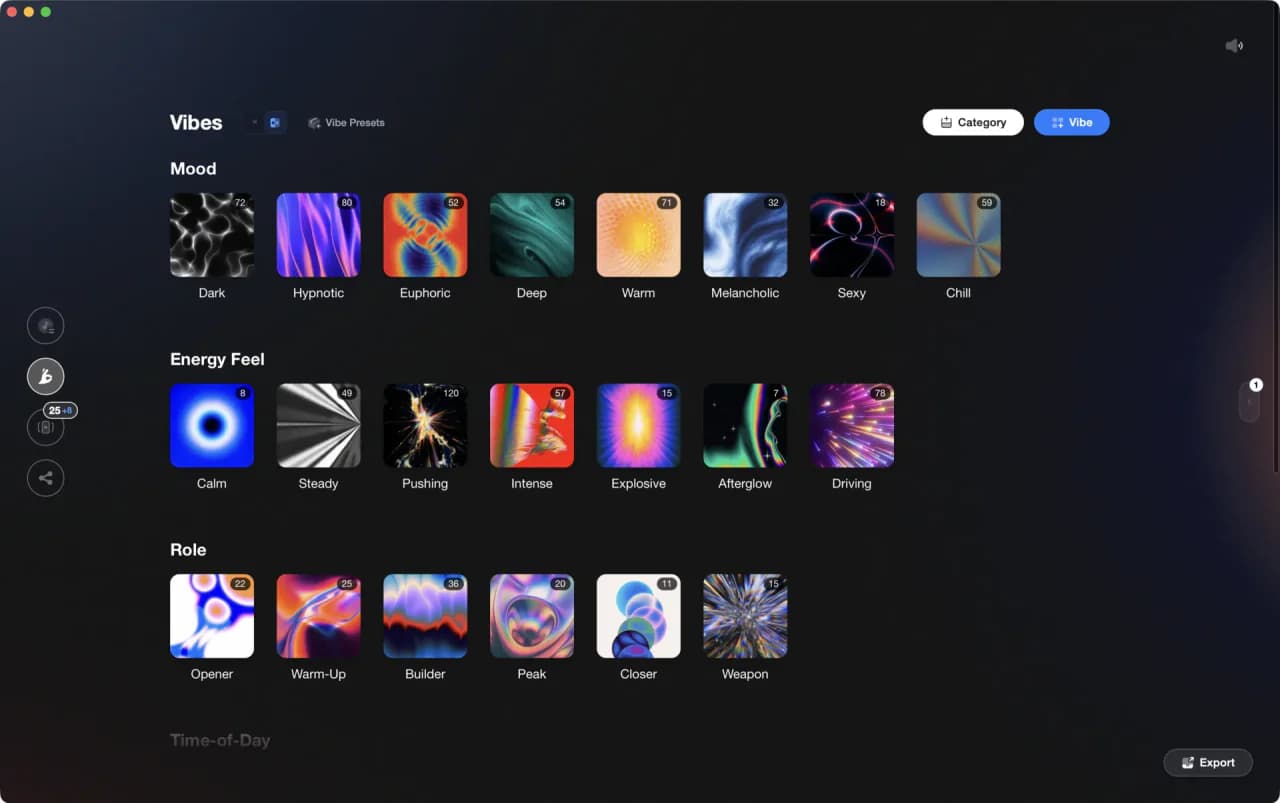
Next stepVibes reads Serato crates directly on import, so the track list this tool extracts can become part of one organized library instead. DJ library in Vibes
Drop Serato .crate files and see the ordered track list inside each one: filename, folder, and format, with search for big crates. Export any crate (or all of them combined) as CSV, M3U, or plain text. Everything runs in your browser; your files are never uploaded and you do not need Serato installed.
- Saved locally
- Editable output
- Private by default
What a crate is
A Crate Stores References, Not Music
A .crate file is a small binary list: a version header, some display settings (column layout, sorting), and one record per track containing the file's path. That is all. No audio, no cue points, no beatgrids, no BPM or key data; those live in Serato's database file and in the music files' own tags. This reader parses that binary structure directly in your browser and shows you the ordered paths, which is exactly the part of your library a crate actually owns: which tracks, in which order.
On disk, crates live in Music/_Serato_/Subcrates on Mac and in the _Serato_\Subcrates folder inside your Music folder on Windows. Music on an external drive gets its own _Serato_ folder at the root of that drive. Subcrate nesting is encoded in the filename with %% separators, which this tool displays as a folder path.
Paths
Why Some Paths May Not Resolve on Another Machine
Crate paths are stored relative to the root of the drive the music lives on, without the drive itself: a Mac track shows as Users/name/Music/track.mp3 and an external-drive track as Music/track.mp3. Serato pairs each crate with the drive it sits on, so this works inside Serato. Outside it, the same list only resolves if the files exist at those paths on your machine: copy a crate to a computer with a different user name, drive letter, or folder layout and the references point at nothing, even though the crate itself is intact. The exports here keep the paths exactly as stored so you can see, fix, or re-prefix them deliberately rather than having a tool guess.
Next steps
From Crate File to Another DJ App
The most common reason to crack open a crate outside Serato is a move. For playlists, the path runs through this page: export a crate as M3U, then feed it to the rekordbox playlist converter to get an importable rekordbox XML. For an honest picture of what survives beyond playlists (cues, grids, ratings, tags), see the DJ app transfer matrix. And when you are moving or reorganizing a whole library rather than inspecting single crates, the Vibes app reads your Serato library directly and exports to rekordbox, Traktor, and Engine DJ with the DJ data that crate files never carried.

Hey, it's Ben Modigell 👋
I've been DJing and producing music as "so I so," focusing on downtempo, minimal, dub house, tech house, and techno. My background in digital marketing, web development, and UX design over the past 6 years helps me create DJ tutorials that are clear, practical, and easy to follow.
Methodology
Last updated
Author and Methodology
Maintained by Ben Modigell, founder of Vibes. Ben builds DJ library, preparation, BPM, and harmonic-mixing tools for working DJs.
- Source
- Vibes DJ-tool taxonomy and page logic maintained by Vibes.
- Evidence
- Page output checked against the current tool behavior and internal DJ reference data.
- How this page is made
- Tool pages are built from reusable page logic, internal DJ reference data, and visible on-page calculations. Programmatic reference pages are generated from structured data rather than hand-written one by one.
BPM, key, and genre labels can vary by edit, remaster, detection engine, and DJ software. Use these pages as a practical mixing reference, then verify important tracks in your own library.
Report a correctionThe visual way to organize your DJ library
Tag tracks by vibe. See everything at once. Export to rekordbox, Serato, Traktor or Engine DJ.
14-day free trial. Full access, no strings attached.
or see how it works