
Vibes is live
How to · Serato DJ

Set quantize (beat snap) in Serato DJ.

Quantize in Serato DJ Pro snaps new cue points and manual loop in and out points to the track's beatgrid, and makes cue triggers and reloops fire in time with it. Turn it on with the Q button in the top toolbar, then choose how wide the snap is under Setup, DJ Preferences, Quantize Value. It only works on tracks that already have a beatgrid, so analysis comes first.

$49$79USD one-time purchase. First 250 licenses at this price. 14-day free trial.
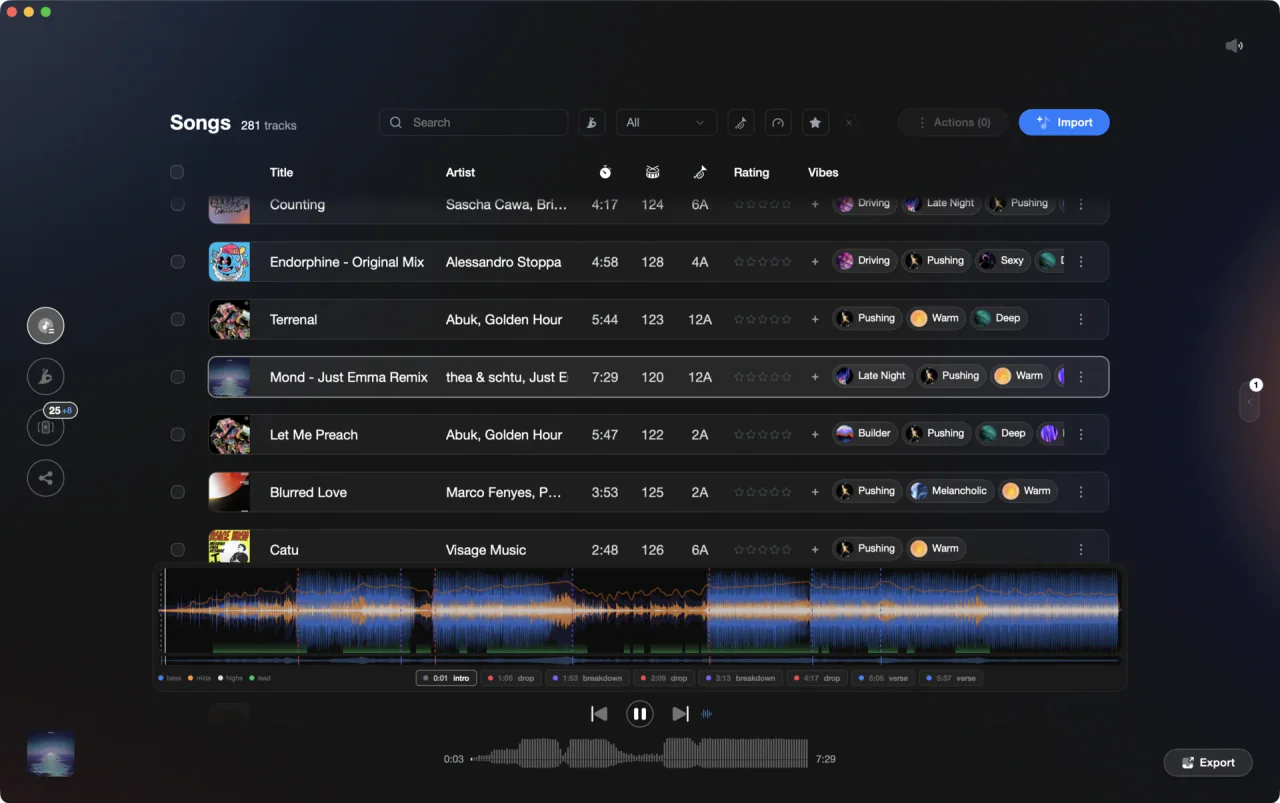
The Vibes player showing a track's waveform with detected sections, BPM and key

Vibes analyzes the track at home. The snapping itself happens on the deck.

Set quantize (beat snap) in Serato DJ, step by step.

This guide covers how to turn on quantize, Serato DJ Pro's Quantize Value setting, and the beatgrid work that decides whether snapping helps or hurts. Button names follow the Serato DJ Pro 4.0 main screen.

01

Analyze your tracks first

Snapping needs beatgrids: Serato's note on the feature is that it requires beatgrids to be enabled and set, so an unanalyzed file has nothing to snap to. Click Analyze Files in the top left of the library, or drag a crate onto that button, with Analyze BPM / Beatgrid ticked in the analysis settings. Serato DJ 4.0 also analyzes new imports automatically, on by default.

02

Click the Q button in the top toolbar

The Serato quantize button is the small Q in the strip along the top of the main screen, to the right of the Display Mode buttons, Link and MIDI. Click it once to switch snapping on. Cue points and manual loop in and out points then snap to the beatgrid as you set them, and triggering a cue point or a reloop lands in time with the grid.

03

Set the Quantize Value in Setup

Open Setup from the top right of the screen and select the DJ Preferences tab. Under Control Preferences you will find Quantize Value, which sets the beat interval that cue points, manual loops and reloop snap to. A wide interval is forgiving and keeps everything on the downbeat. A narrow one lets you land closer to where you actually pressed. Pick it before the gig, not during one.

04

Check the downbeat before you trust the snap

Snapping is only as good as the grid under it. Load the track, click Edit Grid next to the elapsed and remaining time, and look at the red Downbeat Marker: Serato places it on the first transient, then calculates every bar marker after it from the BPM. If that first marker sits in the wrong place, the whole grid is wrong and every snapped cue inherits the error.

05

Set cues and loops with it switched on

Now place your cue points from the Cue Point tab, or with control plus 1 to 5 on the left deck and control plus 6 to 0 on the right. Manual loops use the Loop In and Loop Out buttons, or the keys O and L for the left deck and P and semicolon for the right. They all land on the grid now, not where your finger did.

The catch

It snaps to the grid, not to the music. On a track whose downbeat is misplaced, or whose tempo drifts because it was played live, it will confidently put every cue in the wrong spot. The fix is the beatgrid, not the setting.

bass
mids
highs
Downbeat-locked grid

Where Vibes fits

Know which tracks have a shaky tempo before you rely on the snap.

Vibes does not set quantize, write beatgrids or place cue points in Serato: all of that stays in the app. What it does is analyze every track you own for BPM, key, energy and sections, so tempo outliers are visible during prep instead of mid-set. Tag and order the tracks in Vibes, export them back to Serato DJ, and the grid checking left to do is a short list rather than the whole library.

See how it works
Analysis gives BPM, key, energy and section markers for every track: intro, buildup, drop, breakdown, outro
Track Inspector shows the detected BPM and key per track, so a tempo that looks odd is easy to spot before the gig
Auto-Tagging and Vibe Sort put tracks into vibes, so the crates you send over arrive sorted by feel, not by folder
Export playlists and vibes back to Serato DJ as a folder tree, with optional Camelot key or BPM sub-folders

Organize in Vibes, export to Serato DJ.

Your playlists, tags, ratings, and cue points travel back to the gear you play on, so nothing you do in Vibes is locked away.

Track 001 by Artist A

Track 001

Artist A

128
3A
Track 002 by Artist B

Track 002

Artist B

124
5B
Track 003 by Artist C

Track 003

Artist C

132
8A
Vibes App
Playlists
Vibes
Mood
Aggressive
Euphoric
Melancholic
Mysterious
Peaceful
Playful
Tense
Function
Arrangement
Sets
Club Night 12/28
NYE Closing Set
Rooftop 01/04

Frequently asked questions

The honest answers, including the trade-offs.

Click the Q button in the top toolbar of Serato DJ Pro, just to the right of the Display Mode buttons. There is one Q for the software, not one per deck, so both decks follow it. You do not need hardware connected: with none attached Serato opens in Offline or Practice mode, and a Serato Play download only adds mixer controls on top. Set the snap interval under Setup, DJ Preferences, Quantize Value.
On, for most mixing. It keeps cue points and loops on the grid when your timing is a fraction early or late, which is exactly what you want when you are cutting between tracks or looping an outro. Switch it off for scratching, for finger drumming, and for any track whose beatgrid you do not trust, because there it moves your cue away from the sound you aimed at.
Not the way a DAW does. Quantizing audio in a music program means cutting and stretching the recording so hits land on the grid, which changes the file. Serato never edits your audio: it moves the trigger point, not the sound. If the track itself drifts in tempo, set a Beat Warp Marker so the grid follows the change, then let the snap work off that. See editing beatgrids in Serato.
It means rounding a moment in time to the nearest point on a fixed grid. In music software that grid is made of beats and beat divisions, so an event that happened slightly off gets moved to the closest one. Nothing about the sound changes, only when it starts. The same word covers MIDI notes in a studio and cue points on a DJ deck.
In DJing it means beat snap. The cue points and loops you set, and the cues and reloops you trigger, are pulled onto the nearest beat of the beatgrid rather than firing at the exact millisecond you pressed. It is the difference between a loop that runs clean for eight bars and one that slips a fraction and drags on the whole mix.
Use it whenever the timing of a trigger matters more than its exact position: hot cue juggling, dropping into a chorus, setting a loop on the fly, or reloading a loop over a live mix. Skip it when you want the raw position, for example marking a spoken word intro, a stray sound effect, or a beatless ambient section with no grid worth snapping to.
In a studio it tidies performance timing. A recorded MIDI take gets its notes pushed to the nearest sixteenth or eighth, tightening a part that was played by hand. Used lightly it fixes small slips. Used at full strength it removes the human feel altogether, which is why producers often tighten drums hard and leave other parts loose.
Consistency. Machines keep time better than hands, so snapping events to a grid removes the small errors that make a loop drift or a cue land late. In a DJ set the point is confidence: you can hit a pad in a dark booth, slightly ahead of the beat, and the software still places it where the bar actually starts.
The software already knows where the beats are, because the beatgrid marks them. When you press a button it compares the playhead position with those markers, picks the nearest one inside the interval you chose, and uses that position instead of yours. That is why an accurate grid matters so much: the snap trusts the grid completely and never re-checks it against the audio.
Almost always the track, not the button. Serato states that the feature requires beatgrids to be enabled and set, so a file that was never analyzed will not snap at all. Run it through Analyze Files with Analyze BPM / Beatgrid ticked, then check the grid on the deck. Serato documents the feature for Serato DJ Pro, and controls that need Pro appear greyed out in Serato DJ Lite with an upgrade message on mouseover.
Any current one. The feature has been in Serato DJ Pro for years, so even an old Serato DJ Pro 2.0 download from the version archive has it, but newer is safer. Check the Serato DJ Pro system requirements on the download page first: recent releases need a processor with AVX support. Serato 3.0 system requirements: Windows and macOS support is published per version. Avoid any Serato DJ Pro 3.0 download crack, since modified builds cannot sign in.
A separate feature entirely. Serato stem separation splits the playing track into vocals, melody, bass and drums in real time. In Serato DJ Pro, Stems appear as Acapella and Instrumental buttons on the virtual deck plus four pads in the Stems tab. Beat snap decides where a trigger lands, Stems decide what you hear. The full walkthrough is in Stems in Serato DJ.
Yes. It ships inside Serato DJ Pro and Serato DJ Lite, so there is no separate Serato Stems download, free or paid: you get Serato Stems by updating to a current version. To use Serato Stems, load a track and click Acapella or Instrumental. The Serato Stems requirements start with a processor that supports AVX, and Serato publishes no separate Serato Stems system requirements. Mac and Windows specs sit on each version's download page.

From a Vibes customer

The import worked perfectly. Have created several sets now and my life is so much easier
Danny

One-time purchase

Get Vibes with a single payment. No subscription.

First 250 licenses at this price, then $79.

Free Trial

14 days • Full access

Full access to all features
No credit card required
Works offline
Download Free Trial

No strings attached

FREE UPDATES FOREVER
$49USD
one-time payment
Includes Vibes Companion Pro
Use on 2 devices (macOS and Windows)
All updates included, free forever
14-day free trial to evaluate

Secure checkout with Stripe

Already have Companion Pro? Upgrade instead

Methodology

How we keep this honest.

Verified against the app

Every step is checked against the current version of Serato DJ.

We own our bias

We make Vibes. We show the native way first and honestly, then where Vibes genuinely helps, and we say when it does not.

Live pricing

The Vibes price shown comes straight from our checkout, never a hardcoded marketing number.

Kept current

Last reviewed June 2026.

5% off