

Back up your library in Serato DJ.
Your library is three folders: the _Serato_ folder in Music that holds your crates, cue points, and database, the Library folder in Application Support that holds crate order and history sessions, and the folder with your audio files. Quit Serato DJ Pro, copy all three to an external drive, and you can put the whole library back on any machine.
$49$79USD one-time purchase. First 250 licenses at this price. 14-day free trial.
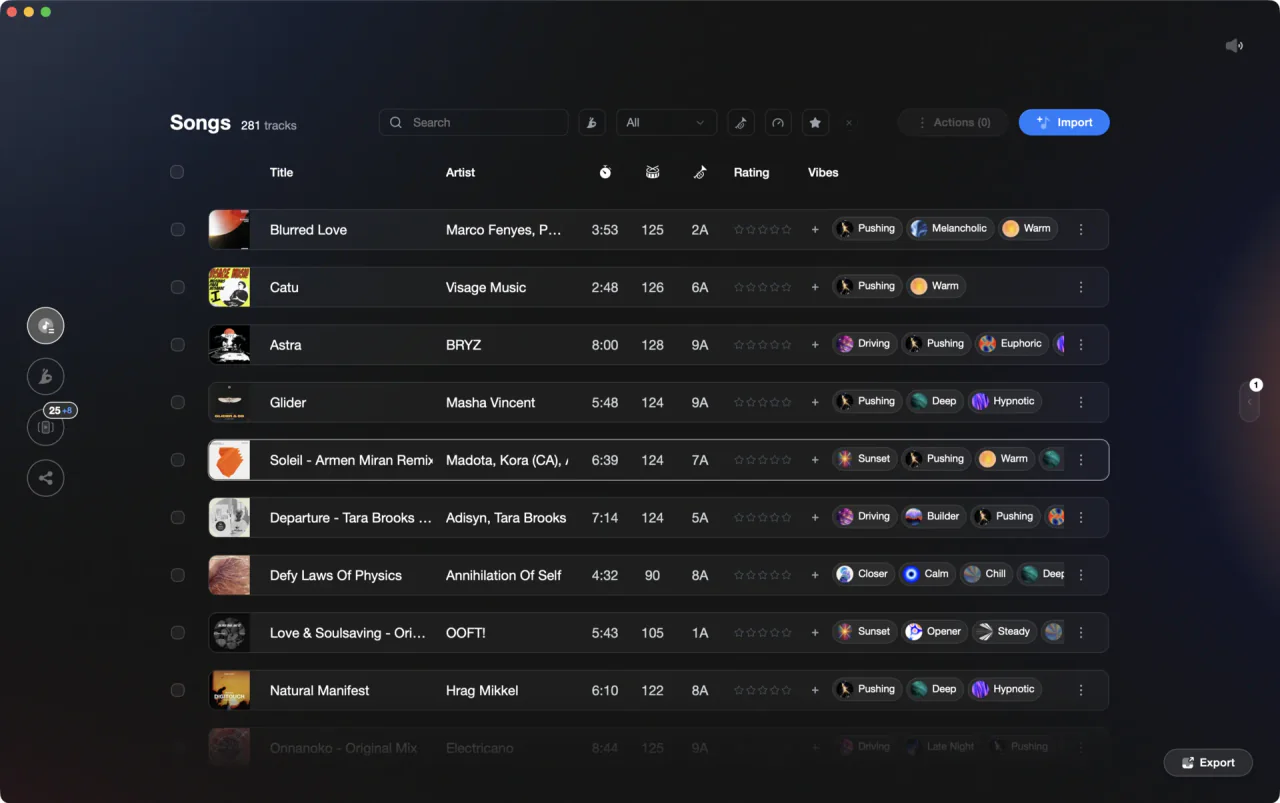
Crates and tags imported into Vibes: a second copy of the structure, outside the Serato database.
Back up your library in Serato DJ, step by step.
Below is how to backup Serato library to external hard drive storage, restore it on another machine, and check the result, using Finder or File Explorer plus the Files panel.
Clear out corrupt files first
Broken files should not ride along into a backup. After analysis, Serato marks corrupt files with a broken disc or lightning bolt icon; hover it for the reason. Re-encode what is worth keeping. How to delete corrupt files in Serato DJ: select the track and press control plus shift plus delete, command instead of control on macOS, which also sends the file to the trash.
Quit the app and find the three folders
Close Serato before you copy anything, or you back up a database that is still being written. On macOS they are Music > _Serato_ and, holding Option, Go > Library > Application Support > Serato > Library. On Windows they are Music > _Serato_ and AppData > Local > Serato > Library. There is no setting to change Serato library location: those paths are fixed.
Copy all three to the external drive
With the drive connected, copy the _Serato_ folder, the Library folder, and one tidy folder holding every audio file. If the drive already has a _Serato_ folder, merge the two rather than replacing it, or you lose the crates for the tracks on that drive. Every .crate file lives in the Subcrates folder inside _Serato_, the folder you need to transfer Serato crates to external hard drive backups.
Check every drive, and the format
Serato writes a second _Serato_ folder at the root of any drive you added music from, so copying the Music folder alone misses crates. Connect each drive and copy its folder too. Format matters: use exFAT, FAT32, or Mac OS Extended. NTFS is read only on macOS, so tags and cue points never save back, which is behind a lot of Serato issues that look like data loss.
Let the app keep its own copies too
Serato backup library on exit is the prompt you see when you quit: accept it and a _Serato_Backup folder appears next to _Serato_. Only one is kept, and each backup overwrites the last. Separately, Serato copies the library databases to the Serato/Library/Backups folder about 15 minutes after you open the library, then every 24 hours and whenever the database structure changes.
Switch on Protect Library
A backup does not help against a slip you copy over the next day. Serato Protect Library, in Setup under Library + Display, locks the library against accidental track and crate deletion and freezes crate names and file tags. Serato documents it as a 3.3.5 and below feature on the Library + Display page while still describing it in the 4.0 crates guide, so check your own Setup screen.
Restore the folders on a new machine
Reverse the copy with the app closed. Rename the existing _Serato_ and Library folders first, for example to _Serato_OLD, then move your backup copies into place. This is also how to transfer Serato crates to new computer setups, and it is the honest answer to how to fix Serato library damage after a crash: swap in a known-good folder instead of rebuilding by hand.
Rescan and relocate before you trust it
Open Serato, turn off Show iTunes Library under Setup > Library + Display, then click Files and click Rescan ID3 Tags. Your tracks flag as missing, which is expected. Still in the Files panel, drag the folder holding your music onto the Relocate Lost Files button. Check a few cue points afterwards: if they survived, the database came across intact.
The catch
Serato has no restore command. The Serato music library tools that matter here live in Finder and File Explorer, not in the app, and the common advice about how to reset Serato library by deleting the database throws away every crate that is not already copied somewhere else.


The faster way
Keep the structure in a second place a broken database cannot touch.
Vibes imports your Serato library with the Import Wizard, and Smart Import detects the app for you, so crates, BPM, key, and existing tags come across in one pass. Your DJ crate organization then lives in a second local library, and one export writes the whole tree back into Serato as folders, with optional Camelot key or BPM sub-folders. It is a copy of the structure, not of the audio, so keep copying your music folder as well.
See how it worksOrganize in Vibes, export to Serato DJ.
Your playlists, tags, ratings, and cue points travel back to the gear you play on, so nothing you do in Vibes is locked away.
Track 001
Artist A
Afterhours Mysterious
 Introspective
Track 002
Artist B
 Cozy FloorPeaceful
 Home
Home
Track 003
Artist C
Rave Aggressive
 Festival
 Build & Release
Frequently asked questions
The honest answers, including the trade-offs.
From a Vibes customer
The import worked perfectly. Have created several sets now and my life is so much easier
One-time purchase
Get Vibes with a single payment. No subscription.
Vibes is the step before you open your DJ software, not a replacement for it.
First 250 licenses at this price, then $79.
14 days • Full access
No strings attached
Secure checkout with Stripe
Already have Companion Pro? Upgrade instead

Methodology
How we keep this honest.

Verified against the app
Every step is checked against the current version of Serato DJ.
We own our bias
We make Vibes. We show the native way first and honestly, then where Vibes genuinely helps, and we say when it does not.
Live pricing
The Vibes price shown comes straight from our checkout, never a hardcoded marketing number.
Kept current
Last reviewed September 2026.
Keep exploring
Compare Vibes
DJ apps head to head
Works with your software
Vibes for DJs
Vibes features
How-to guides
Best DJ software
Move between apps
Learn to DJ