
Tidal DJ
Tidal DJ is the paid add-on that lets a Tidal subscription stream into DJ software and standalone hardware. Here is which apps support it, what offline access really means, and the limits no app can work around.
Quick Answer
What the Tidal DJ Extension actually is
The Tidal DJ Extension add-on is a license, not a program. There is no Tidal DJ Extension download and nothing to install: you add it to your Tidal account, log in from inside the DJ software you already use, and the catalog appears in the browser next to your own files. Tidal does not build a Tidal DJ app of its own, so the mixing always happens in someone else's software or in the hardware's own operating system.
Without the add-on, a plain subscription will not play into DJ software at all. Serato documents an active Tidal subscription with Tidal DJ as a hard requirement, and rekordbox lists a TIDAL plan including the DJ Extension as what its streaming panel expects. The Tidal DJ Extension rekordbox asks for is the same one every other partner asks for: one purchase on your Tidal account covers all of them.
Which apps and hardware work with it
Five integrations are documented by their vendors today, and they do not behave the same way. Offline behavior is where they differ most, so read that column before you decide the add-on solves your gig.
| App | What the vendor requires | Offline playback |
|---|---|---|
| Serato DJ Pro and DJ Lite | Serato DJ Pro 2.1 or above with an active Tidal subscription including Tidal DJ; Stems needs 3.1.3 or later | Not available. Serato states an internet connection is required |
| rekordbox | A TIDAL plan including the DJ Extension; usable in Performance and Export mode | 30 days from the date of offline storage, reset by logging in online near the end of that window |
| VirtualDJ | A Tidal subscription with the DJ Extension add-on | Download to cache, re-authorized online every 30 days |
| djay | A recent djay for iOS, Mac or Windows and a qualifying Tidal subscription | Not documented on Algoriddim's Tidal page |
| Engine OS hardware (Denon DJ) | Streams on Engine OS devices with no computer attached | Not documented on the Engine DJ streaming page |
What each vendor documents as of this update. Partner lists and minimum versions change, so check the vendor page before you pay for anything.
A Tidal DJ Extension Serato setup and a rekordbox one buy exactly the same thing, so the difference you feel is the app, not the subscription. If your software is not on that list, there is no workaround: the integration has to be built and licensed on both sides, and no plugin or converter can stand in for it.
How to get Tidal DJ Extension
- 1
Check how your Tidal account is billed
The add-on can only be attached to an account registered directly with Tidal. Accounts billed through Apple or Google cannot add it, so that is the first thing to confirm rather than the last.
- 2
Add it to an eligible plan
It sits on an Individual or Student plan. New subscribers get a 30-day Tidal DJ trial, and adding it while a plan trial is already running does not shorten the time you have left. Student accounts re-verify every 12 months to keep the discount.
- 3
Update the DJ app first
Every vendor names a minimum version, and stem support usually arrived later than the streaming support itself. Serato asks for Serato DJ Pro 2.1 or above for Tidal, and 3.1.3 or later before Stems will work on streamed tracks.
- 4
Log in from inside the app
Open the streaming or online music section of the browser, choose Tidal, and sign in with your Tidal credentials. A browser window handles the authorization and hands control back to the app.
- 5
Load a track and analyze it
Drag a track from the Tidal folder onto a deck. Once it is live, how to use Tidal DJ Extension tracks is the same everywhere: browse, load, analyze for key and BPM, set cue points and loops. Serato keeps that analysis and those cues when the track is loaded again.
Offline, USB and the limits you cannot design around
Tidal offline DJ playback is real in some apps, but it is a lease. rekordbox Tidal DJ Extension offline playback lasts 30 days from the date of offline storage and only resets if you log in with a connection between the 27th and the 30th day; once that period expires, the track stops playing. VirtualDJ caches downloads on the same clock and re-authorizes them every 30 days. Serato does not offer it at all and says an internet connection is required.
What it is good at, and what people complain about
The strengths are easy to state: a very large catalog, lossless FLAC where the plan allows it, and stem separation inside the apps that support it on streamed audio. The complaints are just as consistent. Search Tidal DJ Reddit posts from the 2024 pricing change onward and the theme is the extra monthly line on top of a plan people were already paying for. Tidal DJ Extension Reddit threads add the second one: the moment the connection drops or the lease expires, the set list is gone.
Two more things worth knowing before you subscribe. Tidal AI DJ is a search that leads nowhere: the DJ product is a license to stream into other people's software, not an automatic mixing mode. And there is no Tidal DJ Extension family plan. Tidal's support pages put the add-on on Individual and Student plans only, so a Tidal Family DJ Extension does not exist and the account owner has to move to an eligible plan to get it.
Streaming a set against playing your own files
The real question underneath all of this is whether you can DJ Tidal tracks the way you play the files on your drive. Not quite, and the gap is worth seeing side by side before you build a night around it.
Streaming with the add-on
- One monthly extra and the catalog is bigger than any hard drive you own.
- Lossless where the plan allows it, stems in some apps, and requests answered in seconds.
- Needs a stable connection, stops working without one, cannot be recorded, and never reaches a USB stick.
Playing files you own
- -Slower to build and it costs you per track.
- -Nothing expires, nothing needs a signal, the files export to USB for standalone gear, and every cue point, tag and rating you make stays yours even when you change DJ software.
Most working DJs run both. The streaming half is the discovery half and the safety net for requests; the owned half is what actually goes to the gig on a drive.
Where Vibes fits
Not on the streaming side, and not with a workaround. Vibes works on files you own: it has no Tidal import, no streaming playback, and nothing in it turns a licensed stream into a file. What it does is make the half of your library that is genuinely yours worth playing. Track analysis reads BPM, key, an energy curve and the sections of each track, Auto-Tagging and Vibe Sort group them into vibes, and Set Designer orders a set by energy flow or key path.
That matters more, not less, once you stream. The tracks that survive a dead connection are the ones on your drive, and exports go back to rekordbox, Serato, Traktor and Engine DJ as ordinary folders with optional Camelot or BPM sub-folders. If you are still weighing services, Beatport Streaming and Apple Music sit under the same rules.
The visual way to organize your DJ library
Tag tracks by vibe. See everything at once. Export to rekordbox, Serato, Traktor or Engine DJ.
14-day free trial. Full access, no strings attached.
or see how it works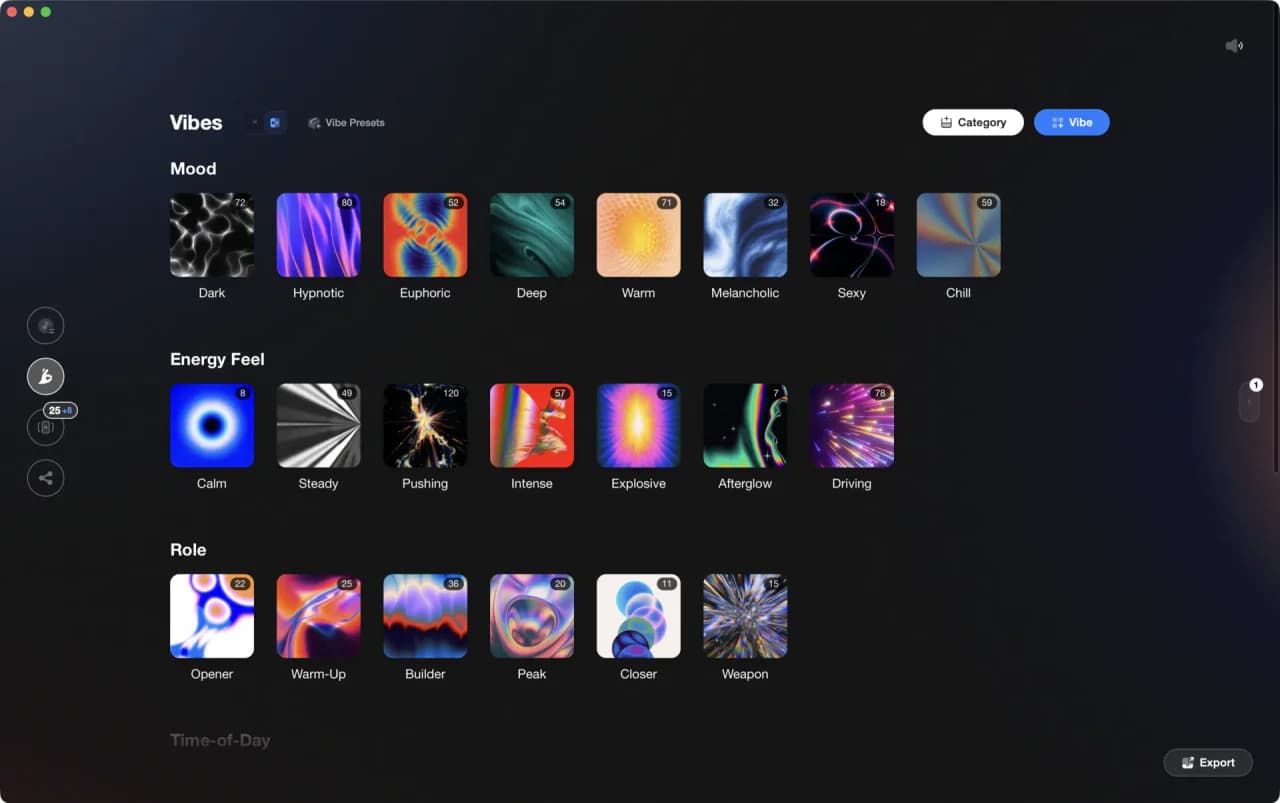
Frequently Asked Questions

Hey, it's Ben Modigell 👋
I DJ and produce as so I so: downtempo, minimal, dub house, tech house, and techno (releases on Spotify and SoundCloud, links above). Everything I write here comes from my own gigs, studio sessions, and library cleanups: the rules I follow, the failure modes I have actually hit, and the workflow I use when nobody is watching. If a technique did not earn its place in my own sets, it does not make it into a tutorial.