

Sort tracks by key in Serato DJ.
Right-click the library column header area, tick Key, then click the Key column header once for ascending order or twice for descending. Hold Ctrl (Cmd on macOS) and click BPM to add it as a secondary sort, so tracks group by key first and by tempo inside each key. Tracks only show a key if they were analyzed with the key option switched on.
$49$79USD one-time purchase. First 250 licenses at this price. 14-day free trial.
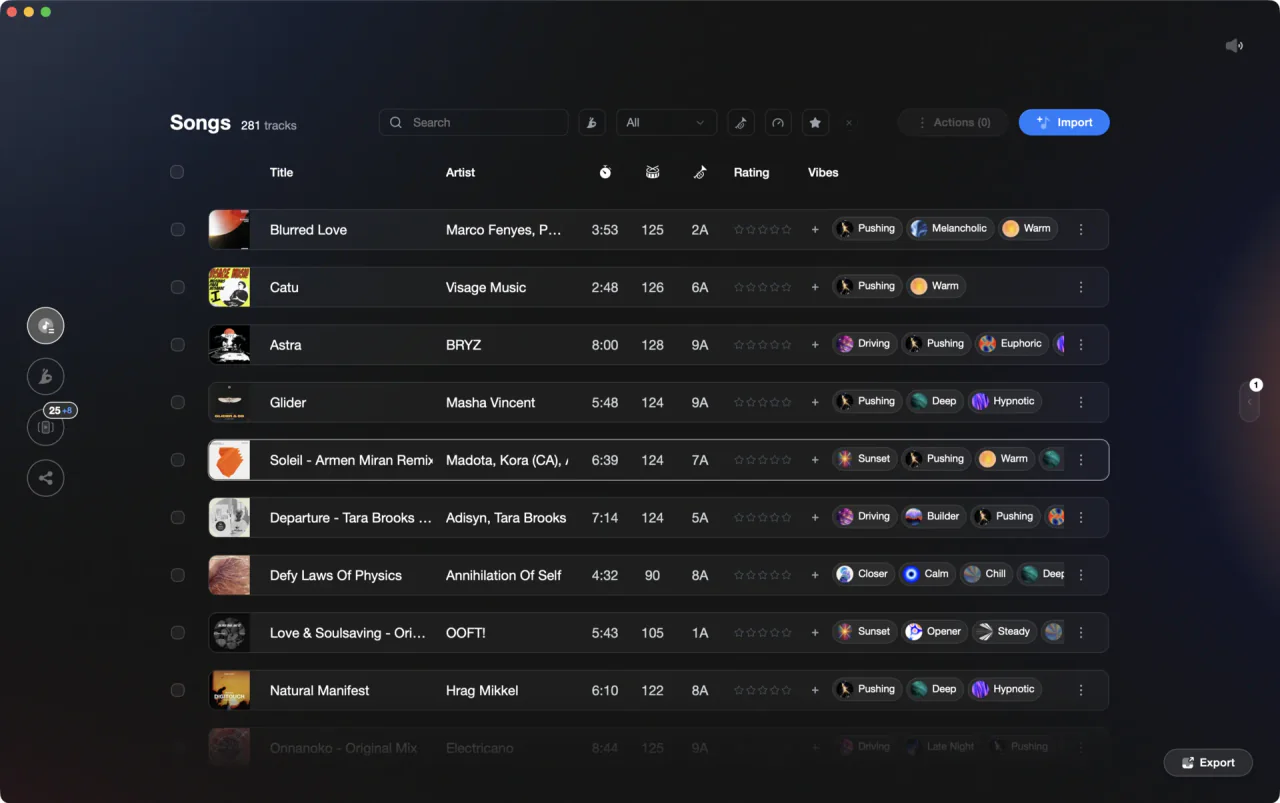
Key on every track, and the compatible ones one click away.
Sort tracks by key in Serato DJ, step by step.
Most answers to how to sort by key in Serato stop at the column header. The secondary sort column and a key smart crate are the parts that make it useful in a real crate.
Analyze with the key option on
Click the arrow next to the Analyze Files button to open the analysis settings, then check Set Key (it is called Analyze Key in Serato DJ Lite). Click Analyze Files, or drag a folder or crate onto the button to do a smaller batch. Serato DJ 4.0 also analyzes on import by default. Locked tracks keep the key they already have.
Turn on the Key column
Right-click any part of the header area above your library and tick Key in the list of columns. The same list holds BPM, Genre, Grouping, Comment, and Location. Drag the column edge to size it. If Custom Crate Columns is on in Setup, each crate keeps its own column layout, so you may need to do this in more than one crate.
Pick the key notation you read fastest
Open Setup, go to the Library + Display tab, and use the Show Key As dropdown to choose which key notation Serato displays in your library. If your tracks were tagged by another key detection app, choose Original Key so Serato shows the tag exactly as that app wrote it instead of its own value.
Click the Key column header
Click the Key header once to order by ascending values, twice to order by descending values. Every track in the same key now sits together, which is the grouping you want when you are hunting for the next record inside a crate rather than scrolling the whole collection.
Add BPM as a secondary sort
Hold Ctrl on Windows, or Cmd on macOS, and click the BPM header. That assigns BPM as the secondary sort column, so each key block is ordered by tempo inside itself. Clicking a primary or secondary column again flips it between ascending and descending. Ctrl and Shift held together while clicking the secondary column switches secondary sorting off.
Save the useful ones as smart crates
Click Add Smart Crate, then Add Rule, and set the field to Key with Is or Contains and the key you want. Add a BPM rule and tick Match all of the following Rules to combine the two. The crate refills itself as you add music, so a key you play often is one click away instead of a re-sort.
The catch
A column sort is a view of the crate you are in, not a saved order, and Serato has no rule for keys that are merely compatible with the one you picked. A smart crate matches the key values you type, so covering a full harmonic neighborhood means one rule per key, or one crate per key.
The faster way
Sort by key once, then let the compatible tracks come to you.
Vibes imports your Serato crates, analyzes BPM and key locally, and shows the key in Camelot, musical, or Open Key notation, whichever you read fastest. Find Compatible lists the harmonic Camelot neighbors of any track inside a BPM window you set, half and double time aware, so you skip the manual re-sorting. Set Designer can sort a whole set along a key path or an energy curve, and the finished list exports back to Serato as crates, with optional Camelot key sub-folders.
See how it worksOrganize in Vibes, export to Serato DJ.
Your playlists, tags, ratings, and cue points travel back to the gear you play on, so nothing you do in Vibes is locked away.

Track 001
Artist A
Afterhours Mysterious
 Introspective
Track 002
Artist B
 Cozy FloorPeaceful
 Home
Home
Track 003
Artist C
Rave Aggressive
 Festival
 Build & Release
Frequently asked questions
The honest answers, including the trade-offs.
From a Vibes customer
The import worked perfectly. Have created several sets now and my life is so much easier
One-time purchase
Get Vibes with a single payment. No subscription.
Vibes is the step before you open your DJ software, not a replacement for it.
First 250 licenses at this price, then $79.
14 days • Full access
No strings attached
Secure checkout with Stripe
Already have Companion Pro? Upgrade instead

Methodology
How we keep this honest.

Verified against the app
Every step is checked against the current version of Serato DJ.
We own our bias
We make Vibes. We show the native way first and honestly, then where Vibes genuinely helps, and we say when it does not.
Live pricing
The Vibes price shown comes straight from our checkout, never a hardcoded marketing number.
Kept current
Last reviewed September 2026.
Keep exploring
DJ apps head to head
Works with your software
Vibes for DJs
Vibes features
How-to guides
Best DJ software
Move between apps
DJ tools
Learn to DJ