
Filter your crate to this range, then verify each track's beatgrid and Camelot key before you blend.
- Practical target
- 128 BPM
- Tracks shown
- 7 shown
- Track spread
- 123-138 BPM
- Inside core range
- 3 of 7
- Below · above
- 3 below · 1 above
- Median · mean
- 126 · 127 BPM
- Family
- House
- Evidence
- Limited but reviewed: 7 tracks, 3 core examples
Counts describe the reference tracks resolved on this page, not every record in the genre. Use the BPM that makes loops, cue points, and phrase markers behave cleanly.
Next stepVibes tags a house library by mood and energy, beyond genre, then helps design the set on a visual canvas. Vibes for house DJs
Quick answer
What BPM is Progressive House?
A DJ tempo guide for Progressive House: where the core range sits, and 7 reference tracks spanning 123-138 BPM, separated into core, adjacent, and outlier records.
- DJ-ready reference
- Printable
- Methodology included
Reference tracks
Progressive House Reference Tracks
Resolved Progressive House tracks, verified against their beatgrids with real BPM, Camelot key, energy and length, separated by DJ fit. Click any row to open its full sonic profile.
Core Progressive House examples
3 inside 126-132 BPM
Adjacent and outlier examples
4 outside core

DJ fit notes
- FEEL: Below the 126-132 BPM core range; use as a bridge record or test a doubled grid.
- Lamur - AM Mix: Below the 126-132 BPM core range; use as a bridge record or test a doubled grid.
- Opus: Below the 126-132 BPM core range; use as a bridge record or test a doubled grid.
- Flaming June: Above the 126-132 BPM core range; check whether it behaves better as halftime.
Genre family
Progressive House in the House Family
Progressive House sits at 126–132 BPM as a core DJ range, with 128 BPM as a practical target for crate filtering and set planning. Viewing Progressive House as a sub-genre of House, it sits within the broader 115–132 BPM family.
House BPM Reference
House: 115-132 BPM, typical 125 BPM.
| Genre | BPM Range | Typical BPM | Notes |
|---|---|---|---|
| House | 115-132 | 125 | The foundation of electronic dance music, born in Chicago in the early 1980s. Characterized by a steady four-on-the-floor kick drum pattern, synthesized basslines, and soulful vocals. |
| Tropical House | 100-118 | 110 | Slow, sun-soaked house with marimba/steel-drum leads, panflutes, and tropical instrumentation. Popularized by Kygo, Thomas Jack, and Matoma in 2014-2016. |
| Slap House | 110-125 | 120 | Plucked, slap-bass-driven house with downtempo trap-influenced energy. Brazilian Bass evolution: Imanbek, VIZE, Alok. Massive in 2019-2021. |
| Outsider House | 115-128 | 120 | Raw, lo-fi, outsider-art house from labels like L.I.E.S., Mood Hut, and 1080p. DJ Sotofett, Huerco S., Anthony Naples. Tape hiss and DIY production aesthetics. |
| Lo-Fi House | 115-125 | 120 | Raw, tape-saturated house with intentionally degraded sound quality. Vintage samples, dusty drums, and DIY aesthetic. Ross From Friends, DJ Boring, Mall Grab. |
| Chicago House | 118-128 | 122 | The original house sound from clubs like The Warehouse and Music Box. Drum machine patterns (TR-707, TR-909), Roland bass, and disco DNA. Pioneered by Frankie Knuckles, Marshall Jefferson, and Larry Heard. |
| Deep House | 118-125 | 122 | A smoother, more atmospheric take on house. Warm pads, jazzy chords, and subdued vocals create a hypnotic, late-night feel. |
| Disco House | 118-126 | 122 | House built on disco loops and live instrumentation feel. Strings, horns, slap bass, and four-on-the-floor uplift. Overlaps with French and funky house. |
| Italo House | 118-128 | 122 | Late-80s Italian house with piano stabs, female diva vocals, and synth strings. Black Box's 'Ride on Time' and 49ers epitomize the sound. |
| Organic House | 115-124 | 122 | Layered, percussive, melody-soft house championed by labels like All Day I Dream and Crosstown Rebels. Bedouin, Sébastien Léger, Tinlicker, Bona Fide. Subtle, warm, organic textures over deep grooves. |
| Melodic House | 118-126 | 122 | Anjunadeep-adjacent, emotional, melody-led house. Innellea, Massano, Cassian, Anyma, Argy. Distinct from melodic-techno: groovier, slightly slower, more song-like. |
| French House | 118-128 | 124 | Filter-driven house pioneered by Daft Punk, Cassius, Stardust, and the Ed Banger crew. Heavily filtered disco and funk samples, sidechain pumping, and phaser sweeps. |
| Soulful House | 120-128 | 124 | House with gospel-rooted vocals, jazzy keys, and live-feel arrangements. Defined by labels like Defected, Soulfuric, and artists like Louie Vega and Kerri Chandler. |
| Brazilian Bass | 120-128 | 124 | São Paulo-born deep house variant with prominent slappy bass and minimal arrangement. Alok, Bhaskar, and Vintage Culture defined the sound that birthed slap house globally. |
| Microhouse | 120-128 | 124 | Glitchy, micro-sampled minimal house pioneered by Akufen, Ricardo Villalobos, and the Perlon/Kompakt circle. Granular textures and click-house grooves. |
| Afro House | 120-128 | 124 | Fuses house music with African rhythms, percussion, and melodic elements. Rich in polyrhythmic patterns and organic instrumentation. Black Coffee, Keinemusik. |
| Acid House | 120-130 | 125 | Defined by the squelchy, resonant sound of the Roland TB-303 bass synthesizer. A pivotal genre in rave culture. |
| Funky House | 122-128 | 125 | Infuses house with funk and disco elements. Groovy basslines, filtered samples, and uplifting energy. |
| Garage House | 122-128 | 125 | The New York/New Jersey vocal house sound from Paradise Garage and Tony Humphries era. Soulful, gospel-tinged vocals over swung drums. Direct ancestor of UK garage. |
| Latin House | 122-128 | 125 | House laced with congas, timbales, and Latin/salsa percussion. DJ Disciple, Erick Morillo, Roger Sanchez crossover sound. |
| Afro-Tech | 122-128 | 125 | Tech house variant with African percussion layers, log drums, and organic textures. Sits between Afro House and tech house: Themba, Black Motion sound. |
| Tech House | 124-128 | 126 | Blends house groove with techno's minimalism. Punchy percussion, rolling basslines, and stripped-back arrangements dominate the dancefloor. |
| Future House | 124-128 | 126 | Bouncy, metallic-bass house pioneered by Tchami, Oliver Heldens, and Don Diablo. Mid-2010s Spinnin'/Mixmash sound bridging UK garage swing and big-room drops. |
| G-House | 124-128 | 126 | Gangsta-house: tech house with West Coast hip-hop samples and gangsta rap acapellas. Pioneered by AC Slater, Amine Edge & DANCE, and the Night Bass label. |
| Jackin' House | 124-128 | 126 | Cut-up disco-loop house with chopped vocal stabs and bouncy swung drums. Strictly Rhythm/Defected territory. The 'jacking' references original Chicago house dance. |
| Tribal House | 124-130 | 126 | Percussion-heavy house with congas, djembes, bongos, and chant vocals. Pier Bucci, DJ Chus, Stephan Hinz territory. Different from Afro House: tribal is more global drum focused. |
| Progressive House | 126-132 | 128 | Long, evolving builds and breakdowns with layered melodies. Tracks develop gradually over 7-10 minutes with emotional peaks. |
| Electro House | 126-132 | 128 | Big, distorted basslines and aggressive synth leads. High-energy festival sound with dramatic drops. Distinct from classic 'electro' (electrofunk). |
| Bass House | 124-130 | 128 | Aggressive, bass-forward house drawing from UK bassline and dubstep. AC Slater, Joyryde, Habstrakt territory. Heavy mid-range growls over four-on-the-floor. |
| Big Room House | 126-132 | 128 | Stripped-down festival house built around massive kick-driven drops. Hardwell, Martin Garrix, W&W era of Mainstage EDM at Tomorrowland and Ultra. |
| Ghetto House | 130-150 | 135 | Raw, sexually explicit Chicago house with stripped 808/909 patterns. Dance Mania label sound: DJ Funk, DJ Deeon. Direct precursor to juke and footwork. |
| Hard House | 140-150 | 145 | UK rave-era hard house with pumping kicks, hoover synths, and crowd-rallying energy. Tidy Trax, Trade nightclub heritage. Tony De Vit, BK, Lisa Lashes. |
vibesdj.io/dj-tools - BPM ranges are practical DJ references, not strict genre boundaries.
House
The foundation of electronic dance music, born in Chicago in the early 1980s. Characterized by a steady four-on-the-floor kick drum pattern, synthesized basslines, and soulful vocals.
Sub-genre tempo spectrum
31 stylesReading the grid
How to Read Progressive House BPM in DJ Software
Progressive House is usually mixed around 126-132 BPM, with 128 BPM as a practical DJ target. The reference tracks on this page span 123-138 BPM, so use the grid that makes loops and phrase markers line up cleanly.
| Reading | Meaning | Action |
|---|---|---|
| 126-132 BPM | Core Progressive House DJ range | Beatmatch normally, then check phrasing around intros, breaks, and drops. |
| 63-66 BPM | Halftime interpretation of the core range | Double the grid if 8-bar loops or cue points feel too slow. |
| 128 BPM | Practical target for crate filtering | Use as a starting point, then sort by energy, key, and arrangement. |
| < 126 BPM | Slower adjacent or bridge records | Treat as tempo bridges unless the grid doubles cleanly into the core range. |
| > 132 BPM | Faster outliers or double-time readings | Check whether the track behaves better as halftime before using it as a fast transition. |
DJ Overview for Progressive House
Use this as a mixing and library-prep description, not an encyclopedia entry.
| Aspect | Detail |
|---|---|
| Sound palette | Long builds, Layered melodies, Evolving arrangements, Emotional breakdowns |
| Drum feel | 126-132 BPM core range; check whether slower readings work better doubled or as halftime. |
| Arrangement and phrasing | Confirm intro, build, drop, breakdown, and outro cue points before trusting the analyzer value. |
| Energy use in a set | club flow, long blends, and steady energy |
| Often compared with | House, Electro House, Bass House |
Mix Into Progressive House
Tempo overlap is only one part of the decision. These suggestions separate BPM fit from style fit so same-tempo but unrelated genres do not look like natural transitions.
| Genre | BPM fit | Style fit | Transition |
|---|---|---|---|
| House115-132 BPM · typical 125 | High | High | Long blend, harmonic blend, or drop swap |
| Chicago House118-128 BPM · typical 122 | High | High | Long blend, harmonic blend, or drop swap |
| Deep House118-125 BPM · typical 122 | High | High | Long blend, harmonic blend, or drop swap |
| Tech House124-128 BPM · typical 126 | High | High | Long blend, harmonic blend, or drop swap |
| Acid House120-130 BPM · typical 125 | High | High | Long blend, harmonic blend, or drop swap |
| Electro House126-132 BPM · typical 128 | High | High | Long blend, harmonic blend, or drop swap |
| Funky House122-128 BPM · typical 125 | High | High | Long blend, harmonic blend, or drop swap |
| French House118-128 BPM · typical 124 | High | High | Long blend, harmonic blend, or drop swap |
Reference Artists in Progressive House
Artists represented in the current Progressive House track sample:
Compare Nearby Styles
Primary reference for this page.
Broader family range for planning transitions.
Same typical tempo; compare by arrangement and energy.
Same typical tempo; compare by arrangement and energy.
Same typical tempo; compare by arrangement and energy.
Common Keys for Progressive House
Most-used Camelot keys among the Progressive House tracks shown here:
Got a track and no tempo for it? Drop the file into the song key and BPM finder to read its BPM and key in the browser, then place it against the Progressive House ranges above.
Want to hear it in practice? Browse Progressive House tracks and the DJs who play them in the directory, filterable by key, tempo, and energy.
Explore Related References
Mixing Tips
Tempo Window
Stay in the 126–132 BPM band for clean mixes; verify unknown tracks with the BPM tapper.
Harmonic Fit
Use the Camelot wheel to find compatible keys before transitioning, especially when Progressive House tracks have prominent melodic content.
Tempo Bridges
When bridging into a different tempo, use the key transposer to plan how pitch change affects key, or transition during a breakdown where the beat drops.
Next Reference
Browse the EDM genre BPM chart or the music genre tree to see how Progressive House relates to neighboring styles.
Typical Tempo
See tracks at the typical 128 BPM on the 128 BPM tracks page.

Hey, it's Ben Modigell 👋
I've been DJing and producing music as "so I so," focusing on downtempo, minimal, dub house, tech house, and techno. My background in digital marketing, web development, and UX design over the past 6 years helps me create DJ tutorials that are clear, practical, and easy to follow.
Methodology
Last updated
Author and Methodology
Maintained by Ben Modigell, founder of Vibes. Ben builds DJ library, preparation, BPM, and harmonic-mixing tools for working DJs.
- Data used
- 7 reference tracks
- Source
- Audio features sourced from ReccoBeats (https://reccobeats.com); track metadata via Spotify Search API. Spotify deprecated audio-features for new apps in Nov 2024. Manual label reference tracks use Beatport BPM/key metadata where available.
- Evidence
- 7 reference Progressive House tracks from a 391-track dataset; 3 sit inside the core DJ range and 4 are labeled as adjacent or outlier examples.
- How this page is made
- This page is generated from the Vibes genre taxonomy, curated reference tracks, computed evidence statistics, and reference track metadata where available. AI-assisted research helped draft the taxonomy notes; the visible page is rendered from structured data and reusable page logic.
Genre BPM ranges are practical DJ references, not statistical claims about every track. Different edits, live versions, and analysis engines may report slightly different tempos.
Report a correctionThe visual way to organize your DJ library
Tag tracks by vibe. See everything at once. Export to rekordbox, Serato, Traktor or Engine DJ.
14-day free trial. Full access, no strings attached.
or see how it works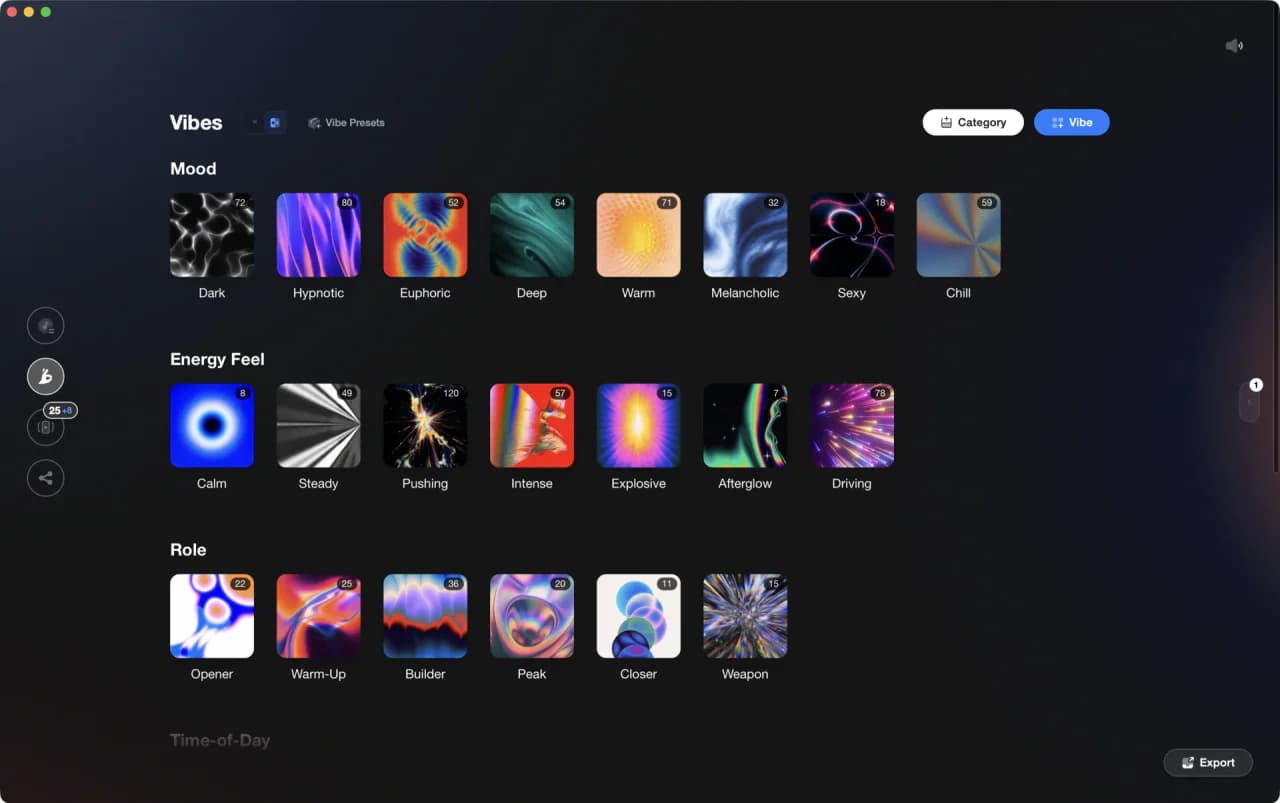
Frequently Asked Questions
Related Tools
Music Genre Tree
Complete electronic music genre taxonomy with BPM ranges
EDM Genre Chart
Interactive genre tree with BPM ranges
House Music BPM Guide
BPM ranges for house music and all sub-genres
Techno BPM Guide
BPM ranges for techno and all sub-genres
Drum & Bass BPM Guide
BPM ranges for drum and bass and all sub-genres
Trance BPM Guide
BPM ranges for trance and all sub-genres