

Analyze tracks in Serato DJ.
To analyze tracks in Serato, click Analyze Files above the library, or drag tracks, crates, or folders onto the button. With Set Key and Analyze BPM / Beatgrid enabled in Analysis Settings, Serato detects BPM and key and builds a beatgrid for every file it processes, and it does the same for an unanalyzed track the first time you load it to a deck. Vibes can batch-analyze your entire library before you open Serato, using neural-net key detection and BPM detection, then export the results straight into your Serato crates.
$49$79USD one-time purchase. First 250 licenses at this price. 14-day free trial.
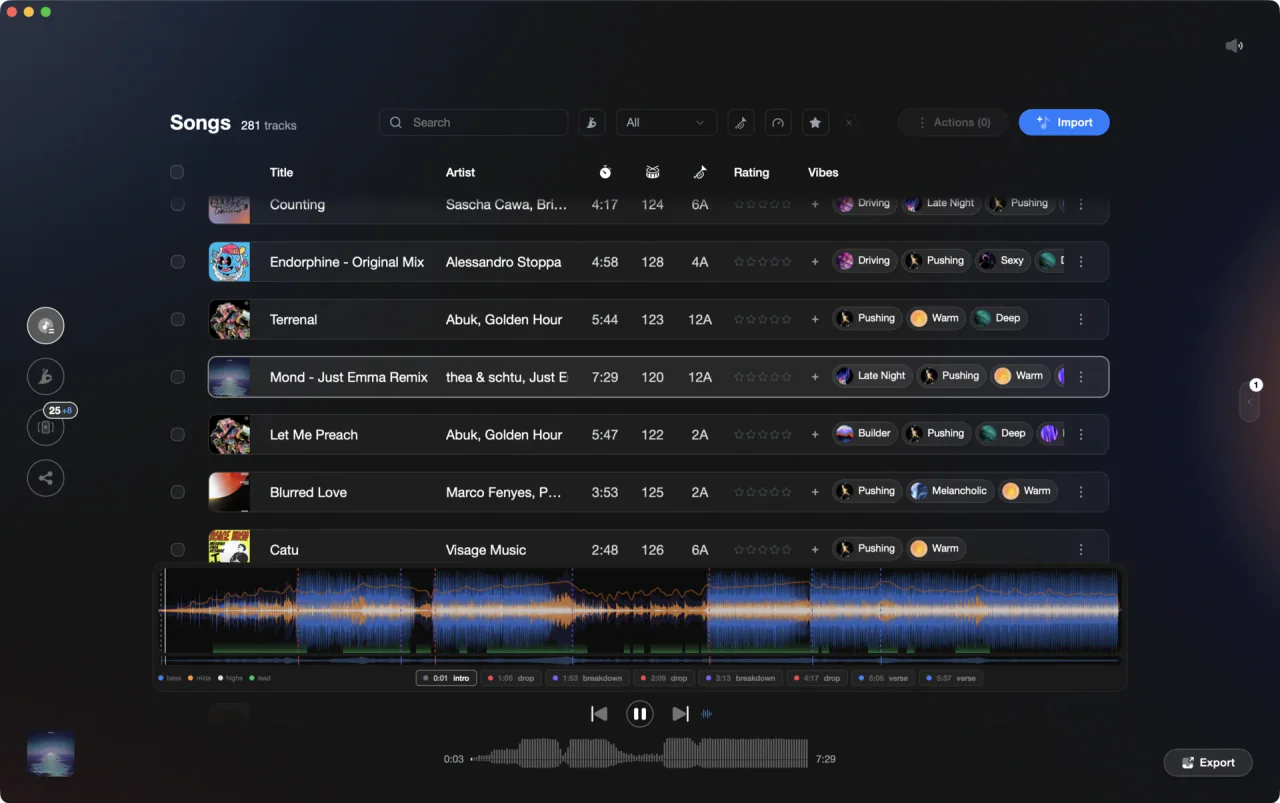
Vibes detects BPM and key across your whole library, then exports into Serato.
Analyze tracks in Serato DJ, step by step.
Both Serato DJ Pro and Serato DJ Lite analyze your files with a built-in engine. You can run a dedicated Analyze Files pass on tracks, crates, or the whole library before your set, let Analyze on Import handle new files as you add them, or let Serato analyze each track the first time it is loaded to a deck.
Add your tracks to Serato
Click the Files button to open the Files panel, browse to your music, and drag the folder or files onto the purple All icon or into a crate. Whether you want to analyze songs in Serato one at a time or in bulk, they need to be in the library first. With Analyze on Import enabled in Analysis Settings, Serato analyzes new files as they arrive. With it off, new tracks show empty BPM and key columns and no waveform overview until you analyze them.
Set the analysis options
Open the Analysis Settings menu next to the Analyze Files button above the library. Check Set Key (Analyze Key in Serato DJ Lite) to detect keys, check Analyze BPM / Beatgrid to calculate BPM and set a beatgrid, and pick a BPM Range that fits your music. Serato's own example: tracks that come out at 140 BPM but should read 70 want the 68-135 range. Only Serato DJ Pro 3.3.5 or below still needs your hardware disconnected before it will analyze.
Run Analyze Files
To analyze files in Serato DJ Pro, click Analyze Files to process every unanalyzed track in your library, or drag tracks, a crate, or a folder onto the button to analyze just those. In Serato DJ Pro 4.0 you can also right-click a selection or a crate and choose Analyze Files. The same button is how you analyze files in Serato DJ Lite. Serato shows its progress as it goes, and a large library can take a while.
Review BPM and key results
Once analysis is complete, BPM and key values appear in the library columns. Check for tracks with unusual BPM readings: Serato can halve or double the detected tempo when the selected BPM Range does not suit the track. Correct the BPM Range in Analysis Settings, drag the affected tracks back onto Analyze Files to re-analyze them, then confirm the beatgrid on a deck. Re-analyzing overwrites manual edits, so lock tracks you have already fixed first.
Lock beatgrids you trust
Load a track into a deck and verify the beatgrid is aligned to the downbeat. If it is correct, go back to the library, hold Ctrl and click the track's Status column to set a blue lock icon. Locked tracks will not get a new beatgrid or key from future analysis passes. To lock multiple tracks at once, highlight the selection and then click (no Ctrl modifier needed) in the Status column; Serato asks whether you want to edit the tags for all of them.
The catch
Serato's analysis runs tracks sequentially. Key detection is included in the standard offline batch analysis pass and does not require loading each track to a deck. If Serato's built-in key accuracy is not sufficient for harmonic mixing, a dedicated tool such as Mixed In Key can write key values directly to your files before importing.

Track 001
Artist A
Afterhours Mysterious
 Introspective
Track 001
Artist A
AfterhoursMysteriousIntrospective
Track 002
Artist B
 Cozy FloorPeaceful
 Home
HomeTrack 002
Artist B
Cozy FloorPeacefulHome
Track 003
Artist C
Rave Aggressive
 Festival
 Build & Release
Track 003
Artist C
RaveAggressiveFestivalBuild & ReleaseThe faster way
Batch-analyze your library before you touch Serato.
Vibes analyzes BPM and key across your entire imported library in one pass, using its own neural-net key detection (Skey, Camelot-aware) and downbeat-locked beatgrid detection. When you are done, it exports crates directly into Serato so the results are waiting for you.
See how it worksOrganize in Vibes, export to Serato DJ.
Your playlists, tags, ratings, and cue points travel back to the gear you play on, so nothing you do in Vibes is locked away.
Track 001
Artist A
AfterhoursMysteriousIntrospectiveTrack 002
Artist B
Cozy FloorPeacefulHomeTrack 003
Artist C
RaveAggressiveFestivalBuild & Release
Frequently asked questions
The honest answers, including the trade-offs.
From a Vibes customer
The import worked perfectly. Have created several sets now and my life is so much easier
One-time purchase
Get Vibes with a single payment. No subscription.
Vibes is the step before you open your DJ software, not a replacement for it.
First 250 licenses at this price, then $79.
14 days • Full access
No strings attached
Secure checkout with Stripe
Already have Companion Pro? Upgrade instead

Methodology
How we keep this honest.

Verified against the app
Every step is checked against the current version of Serato DJ.
We own our bias
We make Vibes. We show the native way first and honestly, then where Vibes genuinely helps, and we say when it does not.
Live pricing
The Vibes price shown comes straight from our checkout, never a hardcoded marketing number.
Kept current
Last reviewed September 2026.
Keep exploring
DJ apps head to head
Works with your software
Vibes for DJs
Vibes features
How-to guides
Best DJ software
Move between apps
Learn to DJ