

Fix wrong key detection in VirtualDJ.
A wrong key value quietly breaks harmonic mixing: the clash only shows up in the mix. Here is how to re-analyze suspect tracks in VirtualDJ, pick a sane key notation, and correct keys by hand when the detector misses.
$49$79USD one-time purchase. First 250 licenses at this price. 14-day free trial.
Trustworthy keys are the foundation of harmonic mixing.
Fix wrong key detection in VirtualDJ, step by step.
VirtualDJ detects key automatically when it analyzes a track, and like every detector it misses sometimes, most often on sparse intros, heavy vocals, or tracks that change key. The fix is a combination of re-analysis, a readable notation, and manual correction.
Pick your key notation first
In VirtualDJ's settings, the key display option controls whether keys show as musical notation (like Am or F#) or as a numeric harmonic notation compatible with the Camelot wheel. Pick one and stick to it before fixing anything, so you are not correcting values you will re-read differently next week. The numeric style is easier to reason about mid-set: adjacent numbers mix.
Re-analyze the suspect track
Right-click the track in the browser and re-run analysis. This recomputes BPM and key from the audio, which fixes values that came from stale or wrong file tags. If you recently changed analysis-related settings, re-analysis also applies them.
Check the result against your ears
Load the track, play the main section, and compare it against a track whose key you trust, one step apart on the wheel should blend smoothly. Detection errors most often land on a closely related key, a fifth away or the relative major or minor, which still sounds acceptable, so borderline calls matter less than they look.
Edit the key manually when the detector is wrong
Open the track's tag editor from the right-click menu and type the correct key into the key field. VirtualDJ keeps the value in its database. Correct only the tracks you have actually verified by ear; bulk-overwriting keys by guesswork makes the library worse, not better.
The catch
No key detector is perfect, and re-analysis will not fix a track the algorithm genuinely mishears. For those tracks the ground truth is your ears, and the manual edit is the fix.
Where Vibes fits
A second opinion on every key
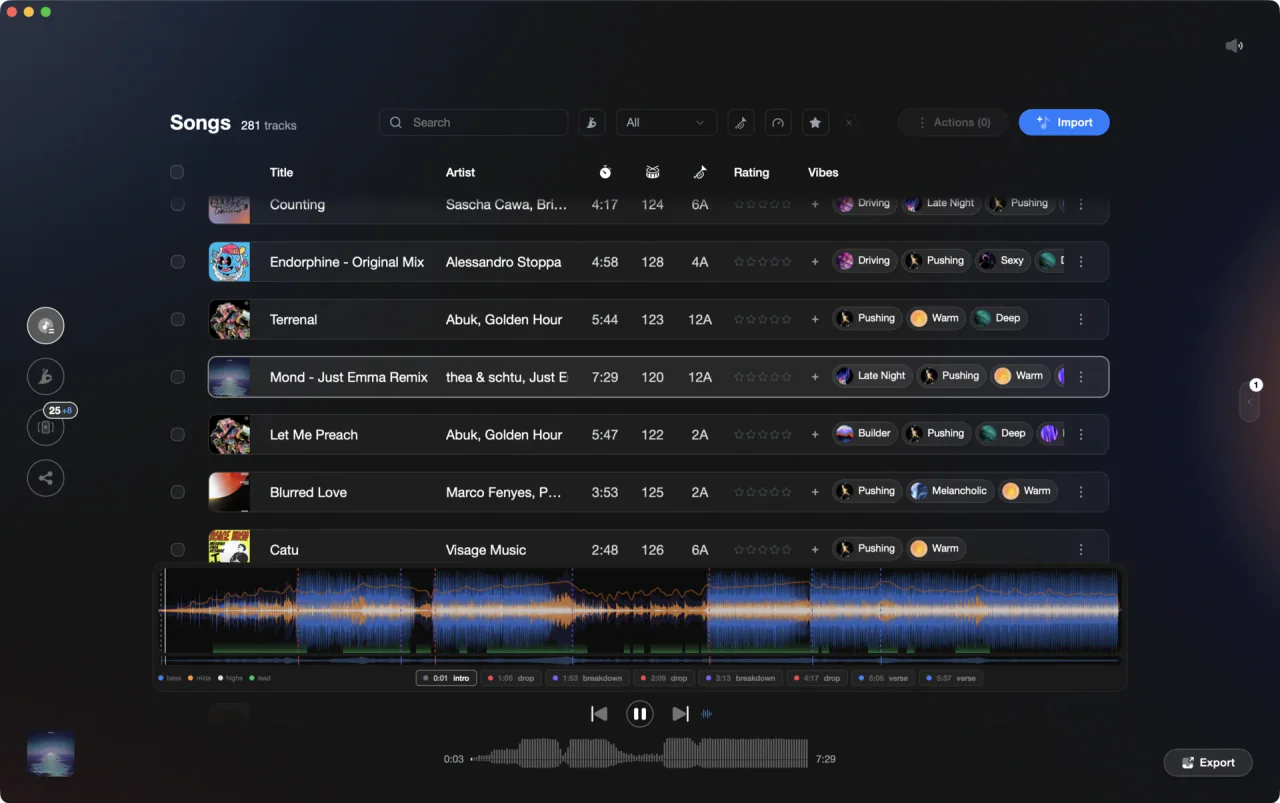
Vibes does not export to VirtualDJ, so its key values cannot be written into your VirtualDJ database; direct export covers Rekordbox, Serato, Traktor, and Engine DJ. What Vibes offers a VirtualDJ user is an independent second opinion: point it at the same music folders and its Skey neural network detects the key of every track locally, displayed in Camelot notation. Where Vibes and VirtualDJ disagree is exactly the shortlist worth checking by ear.
See how it worksOrganize in Vibes, export to VirtualDJ.
Your playlists, tags, ratings, and cue points travel back to the gear you play on, so nothing you do in Vibes is locked away.

Track 001
Artist A
Afterhours Mysterious
 Introspective
Track 002
Artist B
 Cozy FloorPeaceful
 Home
Home
Track 003
Artist C
Rave Aggressive
 Festival
 Build & Release
Frequently asked questions
The honest answers, including the trade-offs.
From a Vibes customer
The import worked perfectly. Have created several sets now and my life is so much easier
One-time purchase
Get Vibes with a single payment. No subscription.
Vibes is the step before you open your DJ software, not a replacement for it.
First 250 licenses at this price, then $79.
14 days • Full access
No strings attached
Secure checkout with Stripe
Already have Companion Pro? Upgrade instead

Methodology
How we keep this honest.

Verified against the app
Every step is checked against the current version of VirtualDJ.
We own our bias
We make Vibes. We show the native way first and honestly, then where Vibes genuinely helps, and we say when it does not.
Live pricing
The Vibes price shown comes straight from our checkout, never a hardcoded marketing number.
Kept current
Last reviewed September 2026.
Keep exploring
DJ apps head to head
Works with your software
Vibes for DJs
Vibes features
How-to guides
Best DJ software
Move between apps
Learn to DJ