
Watch Draken NaZaretH’s tutorial above (872K views on YouTube).
If you are trying to answer the question dj how much, you are usually stuck between two bad options. You either guess too low and lose money, or quote too high and lose the booking. After reading this, you will be able to price a DJ job by event type, hours, gear, and risk instead of copying random rates.
For a fast benchmark, private party DJ pricing often lands around $300 to $800 for four hours, while wedding pricing is usually much higher. WeddingWire says the average U.S. wedding DJ cost is about $1,000, with most couples spending roughly $780 to $1,495, and Fash lists private-party DJ pricing at $300 to $800 for four hours and wedding DJ pricing at $500 to $4,500 for four hours. WeddingWire's wedding DJ cost guide and Fash's DJ pricing guide both show the same pattern: event type matters more than the word "DJ."
That is the core mistake. People ask dj how much as if there is one rate. There is not.
A birthday party, a bar set, a corporate mixer, and a wedding reception can all be four hours long. They do not carry the same prep load, client pressure, equipment needs, or failure cost.
If you also manage a large local music collection for gigs, pricing gets tied to prep time faster than most clients realize. Organized crates, repeatable category systems, and pre-built set paths matter here. Some DJs handle that with spreadsheets and manual folders. Others use a library tool like Vibes to sort tracks into custom categories, prepare sets visually, and export structure into performance software. The pricing point is broader than the app. Better prep reduces unpaid labor and makes your quote more defensible.
DJ How Much: Quick Answer
A useful working range for dj how much is this: small private parties often start around $75 to $200 per hour, four-hour private events often land around $300 to $800 total, and weddings commonly cost more because the DJ is also managing timelines, announcements, ceremony audio, and higher client expectations.
- House party or birthday: often $300 to $800 for 4 hours
- Corporate or formal private event: often $500 to $1,500+ depending on production
- Wedding reception: often around $780 to $1,495, with $1,000 as a common average
- Extra hour: often $75 to $300 depending on event type and market
- Add-ons raise price fast: ceremony audio, uplighting, MC work, extra speakers, travel
Use those numbers as a starting frame, not a final quote. Your actual price should reflect scope, market, skill, and what happens if you fail.
Pricing Model: What Clients Are Really Buying
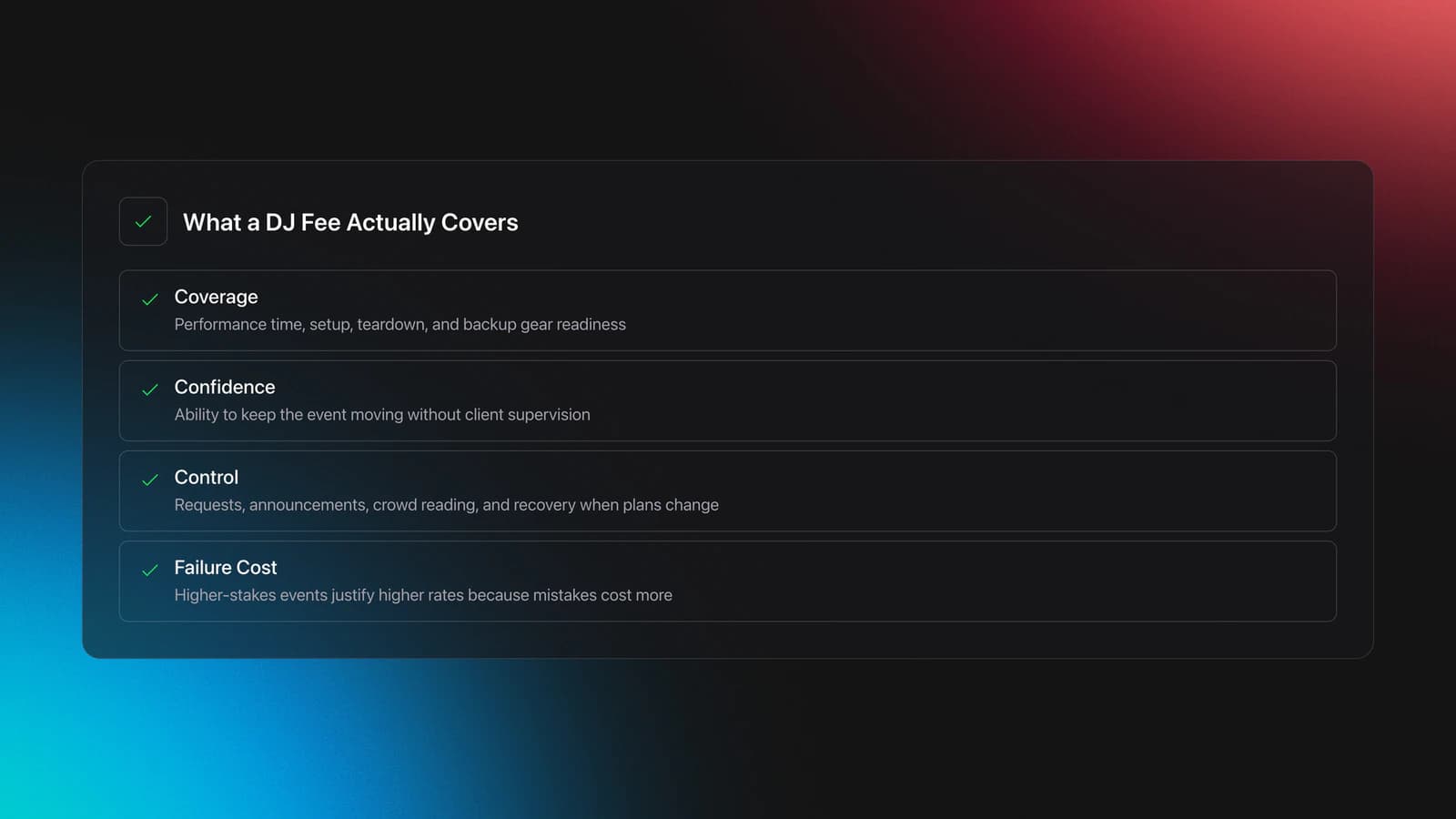
The cleanest mental model is this. Clients are not buying hours. They are buying coverage, confidence, and control.
Coverage means time on site, setup, teardown, and backup gear. Confidence means you can keep the room moving without supervision. Control means you can handle requests, read the crowd, make announcements, and recover when the event changes.
This is why hourly pricing alone breaks down. Two DJs can both play four hours. One shows up with a controller and a speaker for a casual patio party. The other brings ceremony sound, wireless mics, backup hardware, curated playlists, and timeline management for a wedding.
Same hours. Different job.
I call this the failure-cost model. The more expensive the consequences of a bad performance, the higher the acceptable DJ fee.
A missed transition at a birthday party is annoying. Dead audio during a wedding ceremony is remembered for years. That difference should show up in your rate.
This also explains why some clients see one DJ at $400 and another at $1,400 for what looks like the same date block. They are not pricing the same risk.
How Much Should a DJ Cost?
How much should a DJ cost? A fair DJ price matches the event's risk, prep load, equipment demands, and local market. For many private parties, that means a few hundred dollars for a short event. For weddings and high-stakes events, the fair price is often four figures because the job includes more than playing music.
Start with event type. Then layer in hours, equipment, travel, prep, and client management. If you skip that order, your quote will feel random.
Private parties usually price lower because the structure is simpler. The playlist can stay flexible. The timeline is loose. The client usually cares more about a fun room than a tightly managed production.
Weddings price higher because the DJ often acts as part performer, part coordinator, and part MC. WeddingWire's current cost data puts the average around $1,000, with most couples spending from about $780 to $1,495. That is not just music money. It reflects planning and execution risk.
Example one. A 4-hour birthday party in a local community hall needs one sound setup, no formal announcements, and a basic request-friendly set. A sensible quote might land around $400 to $700 depending on your market and gear.
Example two. A 4-hour wedding reception may still look like "4 hours" on paper, but you may need pre-event planning calls, formal intro timing, wireless mics, backup gear, and a more polished music plan. That can push a fair quote toward $1,000 or more.
The failure mode here is underpricing by runtime only. The symptom is obvious. You book a job that sounds profitable, then spend three unpaid hours on prep, packing, client emails, and early load-in.
You will know your price is closer to right when each quote covers four things. It pays for your labor. It pays for your equipment. It pays for your prep. It still leaves margin after routine surprises.
4-Hour DJ Pricing by Event Type
Most searches around dj how much eventually narrow down to four hours. That makes sense. Four hours is long enough to cover a full private party, a school event, or the main part of a reception.
It is also the easiest place to make a quoting mistake. A four-hour quote looks simple, so clients compare numbers without comparing scope.
For private parties, Fash lists an average cost of $300 to $800 for four hours. That is a reasonable public benchmark for birthdays, casual celebrations, and many standard non-wedding events.
For weddings, public examples are much wider. WeddingWire's market-level guide puts typical wedding DJ spending between about $780 and $1,495. Vendor price sheets on WeddingWire also show how wide the real market can be. One 2025 to 2026 pricing guide lists a standard 5-hour wedding package at $1,140 and a 6-hour package at $1,240, with additional hours at $150. Another vendor sheet lists a 4-hour wedding DJ rate at $1,300 and overtime at $300 per hour. Those are vendor examples, not national averages, but they show how quickly event scope changes the quote.
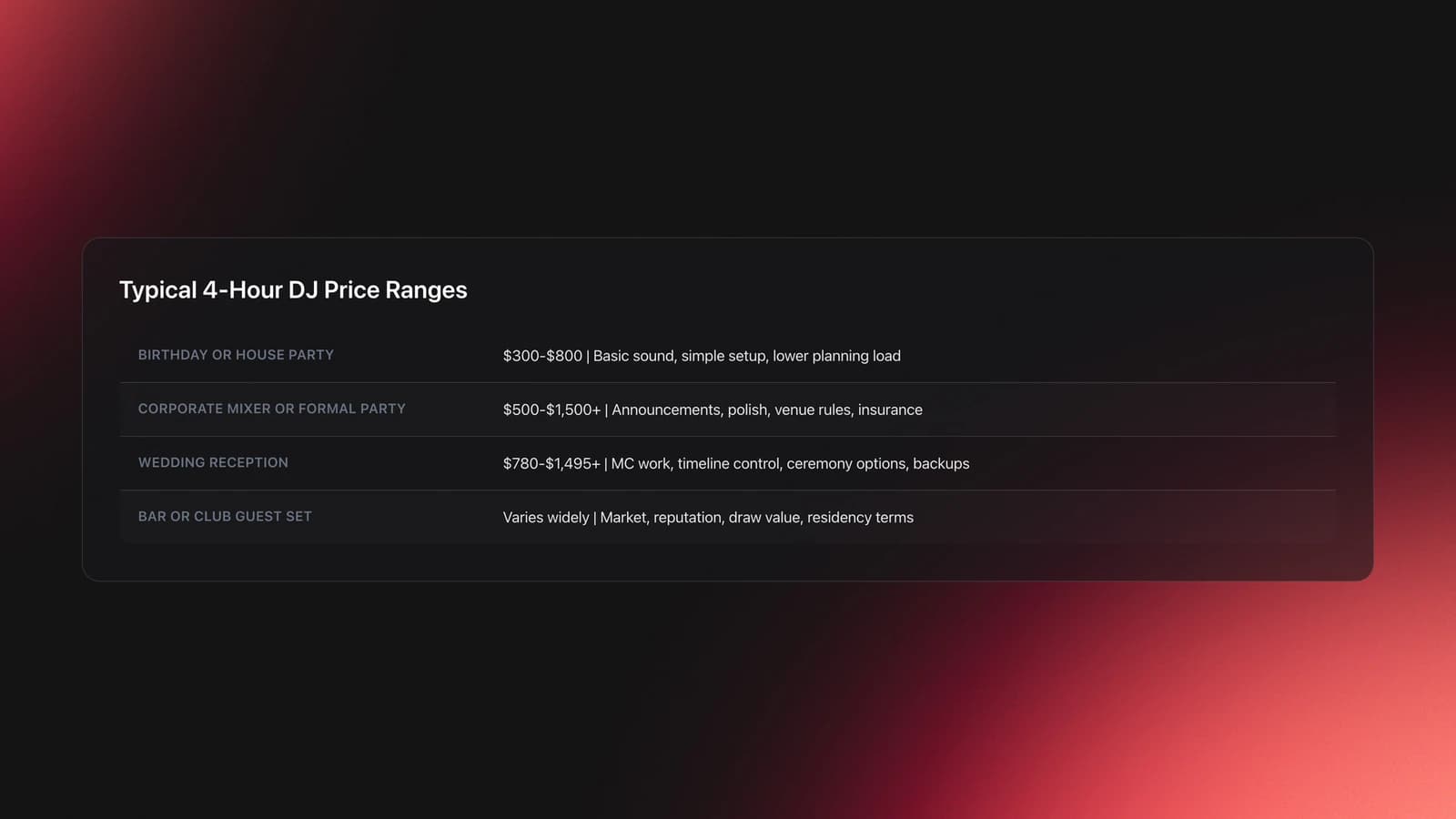
| Event Type | Typical 4-Hour Range | What Usually Drives the Price |
|---|---|---|
| Birthday or house party | $300 to $800 | Basic sound, simple setup, lower planning load |
| Corporate mixer or formal party | $500 to $1,500+ | Professional polish, announcements, venue rules, insurance needs |
| Wedding reception | $780 to $1,495+ common market range | Timeline management, MC work, ceremony options, backup expectations |
| Bar or club guest set | Varies heavily by market and reputation | Draw value, ticket sales, brand, residency terms |
Public-facing benchmarks based on current market guides and vendor examples.
Example one. If a client asks how much should a DJ charge for 4 hours at a backyard graduation party, price the whole operating load. Maybe that means one compact PA, light request handling, thirty minutes of setup, and no MC duties. A mid-range quote may be enough.
Example two. If another client asks how much to hire a DJ for 4 hours at a wedding venue with ceremony sound in another area, your four hours may hide six to eight hours of real work. The quote should move accordingly.
A common failure mode is copying club rates into private-event work. The symptom is that your quote covers performance time but ignores logistics, early arrival, client calls, and gear hauling.
You will know your 4-hour pricing is healthy when you can explain it in one sentence. For example: "That rate covers four hours of performance, standard sound, one setup area, planning, and teardown." If you cannot explain the quote cleanly, the package is still fuzzy.
This is also where organized prep matters in the DJ workflow. A four-hour open-format party often needs faster retrieval than the client sees. If you keep local files sorted by mood, function, and energy, you cut search time during prep and performance. Some DJs build that manually. Others use Vibes to create category systems, track sorting progress, and export the resulting playlist structure into DJ software. The business point is simple. The more repeatable your prep, the easier it is to quote profitably.
Hourly Rate vs Package Rate
Hourly pricing is easy to explain. Package pricing is easier to run.
An hourly rate works best when the event is simple, the scope is stable, and the client understands what is not included. Think short private parties, bar fill-ins, or straightforward recurring work.
Package pricing works better when clients are likely to compare outcomes, not labor units. Weddings are the clearest example. Clients want a smooth event, not a timesheet.
If you price hourly, set a minimum. A two-hour booking can still consume half a day once travel, loading, setup, and teardown are included.
If you price by package, define what changes the number. Good triggers include added hours, second sound area, ceremony coverage, MC duties, lighting, difficult access, and travel beyond a set radius.
A simple structure many DJs use is base package plus modifiers. Base package covers the core event. Modifiers cover extra hours, more gear, extra space, or added formality.
In practice, this stops one bad client habit. They stop asking for "just one more thing" as if it is free.
What Changes a DJ Quote Fast
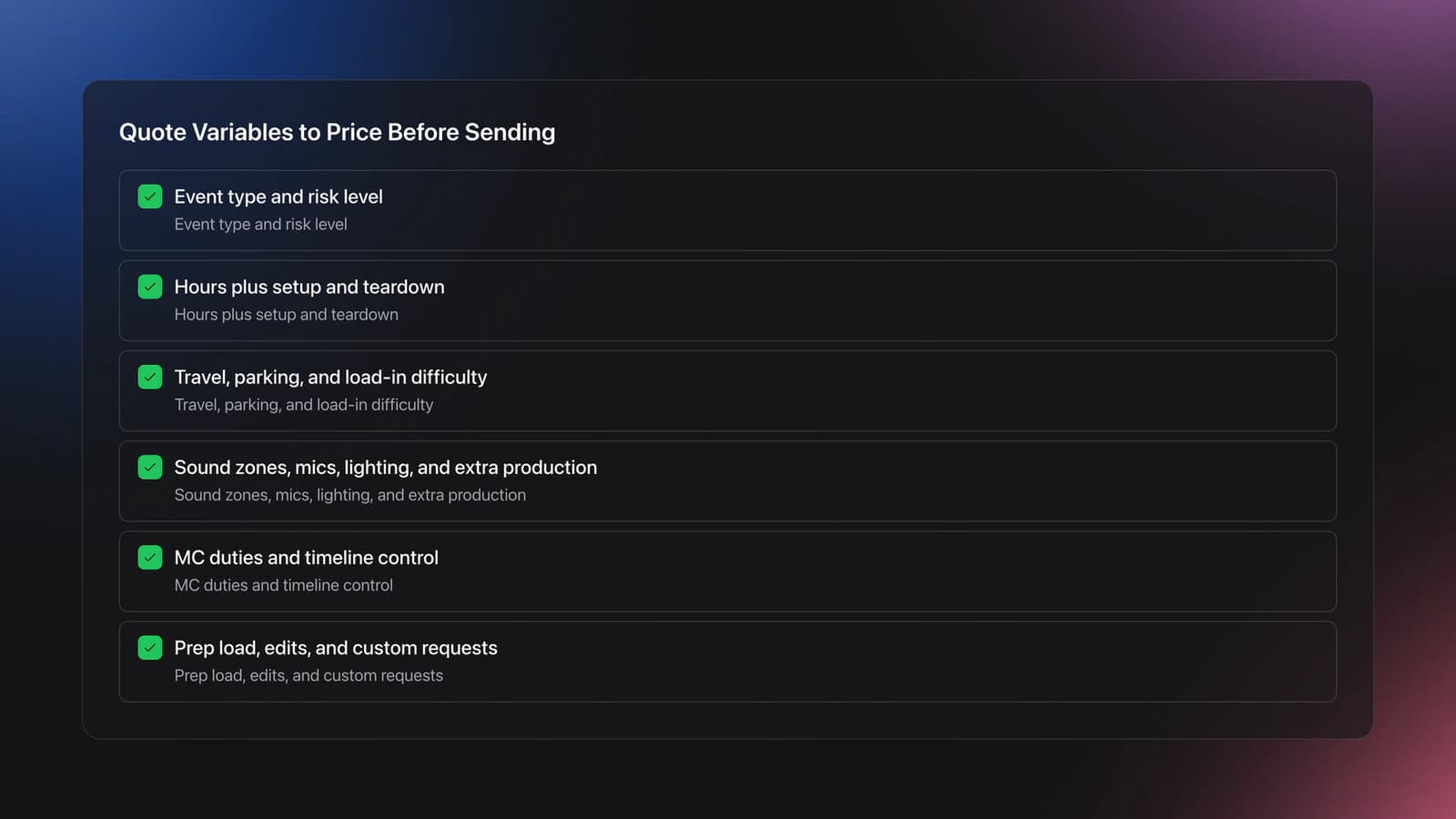
If you want a quote that holds up, price these variables before you send the number.
- Event type and risk level
- Number of performance hours
- Setup and teardown time
- Travel distance and parking
- Number of sound zones
- MC duties and timeline control
- Lighting, microphones, or extra production
- Prep load, edits, and custom requests
Travel is a quiet margin killer. So is difficult load-in. A fourth-floor venue with no elevator is not the same job as a driveway setup.
Client communication also matters. One client sends a playlist and trusts your judgment. Another sends 90 messages, six must-play lists, and day-of changes. Those are different jobs.
The same goes for prep complexity. If you are building multiple crates, cue-pointing key moments, and shaping transitions ahead of time, that labor belongs in the quote.
For DJs working from local libraries, prep gets faster when collection structure already exists. If your tracks are categorized by function or energy and your planned sets are mapped before gig week, you spend less unpaid time rebuilding from scratch. That can be done manually or with software built for set preparation. The important part is that your price reflects the system you had to build.
Build a Simple DJ Pricing Formula
A pricing formula keeps you from improvising under pressure. It also makes discounts harder to demand because the quote has visible logic.
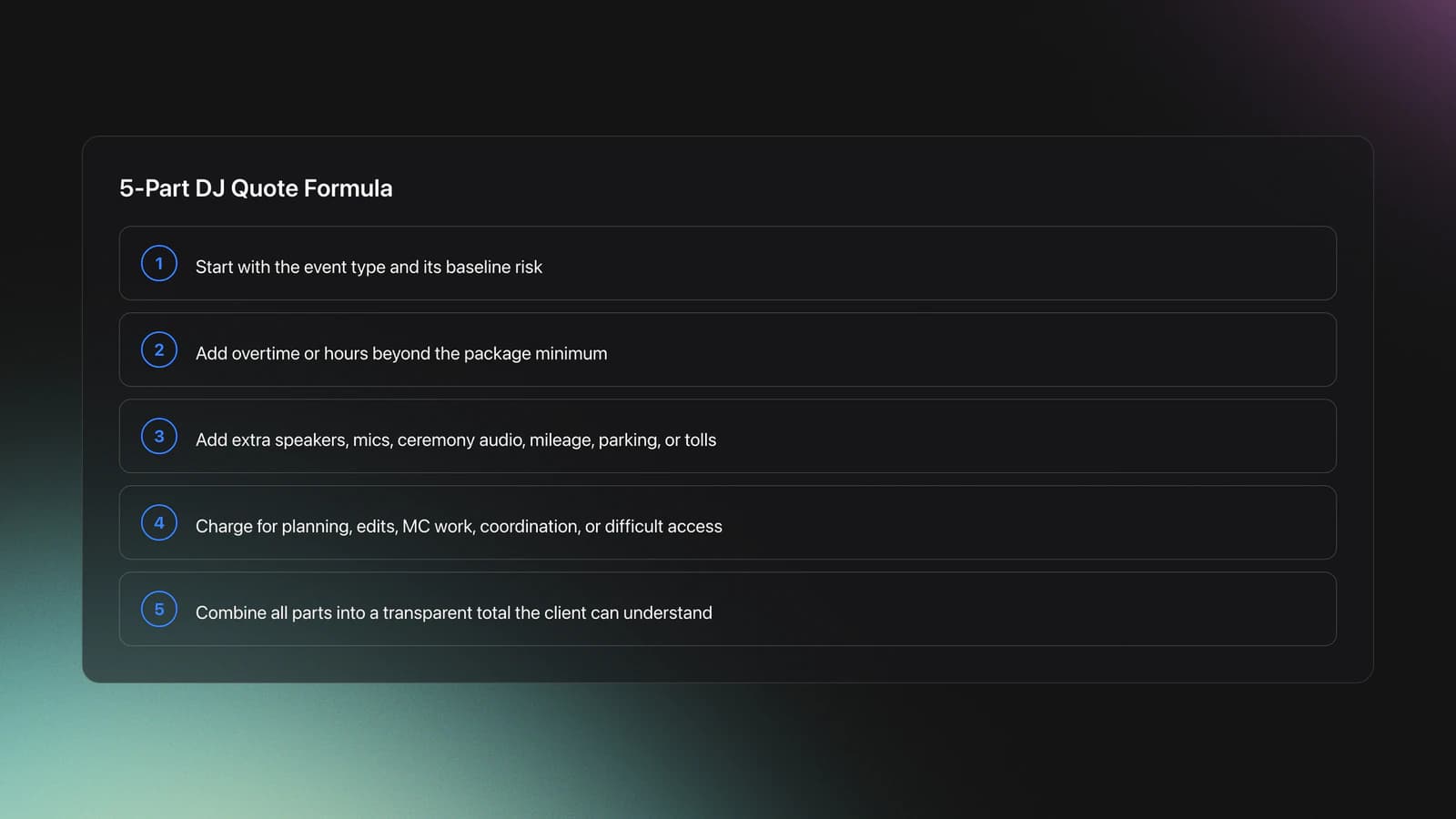
Use this sequence: base event fee + time adjustment + gear adjustment + travel adjustment + complexity adjustment = final quote.
Base event fee should reflect event type. A casual party starts lower. A wedding starts higher.
Time adjustment covers hours beyond your package minimum. Keep overtime separate so the client sees the cost of extending the event.
Gear adjustment covers second speakers, extra microphones, ceremony systems, lighting, or backup needs beyond your standard kit.
Travel adjustment covers mileage, parking, tolls, and time if the job pulls you far outside your normal area.
Complexity adjustment covers timeline management, heavy consultation, song edits, unusual access, or coordination with other vendors.
Example one. A 4-hour birthday party might price like this: $350 base fee + $0 added time + $50 for extra speaker coverage + $0 local travel + $50 for special requests = $450.
Example two. A 5-hour wedding reception might price like this: $900 base fee + $150 extra hour + $200 ceremony audio + $50 parking and travel + $150 timeline and MC complexity = $1,450.
The failure mode is hiding everything inside one round number. The symptom is that clients keep trying to negotiate because they do not see what they are paying for.
Validation Check
What Is a Typical DJ Fee?
What is a typical DJ fee? For many U.S. private parties, a typical fee sits in the low hundreds to mid hundreds for a short event. For weddings, a typical fee often lands around $1,000 and can run much higher when the DJ is covering more production and coordination.
Use public benchmarks carefully. The U.S. Bureau of Labor Statistics reports wage data for broadcast announcers and radio disc jockeys, with a median hourly wage of $21.96 in May 2024, but that is not the same market as private-event and wedding DJs. It is useful only as a reminder that job titles can hide very different business models.
In other words, event DJ pricing is closer to project pricing than wage pricing.
How Much Should I Charge for 5 Hours of DJing?
How much should I charge for 5 hours of DJing? Start with your 4-hour package, then add a clear fifth-hour rate. For lower-complexity private events, that extra hour may be modest. For weddings and formal events, the fifth hour often costs more because fatigue, timeline drift, and overtime risk increase.
Do not just divide your total by five and call that your hourly rate. The first few hours usually carry most of the setup, travel, planning, and client management cost.
A good rule is to price the package minimum first, then add overtime as a premium hour. Public vendor sheets support this. Recent WeddingWire vendor examples show additional hours at around $150 in one case and $300 in another, depending on market and package structure.
If your 4-hour private party package is $500, you might price five hours at $625 or $700, not $500 divided by four times five by accident. If your 4-hour wedding package is $1,150, a fifth hour could reasonably push the total to $1,300 or more.
How Much Is a DJ for Six Hours?
How much is a DJ for six hours? By six hours, you are no longer pricing only performance. You are pricing endurance, timeline drift, backup readiness, and the increasing chance that the event expands beyond the original plan.
For private events, six hours often means either a stronger package rate or a firm overtime add-on. For weddings, six hours is common enough that many vendors package it directly rather than treat it as an exception.
A recent WeddingWire vendor pricing guide lists a 5-hour reception at $1,140 and a 6-hour standard reception at $1,240, with additional hours at $150 after that. Another example shows 6 hours at $2,750 in a more premium package structure. Those are not apples-to-apples numbers. That is the point. The market spans a wide band, and scope drives the fee.
If you are quoting six hours, include a stop time in writing. Long events drift. Your rate should protect against that.
Client Budget vs DJ Price
There are really two versions of the question how much to hire a DJ. One comes from buyers trying to set a budget. The other comes from DJs trying to set a floor.
For buyers, the fastest path is to define the event clearly. Hours, headcount, venue type, indoor or outdoor, one space or two, and whether announcements matter. Without that, every quote will look inconsistent.
For DJs, the fastest path is to define what you refuse to do for free. Travel, early arrival, song editing, second systems, coordination calls, and overtime should all have visible boundaries.
That boundary is what turns a quote into a business system.
Common DJ Pricing Mistakes
| Mistake | Why It Happens | How to Avoid |
|---|---|---|
| Quoting by hours only | Hours are visible, prep and risk are not | Price by event type first, then add hours |
| No minimum booking fee | Short jobs seem easy | Set a base rate that covers travel, setup, and teardown |
| Bundling extras for free | Clients ask late and casually | List add-ons and overtime in writing before booking |
| Ignoring prep time | Music prep feels invisible | Track planning, edits, and communication for every job |
| Copying another DJ's market | Online prices look universal | Use local benchmarks, then adjust for your scope and demand |
Specific pricing errors that make DJ quotes unstable.
Quick Decision Guide
| Scenario | Best Choice | Why | Next Action |
|---|---|---|---|
| Casual local party, one room, 2 to 4 hours | Simple package or hourly minimum | Scope is predictable | Quote one base price with clear hour cutoff |
| Wedding or formal reception | Package pricing | Client is buying outcome and coordination | Break out ceremony, MC work, and overtime |
| Venue with multiple spaces | Package plus gear modifiers | Second setup changes labor and equipment | List each sound zone separately in the quote |
| Long event likely to run late | Package plus premium overtime | Drift risk rises after the planned end time | Define end time and extra-hour terms in writing |
Use this to choose your pricing structure before sending the quote.
The short answer to dj how much is this. Price the job, not the clock.
If you are hiring, define the event clearly before comparing quotes. If you are quoting, build a system that covers risk, prep, equipment, and overtime.
- Event type changes price more than runtime alone
- Four-hour quotes only make sense when scope is defined
- Package structure usually works better for higher-stakes events
From there, refine your packages, tighten your prep workflow, and make every quote explain itself.
The visual way to organize your DJ library
Tag tracks by vibe. See everything at once. Export to rekordbox, Serato, Traktor or Engine DJ.
14-day free trial. Full access, no strings attached.
or see how it works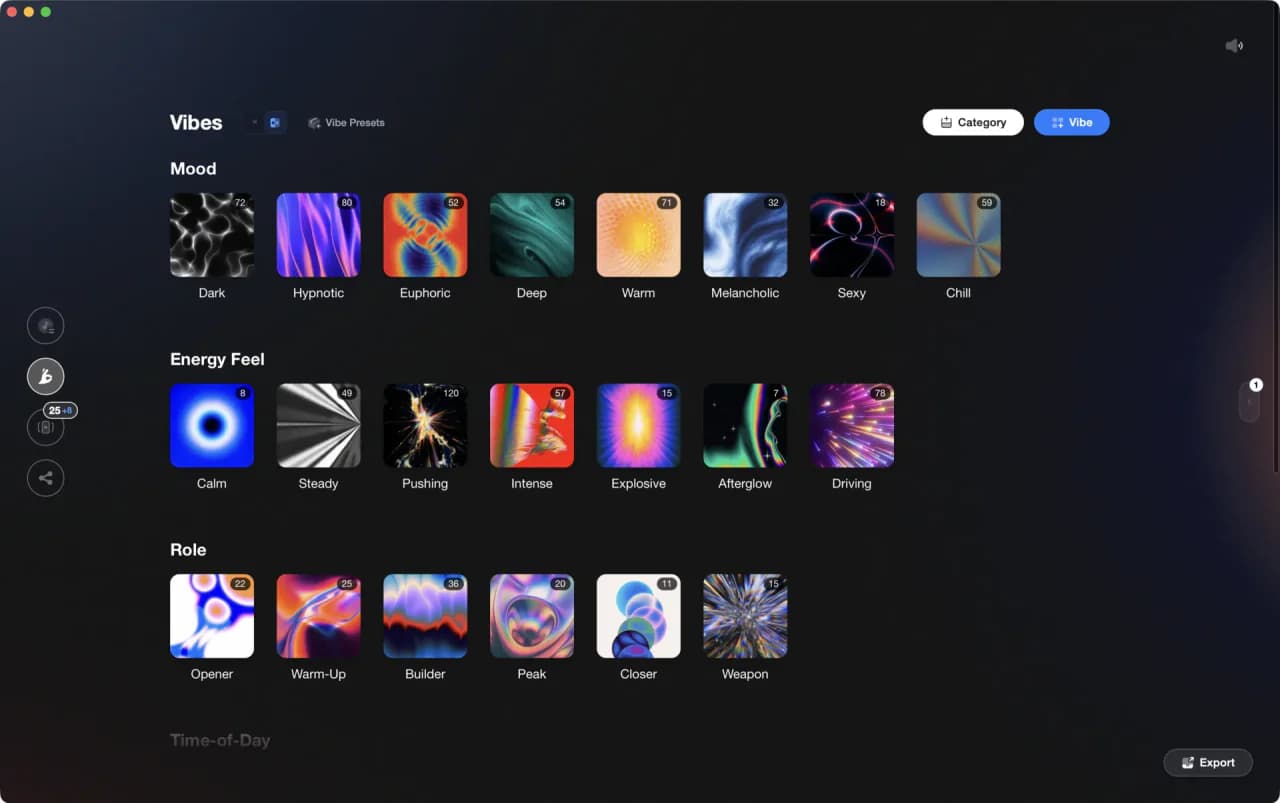
Equipment & Software
Continue Your Learning Journey
Start Here First
How Much for DJ at Wedding
beginner
Best DJ Controller: How to Choose
beginner
How to Choose a DJ Controller for Your Workflow
beginner
Beginner DJ Equipment: What You Need
beginner
DJ Starter Equipment: What to Buy First (and What to Skip)
beginner
Starter DJ Controller Buying Guide
beginner
How Can I Be a DJ and Start Strong
beginner
How to DJ: First Mix, Step by Step
beginner
What Is a House DJ?
beginner
DJ Setup Types
beginner
Portable DJ Controller Buying Guide
beginner
Related Content
DJ Record Pool Guide for Working DJs
intermediate
DJ Decks: 2 vs 4 Channel Buying Guide
intermediate
DJ City Song: What You Actually Get
intermediate
How to DJ With Just a Laptop (No Controller Needed)
intermediate
DJ Playlist Spotify: Mixing With Streaming Inside Rekordbox
intermediate
DJ Library Organization System: Tags, Crates, Keys
intermediateFrequently Asked Questions

Hey, it's Ben Modigell 👋
I DJ and produce as so I so: downtempo, minimal, dub house, tech house, and techno (releases on Spotify and SoundCloud, links above). Everything I write here comes from my own gigs, studio sessions, and library cleanups: the rules I follow, the failure modes I have actually hit, and the workflow I use when nobody is watching. If a technique did not earn its place in my own sets, it does not make it into a tutorial.