
Watch DJ Barr’s tutorial above (24K views on YouTube).
This guide is for couples pricing a wedding DJ and for DJs building sensible wedding rates. If you are stuck on how much for dj at wedding quotes should look like, the short answer is this: most U.S. couples land around $1,000 to $1,700, but real wedding DJ pricing moves fast once you add ceremony sound, MC work, lighting, travel, or longer coverage. You will leave with a working budget range, a quote breakdown, and a simple way to compare offers.
A realistic starting point is to treat the DJ fee as an event-management service, not just music playback. WeddingWire says the average U.S. wedding DJ cost is about $1,000, with most couples spending roughly $780 to $1,495, while The Knot reports an average of $1,689 from its 2025 Real Weddings Study. Those numbers are not contradictory. They show how much the final price changes by market, package scope, and production level.
Wedding DJ Cost: Quick Answer
If you want the fast budgeting version, use these bands.
- $700 to $1,100 for a basic local reception-only booking
- $1,100 to $1,800 for a solid full-service wedding DJ in many U.S. markets
- $1,800 to $3,000+ for experienced MC-led service with ceremony audio, lighting, and higher-touch planning
- $3,000+ for premium production, multi-system setups, assistants, or destination work
That is the practical answer to how much for dj at wedding planning. Most couples should expect the middle band, then adjust for guest count, venue logistics, and the level of coordination they need.
What Changes Wedding DJ Pricing
The biggest mistake is treating every wedding like the same five-hour party. A wedding DJ is usually covering planning calls, cue sheets, formalities, setup, teardown, and crowd management long before the first dance starts.
That is why two quotes with the same hour count can differ by several hundred dollars. One may cover only reception music. The other may include ceremony audio, bilingual MC work, backup gear, and timeline control.
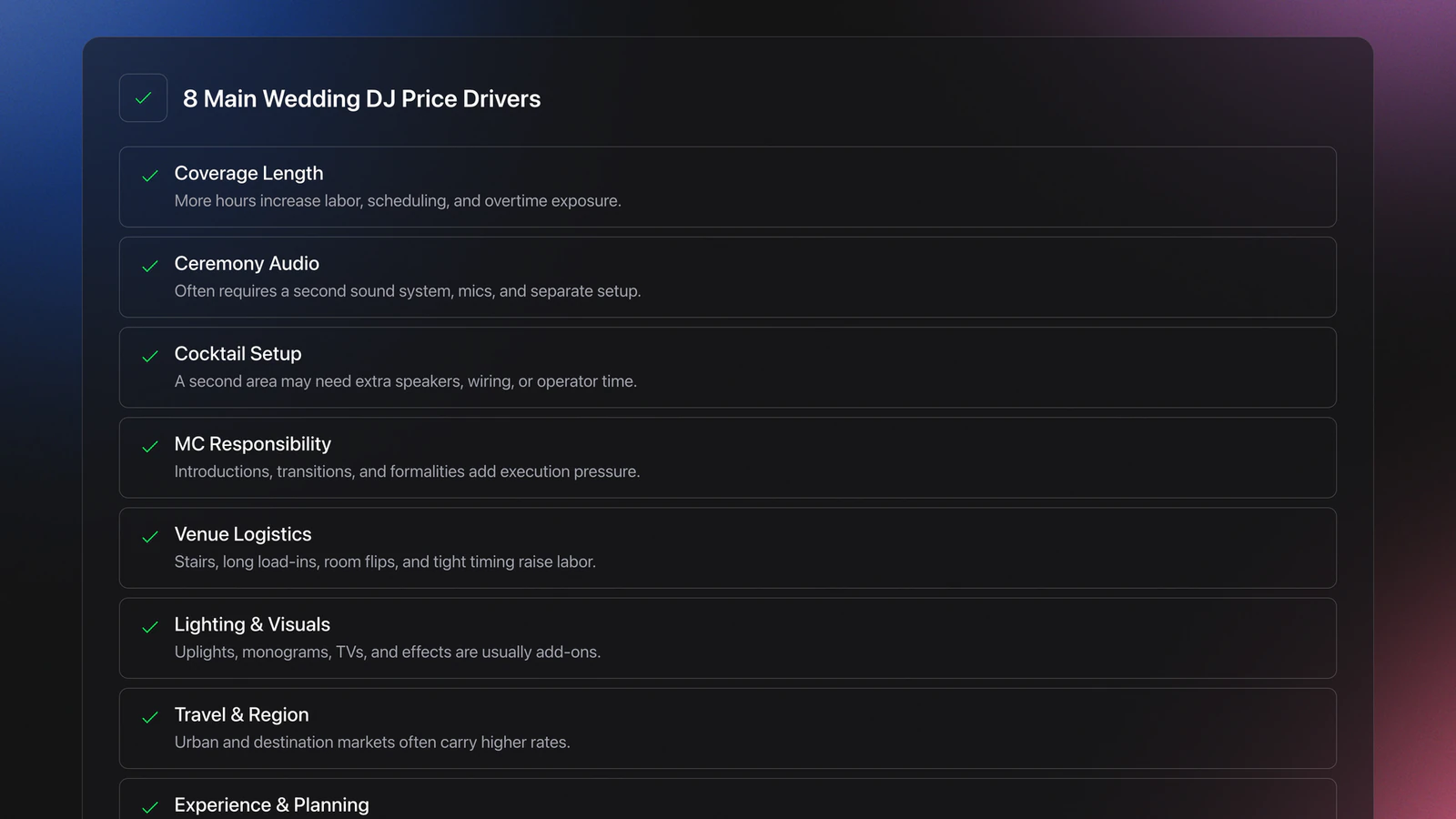
These are the main price drivers.
- Coverage length. Four hours and six hours are not priced the same.
- Ceremony audio. A second sound system often adds cost.
- Cocktail hour in a separate area. That can mean another speaker setup or operator.
- MC responsibility. Introductions, transitions, and formal dances add workload.
- Venue logistics. Stairs, long load-ins, room flips, and tight changeovers increase labor.
- Lighting and visuals. Uplights, monograms, TVs, and effects usually sit outside the base rate.
- Travel and region. Urban and destination markets tend to cost more.
- Experience and planning depth. A DJ who can read a room and run a timeline cleanly charges more for a reason.
The transcript behind this article makes that clear. The DJ is not only mixing. He is handling ceremony and reception in one venue, managing a room transition, introducing the wedding party, switching between English and Spanish, and dealing with a crowd that may or may not dance. That is event execution. Pricing should reflect it.
How Much to Budget for Wedding DJ
If you are the buyer, start with package scope, not with a random average. Ask what parts of the day the DJ is actually covering, what equipment is included, and whether ceremony and cocktail hour need separate systems.
Wedding budgets break when couples compare a bare reception quote to a full-day coordination quote. They look similar on paper, but the service level is completely different.
Use this working budget model.
| Wedding Scope | Typical Price Range | What It Usually Covers |
|---|---|---|
| Reception only | $700 to $1,200 | Music, basic sound, simple announcements, one main setup |
| Reception + MC support | $1,000 to $1,800 | Music, formalities, timeline handling, stronger planning support |
| Ceremony + reception | $1,200 to $2,200 | Separate ceremony audio, wireless mics, reception coverage |
| Full-service with production | $1,800 to $3,500+ | MC, ceremony, cocktail, lighting, custom planning, higher-end gear |
Use scope-first budgeting before comparing quotes.
You can also sanity-check the budget against your overall wedding cost. The Knot reports the average U.S. wedding cost at $34,200 in its 2026 study of couples married in 2025. For many weddings, entertainment lands as a meaningful but controlled line item. If the music and pacing matter to your guest experience, underfunding the DJ often creates more friction than trimming decor.
For a 100-person wedding, which shows up in People Also Ask results around this topic, the guest count alone does not determine the DJ rate. What matters more is room size, schedule complexity, and whether the DJ is expected to coordinate key moments. A 100-person wedding with ceremony audio, bilingual announcements, and a strict timeline can cost more than a 160-person reception-only party.
Hours and Coverage: Real Pricing Math
This is where buyers and DJs both get tripped up. Clients often ask, "How much is a DJ for 1 hour?" In wedding work, that is usually the wrong unit.
A one-hour wedding booking still requires prep, travel, setup, soundcheck, teardown, and date blocking. That is why wedding DJs rarely price like bar or club slots.
In practice, most wedding coverage is sold as a package with a base block of hours, then an overtime rate. WeddingWire vendor pricing PDFs and current package examples commonly show five- or six-hour packages, with additional hours charged separately.
Here is the cleaner way to think about it. A wedding DJ rate has three layers: fixed labor, event-hour labor, and production extras. Fixed labor covers consultations, planning, music prep, admin, loading, setup, and teardown. Event-hour labor covers active performance and MC time. Production extras cover second systems, lighting, visual gear, assistants, and travel.
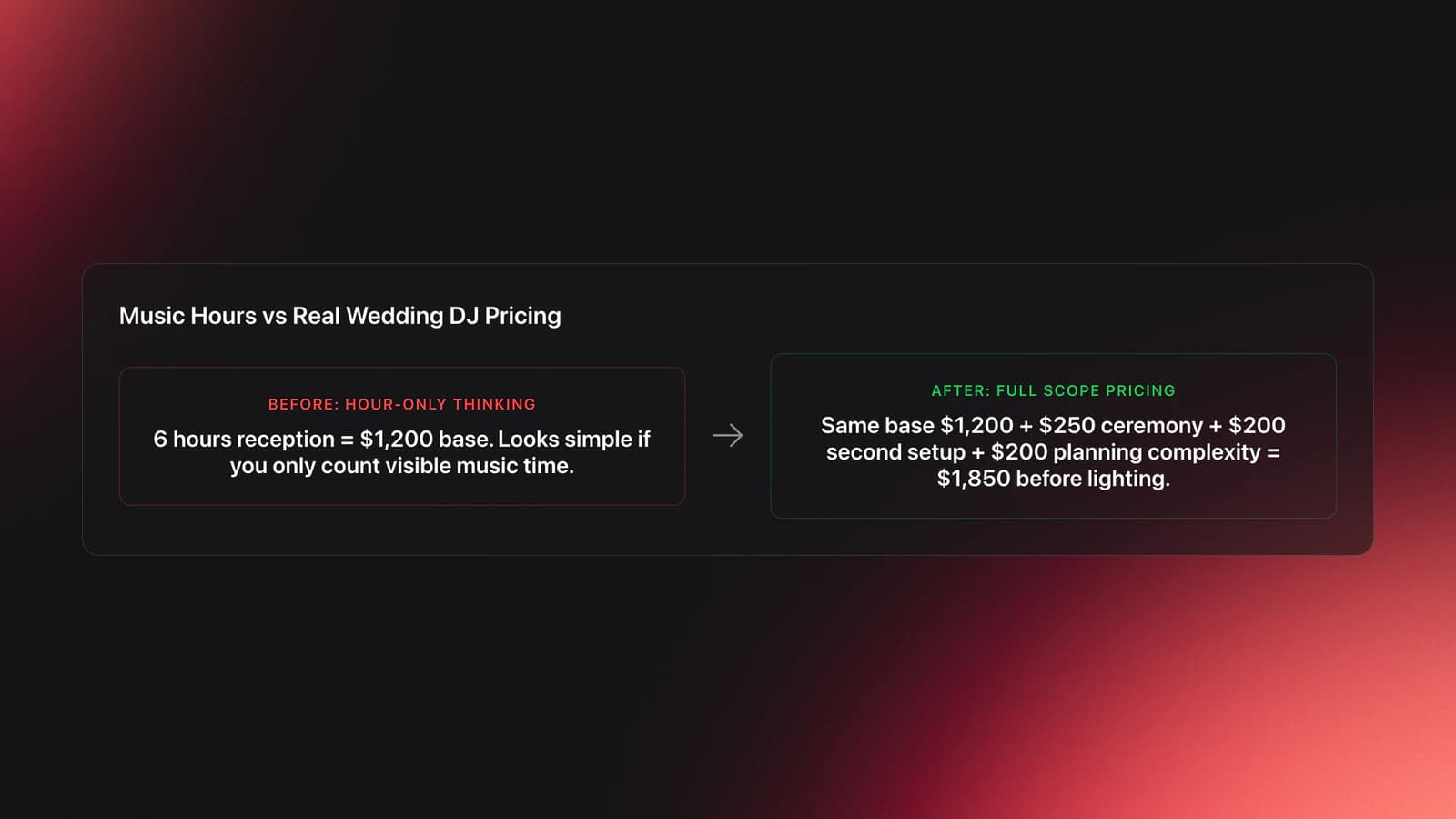
Example one. A couple wants six hours of reception coverage with standard MC work in one ballroom. A DJ might price that at $1,200. If the reception runs one extra hour and the contract says $200 per added hour, the final fee becomes $1,400.
Example two. Another couple wants ceremony audio outdoors, cocktail hour in a side room, six hours of reception, and bilingual MC work. A DJ may start at the same $1,200 base, add $250 for ceremony, $200 for a second setup, and $200 for added planning complexity. Now the quote is $1,850 before lighting.
This means the question is not only how much do dj charge for weddings. The better question is what kind of wedding service the quote is actually buying.
The transcript gives a useful example of hidden labor. The DJ mentions ceremony and reception happening in the same space, a tight room arrangement, TVs, monogram, photo booth, and a one-hour move to the dance floor. None of that is visible if a client only counts "music hours." But it affects price because it affects labor risk.
A common failure mode is the cheap quote that does not include transition pressure. Symptom: the DJ arrives with enough gear for one static reception setup, then struggles when the ceremony needs separate microphones or the room has to flip fast. You will know the quote is realistic when the timeline, room layout, and setup count are all named clearly in writing.
If you are a DJ deciding how much should i charge to dj a wedding, build the rate from your total working day, not just your dance-floor hours. Count planning, travel, setup, breakdown, music prep, insurance, wear on gear, and the opportunity cost of holding a prime Saturday.
Be honest about limitations too. A lower rate can work for a simpler wedding. It usually does not work for a full-service event with multiple spaces, bilingual MC duties, and heavy crowd management. That is not upselling. It is scope control.
Validation Check
MC Work, Bilingual Events, and Coordination
Many couples price a DJ like a playlist operator. Weddings do not work like that. The DJ often acts as host, announcer, traffic controller, and momentum manager.
That matters because MC work has real value. Clean introductions, fast transitions, and confident timing keep the room moving. Bad MC work creates dead air and awkward pauses even if the music is good.
The transcript is a strong example. The DJ is handling formal entrances, first dances, parent dances, cake, and bilingual announcements without sounding repetitive. That is specialized event communication. It takes prep, restraint, and timing.
For multilingual weddings, the price usually goes up when the DJ is truly expected to host in both languages rather than read a few names. The work is not just translation. It is pacing, confidence, and making both sides of the room feel included.
Example one. A DJ charging $1,000 for a straightforward local reception may quote $1,400 for the same date if the event also needs ceremony cueing, family introductions, and bilingual MC flow. The extra fee reflects higher preparation and more ways for the event to go wrong if the DJ misses timing.
Example two. Two DJs each quote six hours. DJ A plans one call and basic announcements. DJ B builds a full timeline, coordinates with the planner, verifies pronunciation, times entrances, and runs every major formal cue. DJ B should cost more because the service is broader.
A practical benchmark for buyers is this: if the DJ is expected to keep the reception coherent, not just loud, you are shopping for coordination skill. Price accordingly.
This is also where referrals matter. In the transcript, the DJ thanks a referrer who sent church and family weddings his way. That is a trust signal. Wedding referrals usually follow reliability more than flashy mixing. Couples remember whether the event ran cleanly.
One useful planning method is to organize your music and formality notes by function before the final call. DJs who manage large local-file libraries often do this manually. In a prep tool like Vibes, for example, you can sort tracks into custom categories for mood, function, or energy, then export that structure into performance software. The point is not the app itself. The point is having ceremony cues, dinner tracks, and dance-floor material separated before the wedding day.
That organization becomes even more important when the crowd is unpredictable. The transcript describes a dry, religious wedding that could have stayed reserved or turned lively depending on music selection and mic handling. In that kind of room, the DJ is managing energy in layers, not chasing a single peak.
Validation Check
Venue Logistics and Add-On Costs
Some weddings are easy to price because the venue makes the day easy. Others quietly add labor at every stage.
The transcript opens with a detail working DJs notice right away: loading and logistics. Good venue access saves time, lowers risk, and keeps setup clean. Tight corners, indoor ceremony flips, stairs, or distant parking push the quote up because they push the workload up.
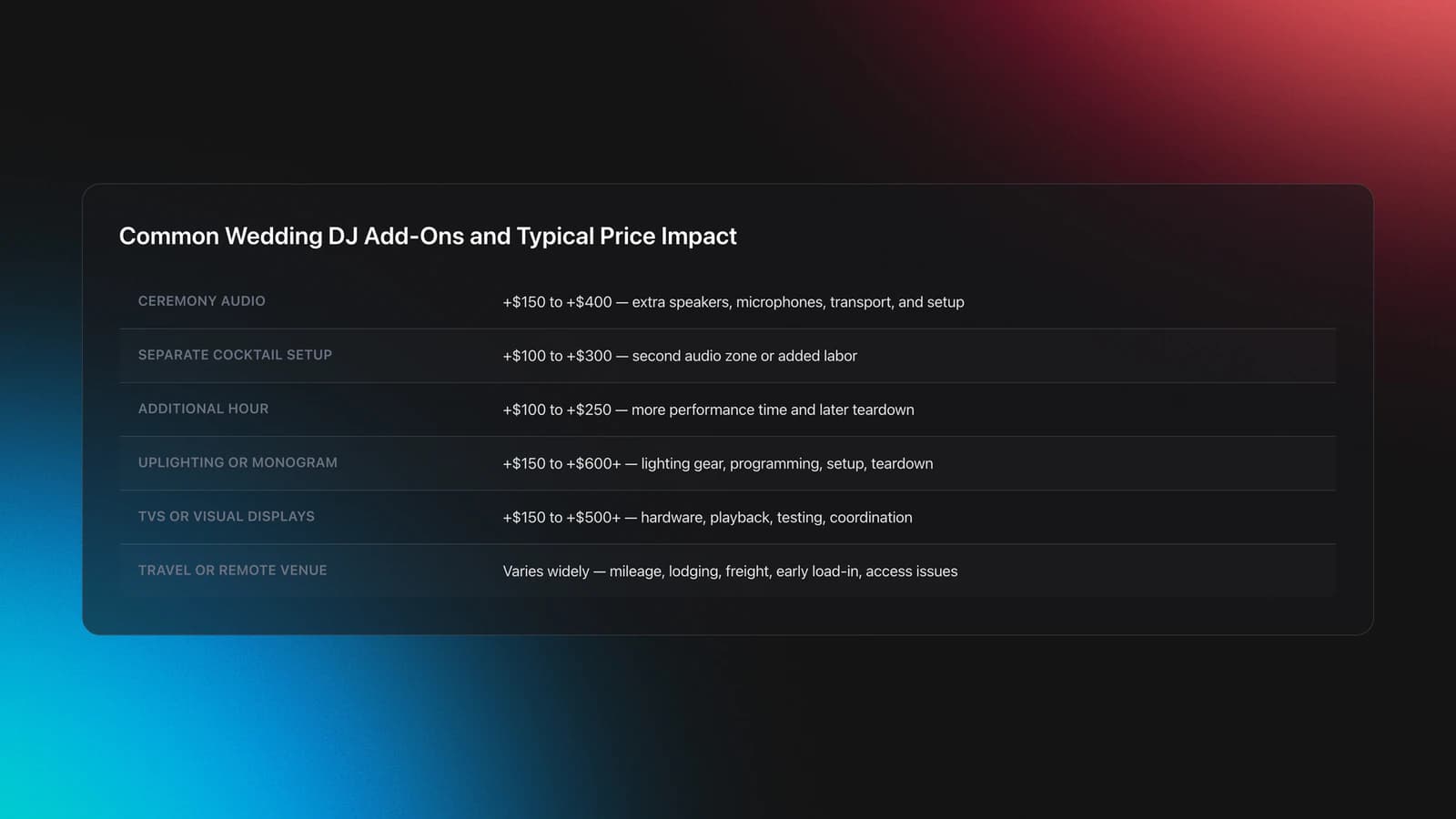
Here are the add-ons that most often move the final number.
| Add-On or Condition | Typical Effect on Price | Why It Adds Cost |
|---|---|---|
| Ceremony audio | +$150 to +$400 | Extra speakers, microphones, transport, and setup time |
| Separate cocktail setup | +$100 to +$300 | Second audio zone or extra labor |
| Additional hour | +$100 to +$250 | More active performance time and later teardown |
| Uplighting or monogram | +$150 to +$600+ | Lighting gear, setup, programming, and teardown |
| TVs or visual displays | +$150 to +$500+ | Extra hardware, playback system, testing, and coordination |
| Travel or remote venue | Varies widely | Mileage, lodging, freight, earlier load-in, or access issues |
Typical wedding DJ add-on patterns in current U.S. pricing.
Current WeddingWire vendor pricing examples show the pattern clearly. One recent pricing guide lists a five-hour reception at $1,140, six hours at $1,240, $150 for each additional hour beyond six, and a second audio setup starting at $250. Another vendor guide shows a five-hour wedding package at $1,500 with ceremony audio at $250 and extra hours at $250. These are not universal rates, but they are useful proof that setup count and logistics drive pricing.
When couples ask how much to hire a dj for a wedding, they usually mean the whole experience. But venues can split that experience into separate technical problems. Ceremony outside. Cocktail hour on a terrace. Reception indoors. If the DJ needs three working zones, expect the quote to move.
A failure mode here is the quote that hides venue friction until the week of the wedding. Symptom: surprise fees for outdoor ceremony sound, extended setup time, or room changes that were obvious from the venue layout. You will know the quote is robust when it names access, room count, power needs, and timeline transitions before the contract is signed.
How Much Should a DJ Charge for a Wedding
If you are the DJ, rate-setting starts with position. Are you selling basic playback, full wedding hosting, or production-led event support? Your price should match that role.
A practical formula is to build from your minimum profitable Saturday, then add scope.
- Set your base floor for a simple reception with one setup.
- Add planning and coordination value if you run formalities.
- Add separate line items for ceremony, extra spaces, travel, and visuals.
- Set a clear overtime rate before the event day.
- Charge more when bilingual MC work or high-stakes coordination is required.
For newer DJs, the trap is pricing off hourly wage logic. Weddings are not hourly labor in the normal sense. You are blocking one of the highest-demand dates in entertainment, carrying gear risk, and being held responsible for moments that cannot be repeated.
At the same time, do not invent premium positioning you cannot deliver. If you are still learning MC flow, room reading, or ceremony timing, price lower and limit scope. Trust grows faster when your offer is narrower but accurate.
Experienced practitioners usually find that musical storytelling matters more than technical showmanship at weddings. The transcript reflects that. The DJ talks about playing classics up front, watching what keeps the women on the floor, and adjusting to the crowd rather than forcing a prebuilt plan. That mindset is worth charging for if you can consistently execute it.
One real-world limitation: not every strong club or underground DJ should sell themselves as a full wedding DJ. Underground sets reward deep selection and long-form flow. Weddings also demand administration, clean language on the mic, family-facing professionalism, and precision around formalities. There is overlap, but they are not the same service.
You will know your pricing is healthy when low-fit clients stop booking you, good-fit clients still do, and each wedding leaves enough margin for prep, backups, and recovery. If every wedding feels like unpaid overtime, the rate is wrong.
How Do You Compare Wedding DJ Quotes?
Compare quotes by scope, not by headline number. A lower quote is not cheaper if you have to bolt on ceremony audio, overtime, and MC help later.
| Scenario | Best Choice | Why | Next Action |
|---|---|---|---|
| You need only reception music in one room | Basic package | Low coordination load and one setup | Confirm speaker coverage, mic access, and overtime rate |
| You need ceremony and reception in different areas | Mid-tier or custom package | Separate systems and timing increase labor | Ask for each setup to be listed separately |
| Your family expects announcements and formal pacing | MC-led package | Hosting skill matters as much as music | Request a sample timeline and formalities checklist |
| You have a bilingual or multicultural wedding | DJ with proven MC communication | Language flow affects guest experience | Ask how entrances, dances, and cues are handled in both languages |
| You want lighting, visuals, or premium effects | Production bundle | Add-ons change the technical footprint | Get each visual service priced as its own line item |
Quick decision guide for comparing wedding DJ proposals.
A strong quote should answer five things without you chasing the vendor: what hours are covered, what spaces are covered, what MC duties are covered, what overtime costs, and what equipment is included. If any of those are fuzzy, the comparison is not ready yet.
Common Mistakes When Pricing a Wedding DJ
| Mistake | Why It Happens | How to Avoid |
|---|---|---|
| Comparing only the total price | Couples assume all packages include the same scope | Match quotes by hours, setups, MC duties, and add-ons first |
| Ignoring ceremony and cocktail logistics | Clients think one DJ setup covers every space | Ask how many sound zones the event needs |
| Asking for an hourly rate only | Wedding work gets confused with party work | Request package details and overtime terms instead |
| Underpricing bilingual or MC-heavy work | The extra prep is invisible until event day | Charge or budget for communication and coordination skill |
| Waiting too long to clarify timeline changes | Formalities get finalized late | Review the run-of-show one to two weeks before the wedding |
Observable pricing mistakes that create avoidable wedding-day stress.
Who Pays for DJ at a Wedding?
Traditionally, different families covered different wedding costs. In practice today, the answer is simpler. Whoever is funding the entertainment line item pays the DJ.
That may be the couple, one set of parents, or a split contribution. The important part is not etiquette. It is decision authority.
If one party is paying but another is choosing the DJ, clarify approval rights early. That avoids the common problem where the couple wants one service level, the payer expects a lower budget, and the DJ gets stuck in the middle.
From the vendor side, the contract should identify who signs, who pays the retainer, when the balance is due, and who has authority to approve changes. Clean admin prevents wedding-week confusion.
Conclusion: Budget for Scope, Not Just Hours
If you remember one thing, make it this. The answer to how much for dj at wedding depends less on raw hours and more on what the DJ is responsible for making happen.
A useful working range for many U.S. weddings is about $1,000 to $1,700, with lower quotes for simpler receptions and higher quotes for ceremony audio, MC-heavy hosting, bilingual flow, or production add-ons. The right budget is the one that matches your schedule, spaces, and expectations.
- Compare quotes by scope, not by total alone.
- Treat MC work and logistics as real value, not free extras.
- Lock down setups, overtime, and add-ons before signing.
If you are still narrowing options, compare this with wedding band vs DJ cost, questions to ask a wedding DJ, wedding reception timeline, and DJ equipment for weddings. Those pages help you turn a price into a decision.
The visual way to organize your DJ library
Tag tracks by vibe. See everything at once. Export to rekordbox, Serato, Traktor or Engine DJ.
14-day free trial. Full access, no strings attached.
or see how it works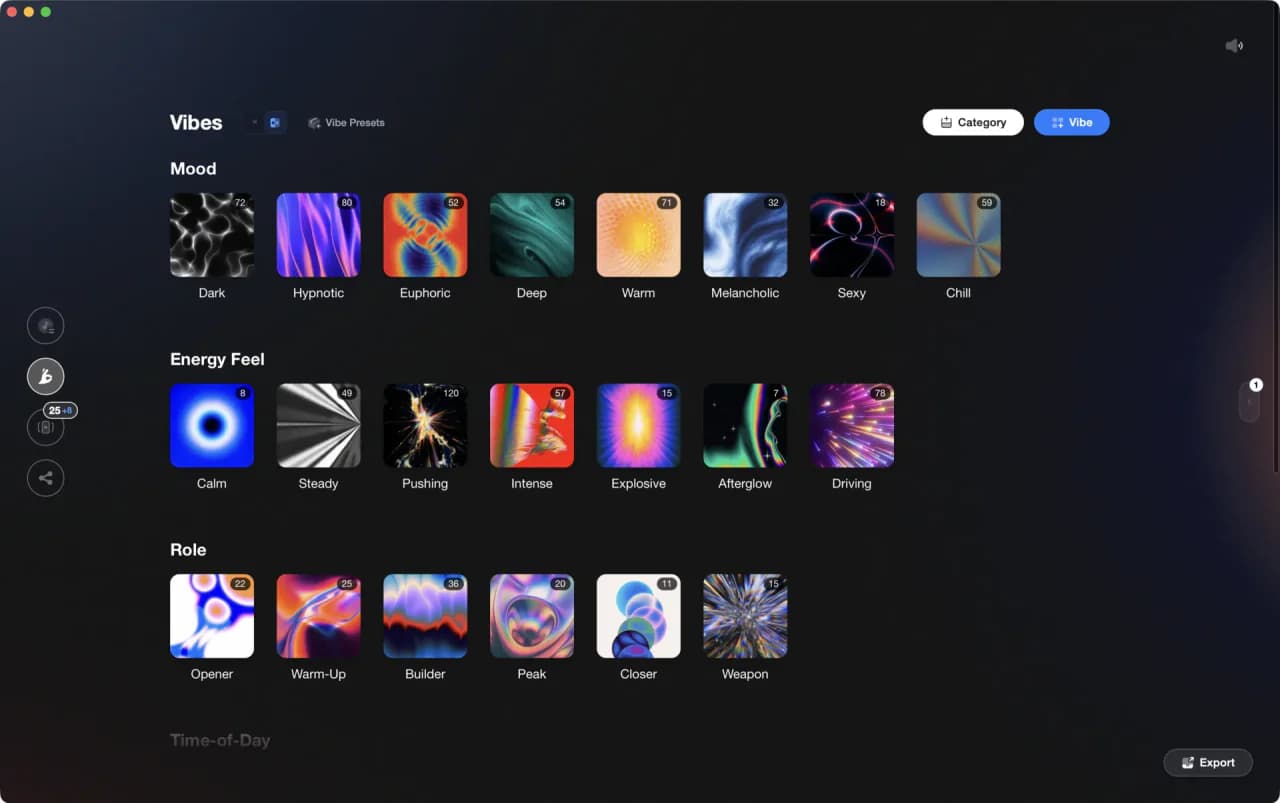
Equipment & Software
Documentation
Continue Your Learning Journey

Frequently Asked Questions

Hey, it's Ben Modigell 👋
I DJ and produce as so I so: downtempo, minimal, dub house, tech house, and techno (releases on Spotify and SoundCloud, links above). Everything I write here comes from my own gigs, studio sessions, and library cleanups: the rules I follow, the failure modes I have actually hit, and the workflow I use when nobody is watching. If a technique did not earn its place in my own sets, it does not make it into a tutorial.