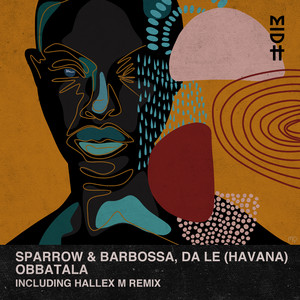
Obbatala
30s preview
- BPM
- 120
- Open Key
- 7d
- Energy
- 81/100
- Pop
- 21/100
- Length
- 6:52
- Released
- 2022
- Genre
- House
- Loudness
- -8.3 dB
- Dynamics
- 11.4 dB
- ISRC
- QMFMF2118542
Key, BPM and audio features: model-based audio analysis · how we measure · catalogue updated July 2026
Other versions
- Obbatala - Hallex M Remixremix2B · 120
Obbatala: club-tempo house, F♯ major (2B), 120 BPM. Tonally it lands dark and driving. Rhythmically it is built for the dancefloor. Its spectrum is weighted to the sub and kick, with a heavy low end. The master keeps unusual dynamic range for club music (crest 11 dB). Slower than 86% of Sparrow & Barbossa's catalogue. In a set it works best as a floor-filler.
- Brightness:
- darker than 76% of Sparrow & Barbossa's catalogue
Sonic profile
Frequency spectrum
amplitude · bass → treble
- 37%
- Low
- 30-130 Hz
- 29%
- Low-mid
- 130-570 Hz
- 21%
- Upper-mid
- 570 Hz-2.5 kHz
- 14%
- High
- 2.5-11 kHz
FAQ
What key is Obbatala in?
Obbatala by Sparrow & Barbossa is in F♯ major, or 2B on the Camelot wheel.
What BPM is Obbatala?
Obbatala runs at 120 BPM, a club-tempo track.
What mixes well with Obbatala?
From 2B it blends harmonically with 3B, 2A, 1B. Moving to 3B lifts the energy a step.
Is Obbatala good for peak time?
With energy 81 out of 100 at 120 BPM, it works best as a floor-filler.
Mixes harmonically
2B → 1B · 3B · 2AFrom 2B, 3B (D♭ major) lifts the energy a step; 2A (E♭ minor) settles into the relative minor; 1B (B major) cools the energy down a step.






How to mix it
In 2B at 120 BPM: 3B (D♭ major) — move to 3B to push the floor harder; 2A (E♭ minor) — switch to 2A for a mood change without losing the groove; 1B (B major) — drop to 1B to bring the room down gently.
Pitch range at ±6%: 113-127 BPM — anything in that window beatmatches without sounding stretched.
Key on the fader: without key lock (Master Tempo on CDJs), above roughly +5% it plays a semitone higher, so treat it as 9B rather than 2B; below -5% it reads as 7B. With key lock on, it stays 2B across the whole range.
Programming: a floor-filler.
Similar tempo
Within ±3 BPM of 120 — beatmatch without a big tempo pull.




More house






More from Sparrow & Barbossa
Full profile




Other recommendations
Beyond strict key and genre matches: tracks that still sit in beatmatch range of 120 BPM with a compatible energy and groove — candidates for a key jump or a genre crossover.





Every insight on this page, for your own library.
Vibes runs this same analysis on the music you own: keys, energy and vibe for every track, organized into sets you can actually play.