Seamless Blend
A length-and-structure decision technique, choose between long fade, bass-swap blend, or quick cut so transition length matches the arrangement.
Seamless Blend Tutorials
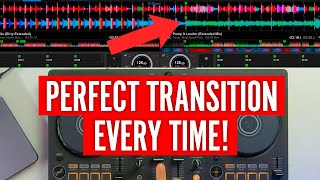

A seamless [blend](/glossary/blend) is a DJ transition where one track slips into the next without a jolt in timing, energy, or tone. If your mixes feel abrupt, muddy, or obvious, seamless blend practice fixes that by combining phrasing, beatmatching, and EQ control into one musical move.
For most DJs, seamless blend is the difference between playing songs and shaping a set. It helps you hold momentum, make long transitions sound intentional, and keep dancers focused on the flow instead of the handoff.
In practice, a seamless blend is not one secret trick. It is the result of aligned phrases, matched tempo, controlled low-end, and a transition length that suits the genre. Educational breakdowns like the Native Instruments phrase mixing guide and the Native Instruments DJ transitions tutorial both frame smooth transitions around song structure, beat alignment, and appropriate fade or cut choices.
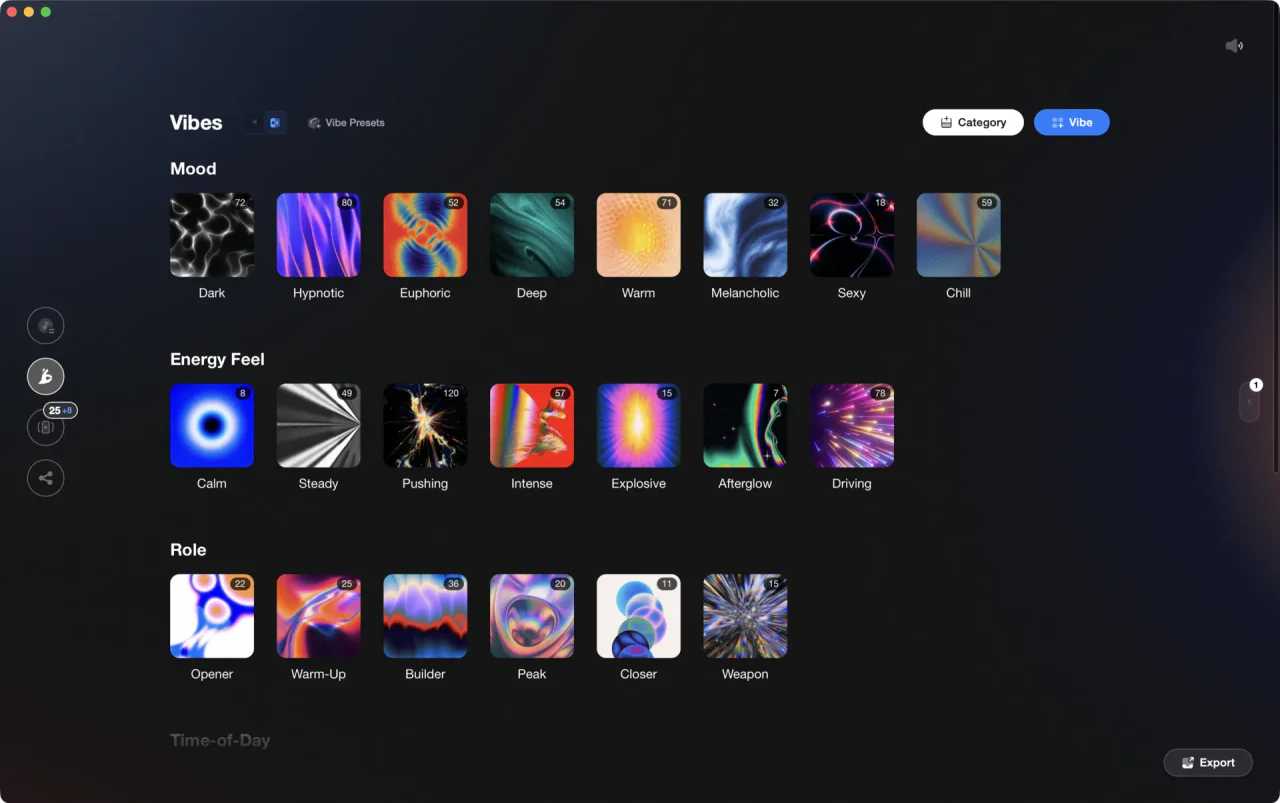
The visual way to organize your DJ library. Tag by vibe, export to any DJ app.
What Is Seamless Blend?
Seamless blend is a phrase-aware DJ mixing technique that overlaps two tracks so the transition sounds natural, steady, and musically logical. The goal is not to hide every change. The goal is to make the change feel inevitable.
Most seamless blend transitions happen in genres that reward continuity, especially house and techno. Native Instruments describes phrase mixing as using track structure to create a smooth, professional mix, while Digital DJ Tips emphasizes that knowing where to transition depends on understanding song structure and choosing safe mix-out points.
That means the technique name is broader than a single mixer move. A seamless blend usually combines build solid beat matching control, phrasing, and some form of EQ shaping. If those foundations are weak, the transition sounds forced.
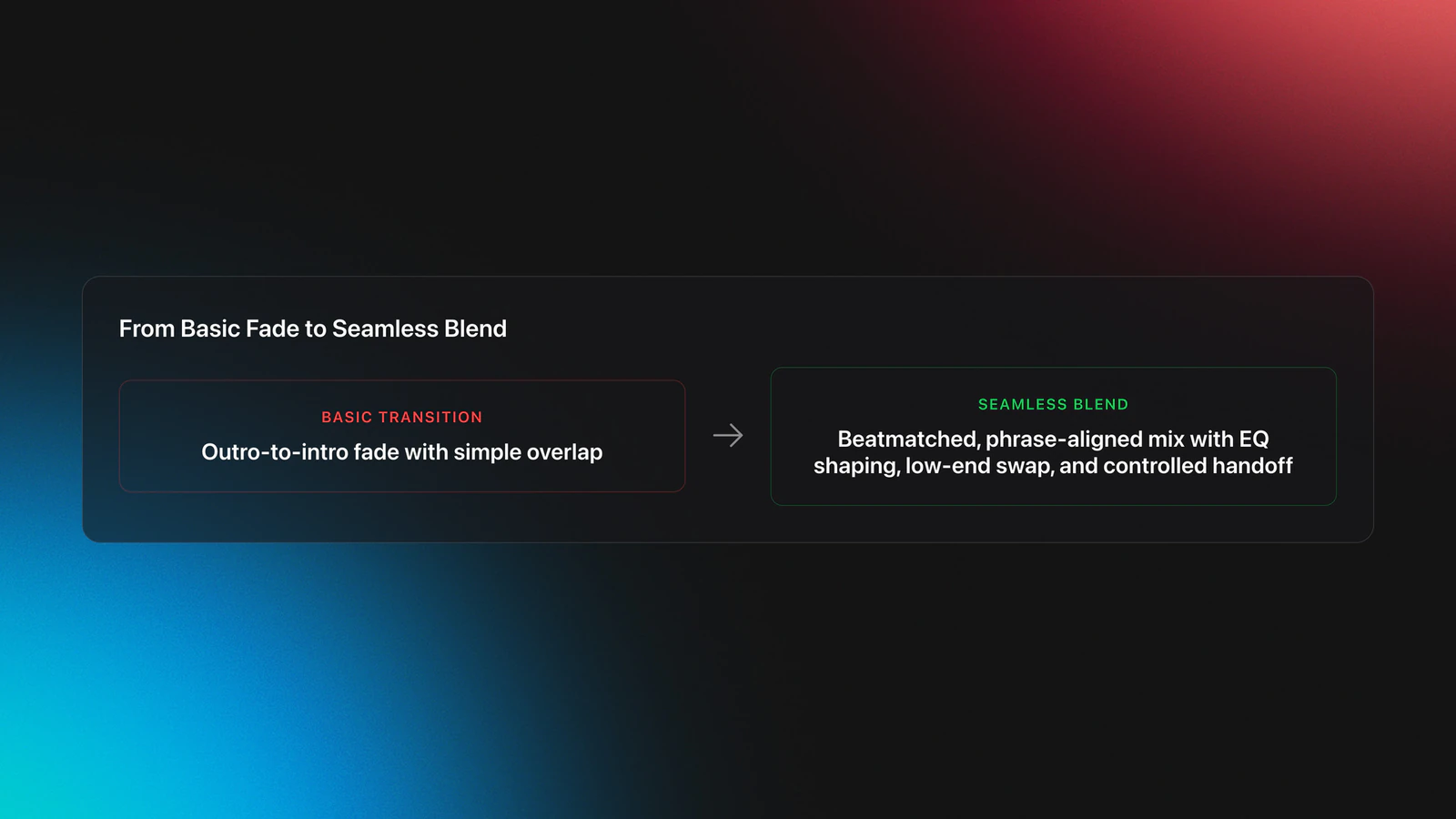
The simplest version is a fade from the outro of one track into the intro of the next. A more polished version adds a low-end swap, slight gain control, and careful phrase timing so the incoming record takes over without a clash.
Why Seamless Blend Matters
Seamless blend matters because it protects the groove. When transitions feel smooth, the audience hears one continuous story instead of two separate records fighting for space.
- It keeps energy stable across 16 or 32 bar changes.
- It reduces harsh bass clashes and crowded mids.
- It makes long-form house and techno sets feel intentional.
- It gives you more control over pacing and tension.
- It creates cleaner recordings for mixes and promos.
This is also why track choice matters. Native Instruments recommends selecting songs with similar BPM and harmonic compatibility for smoother blends, and their transition guide notes that house and techno DJs often prefer smooth transitions over quick cuts.
Seamless Blend Fundamentals
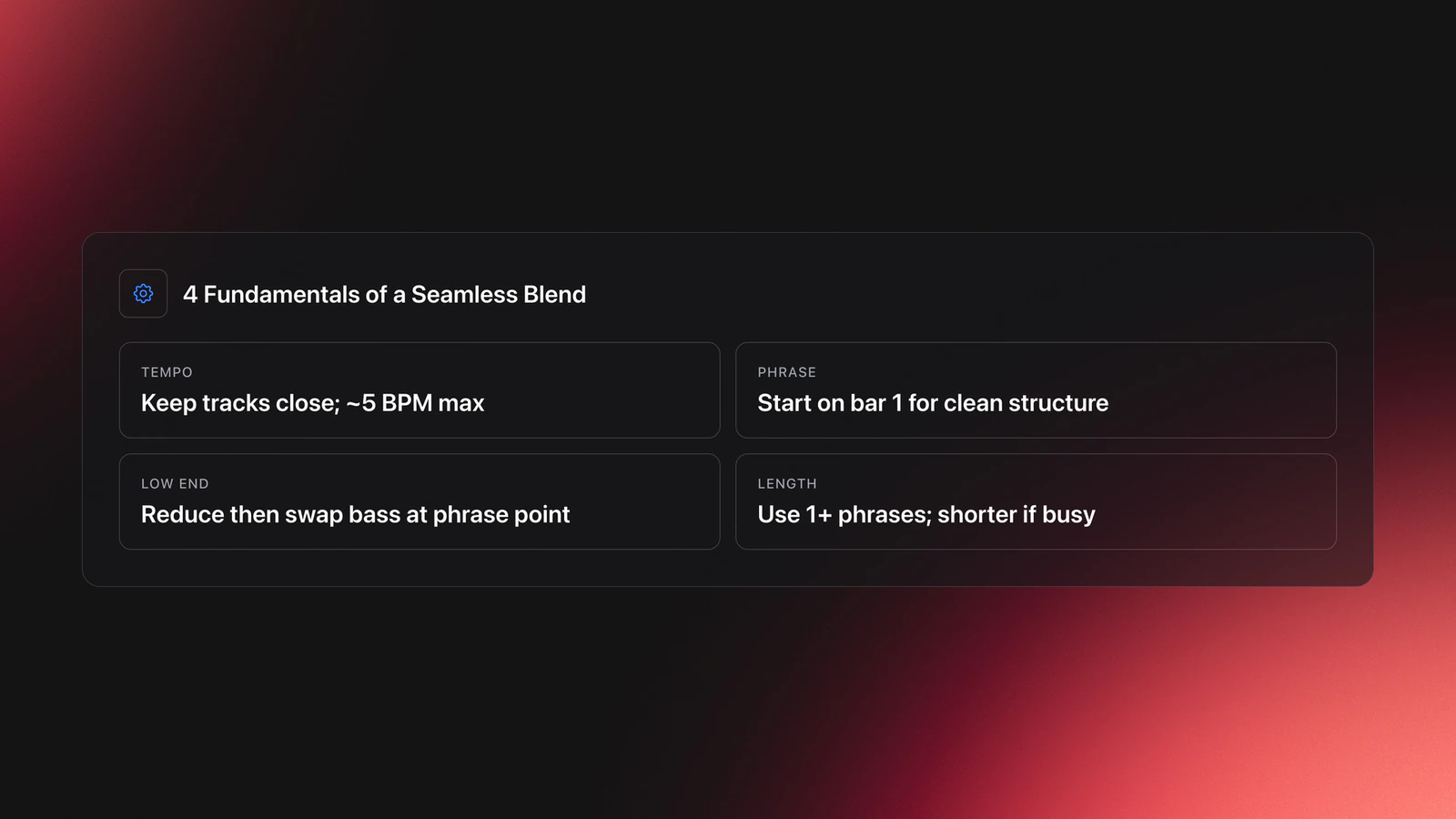
A seamless blend works when four things line up: tempo, phrase, frequency balance, and transition length. If one of those breaks, the mix becomes obvious in the wrong way.
First, match tempo closely. Native Instruments suggests using tracks within about five BPM for beatmatched transitions. Closer is usually better for beginners because you can focus on timing and EQ instead of constant pitch correction.
Second, align phrases. Start the incoming track on the first beat of a bar so its structure lands logically against the outgoing song. If you are not confident here, learn phrase mixing for cleaner entries before trying longer blends.
Third, manage low frequencies. Digital DJ Tips' bassline swap lesson explains why many DJs bring in the incoming track with bass reduced, then swap low EQ at the right moment. This prevents two kick drums and basslines from piling up for too long.
Fourth, choose a sensible length. A seamless blend can be one phrase or several, but longer is not automatically better. If the tracks are busy, a shorter transition often sounds cleaner.
How to Do a Seamless Blend
To do a seamless blend, prepare two compatible tracks, line up their phrases, start the new track on a downbeat, and hand over the low-end at the right musical moment. The move should feel controlled, not rushed.
| Step | Action | Key Point |
|---|---|---|
| 1 | Choose two tracks with close BPM and compatible mood | Simple pairs make practice easier |
| 2 | Find a clean mix-out phrase in Track A | Outro or stripped section works best |
| 3 | Cue Track B at the start of a phrase | Start on beat one of a bar |
| 4 | Beatmatch in headphones | Fix drift before raising volume |
| 5 | Bring Track B in with reduced bass | Avoid low-end conflict early |
| 6 | Swap lows at a phrase boundary | Hand power to the new track cleanly |
| 7 | Remove Track A gradually | Use EQ, fader, or filter with restraint |
Start with tracks that already want to mix. Similar groove patterns, stable drums, and uncluttered intros make the technique much easier. Later, you can explore harmonic mixing for smoother tone and more adventurous pairings.
In your headphones, beatmatch first. Do not try to fix tempo after both tracks are loud in the master unless the drift is tiny. Clean blends start before the audience hears the second deck.
Then think in phrases, not seconds. Native Instruments recommends marking phrase starts with cue points, then triggering the new track when the playing track reaches a logical transition-out point such as an outro, chorus ending, or drop exit.
Bring the incoming track up slowly. Keep its bass low or fully cut at first. This is where use EQ mixing to manage low-end swaps becomes essential, because the lows usually decide whether a transition feels polished or muddy.
At the next phrase boundary, swap the bass. Turn the incoming low EQ back toward neutral while reducing the outgoing low EQ. If the timing is right, the room feels the handoff before it fully notices it.
Finish by fading or filtering the old track out. Native Instruments notes that fade transitions often suit house-style intros and outros, while cuts work better when the musical structure calls for a faster change.
Track Selection for Seamless Blend
Track selection makes seamless blend easier than any mixer trick. Good pairs share tempo range, energy level, phrase clarity, and enough tonal space to overlap without chaos.
For beginners, use tracks with DJ-friendly intros and outros. Digital DJ Tips notes that understanding song structure is the key to knowing where to transition, and electronic dance records are often easier to mix because their structures are already DJ-oriented.
Look for one track that is exiting cleanly and another that enters cleanly. If both tracks have full vocals, heavy bass movement, and dense percussion at the same time, the blend becomes harder.
This is one place where organized practice helps. Building a small practice crate in Vibes with pairs by BPM, key, and energy lets you repeat the same transition families until your timing becomes automatic instead of guesswork.
Practice Drills for Seamless Blend
The fastest way to improve seamless blend is short, repeatable drills. Through daily 15-minute practice sessions over several years, I found that focused transition loops improved timing faster than full-length freestyle sessions.
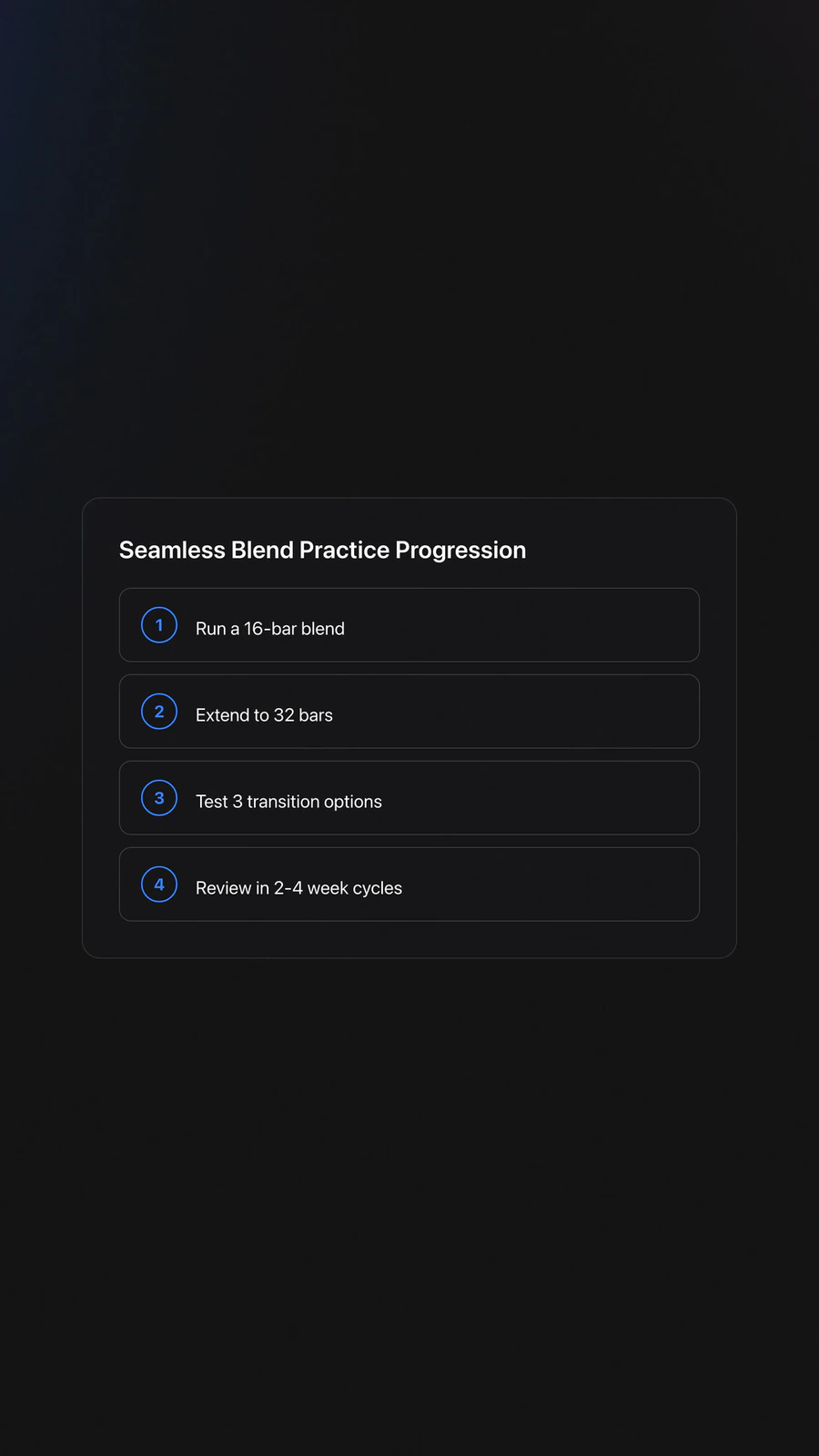
Start with one 16-bar blend. Launch Track B 16 bars before the mix-out point, raise volume gradually, then execute the low swap at the next 8 or 16 bar boundary. Repeat until the handoff feels predictable.
Next, try a 32-bar blend. This drill exposes weak beatmatching fast. If the tracks drift before the swap point, shorten the blend and tighten your cueing.
Then practice decision-making. Use the same two songs three ways: fade blend, bass swap blend, and quick cut. This teaches that seamless blend is not always the longest option. It is the option that fits the arrangement.
Track your progress in 2 to 4 week cycles. Most practitioners improve faster with frequent short sessions than with rare marathon practice, especially when the goal is repeatable phrase and EQ timing.
Common Mistakes in Seamless Blend
Most seamless blend problems come from forcing overlap where the music does not support it. The fix is usually simpler than people think: better phrasing, less low-end overlap, or a shorter transition.
| Mistake | Why It Happens | Solution |
|---|---|---|
| Tracks drift during the blend | Beatmatch was not stable before entry | Cue longer in headphones and shorten the overlap |
| Mix sounds muddy | Both basslines play together too long | Cut or reduce incoming lows until the swap point |
| Transition feels late | Incoming track started mid-phrase | Launch on beat one of a new bar |
| Blend loses energy | Wrong section chosen for mix-out | Use an outro, breakdown exit, or cleaner phrase |
Why do most beginners struggle with this technique? They hear a smooth transition and assume the trick is fader movement. In reality, the structure choice often matters more than the hardware move.
Another common error is overusing filters or effects. DJ TechTools notes that effects can help transitions, but they work best as subtle tools paired with smart volume management, not as a substitute for phrasing.
Troubleshooting a Rough Blend
If a seamless blend sounds rough, identify which layer failed first: timing, phrase, tone, or gain. Fix one variable at a time so you can hear what changed.
If the kicks flam or the groove wobbles, your beatmatch is off. Go back to headphone cueing and practice shorter overlaps until you can hold alignment for 16 bars without correction.
If the blend feels musical at first but collapses when the second bassline enters, the low swap happened too early or too late. Move the swap to the next phrase boundary and compare the result.
If both tracks sound technically aligned but emotionally wrong, the pair is probably the issue. Try a different energy match, or choose a cleaner outgoing section.
If your recordings sound louder and harsher during the overlap, check gain staging. Watch the mixer meters and avoid pushing the master into the red when both tracks are active.
Equipment and Safety
You do not need expensive gear to learn seamless blend. You need reliable cueing, accurate pitch control, clear EQ knobs, and tracks that are easy to analyze.
Headphones matter because cueing is where the transition begins. A nearby booth monitor also helps, but only if it improves timing instead of pushing you to raise headphone volume too high.
For hearing safety, the CDC NIOSH noise and hearing loss guidance advises precautions when noise reaches 85 dBA or higher. That includes reducing time in loud areas, keeping personal listening volume low, taking breaks, and using hearing protection correctly when needed.
Key Takeaways
Seamless blend is really the art of making timing, structure, and EQ work together. When those three parts line up, your transition stops sounding like a handoff and starts sounding like a continuation.
Focus on a small repeatable process first. Choose easier track pairs, align phrases, keep the incoming bass controlled, and only lengthen the blend once you can hold it cleanly.
- Phrase alignment matters more than flashy mixer moves.
- Low-end control is usually the difference between clean and muddy.
- Short daily drills beat occasional long practice sessions.
Start by practicing one 16-bar transition until it feels stable. Then expand into longer blends, more difficult track pairings, and related skills like build solid beat matching control or use EQ mixing to manage low-end swaps.
The visual way to organize your DJ library
Tag tracks by vibe. See everything at once. Export to any DJ software.
A visual system for organizing your DJ library.
Frequently Asked Questions

Hey, it's Ben Modigell 👋
I DJ and produce as so I so — downtempo, minimal, dub house, tech house, and techno (releases on Spotify and SoundCloud, links above). Everything I write here comes from my own gigs, studio sessions, and library cleanups: the rules I follow, the failure modes I've actually hit, and the workflow I use when nobody's watching. If a technique didn't earn its place in my own sets, it doesn't make it into a tutorial.