
House Music YouTube Guide
Watch EZRATO’s tutorial above (78K views on YouTube).
This guide is for listeners, DJs, and producers using house music YouTube searches to figure out what they are actually hearing. If you keep finding mixes and clips labeled "house" but cannot tell deep house from tech house or future house, this will fix that. After reading, you will be able to sort the main mainstream house styles, hear the structural differences, and use better search terms to find the right tracks faster.
The main problem with house music YouTube results is not lack of music. It is messy labeling. Many uploads use broad tags, recycled thumbnails, and vague titles, so you need listening cues, not just genre names.
Use this as a field guide. Start with the groove, then the bass behavior, then the density of the arrangement, then whether the track builds to a climax or loops hypnotically.
If you want a wider genre map after this, it helps to pair this article with a broader electronic music genres overview, a practical DJ track selection workflow, and a focused how to organize DJ music.
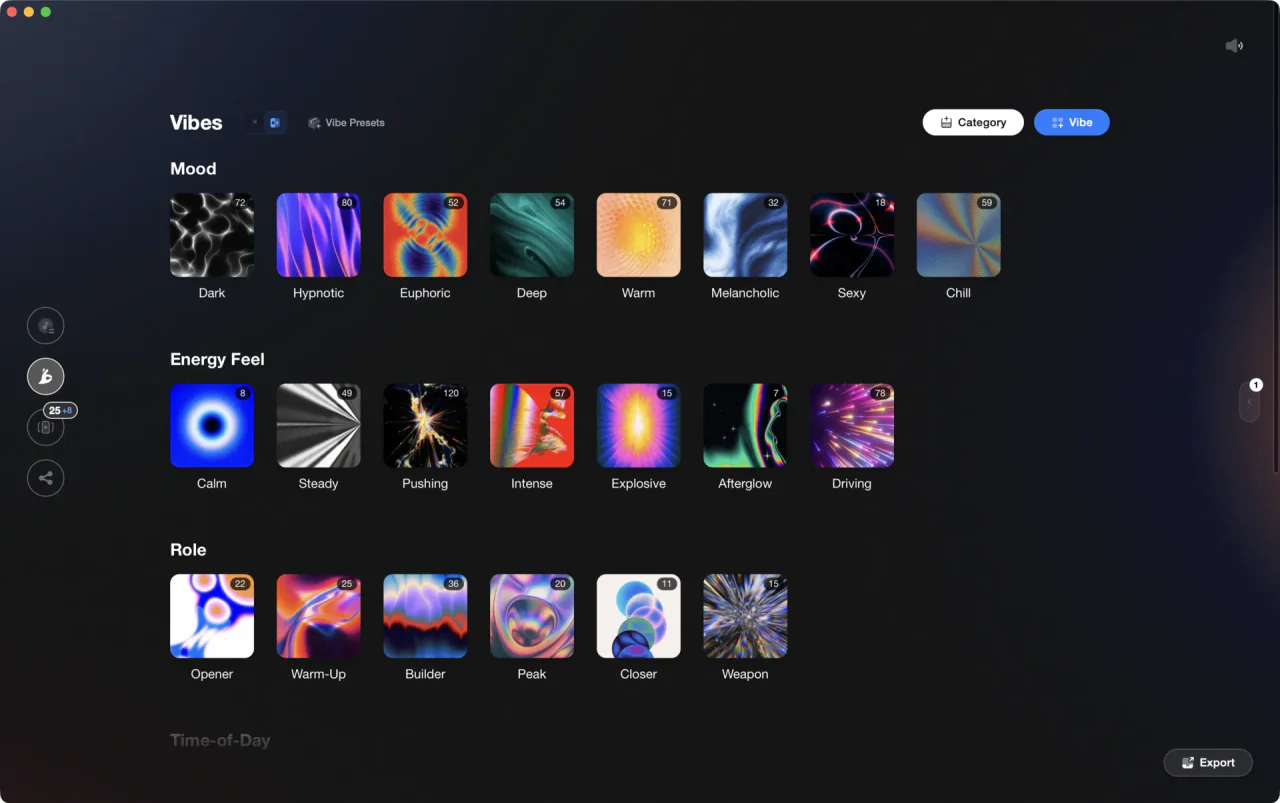
The visual way to organize your DJ library. Tag by vibe, export to any DJ app.
House Music YouTube: Start With Core Signals
Before you compare subgenres, anchor yourself in the base pattern. House music is rhythm-driven dance music built on a four-on-the-floor pulse. That means the kick lands on every beat, and the rest of the groove forms around it.
That simple rule solves a lot of confusion. If the groove does not feel locked to that steady pulse, you may be hearing another EDM branch rather than house.
A useful mental model is what I call the groove-first test. Ask four things in order: What is the kick doing? What occupies the low end? How crowded is the midrange? Does the track climb toward a peak or circle around a loop?
This matters because house subgenres often share instruments. A piano, pluck, saw lead, or vocal chop does not define the genre by itself. The arrangement behavior does.
Example one. A track has a steady kick, muted low-end bass, airy pads, and restrained top-end detail. That points toward deep house, even if the lead is simple.
Example two. A track has the same kick pattern, but the bass is brighter, the layers are denser, and the drop feels heavy and buzzing. That moves you toward electro house.
The common failure mode is over-weighting one surface detail. A tropical-sounding pluck does not automatically make a track tropical house. You still need to hear the broader balance, mood, and drum treatment.
Validation Check
Classic House on House Music YouTube
Classic house is the cleanest reference point because it stays closest to the genre's original form. On house music YouTube, it often appears in uploads focused on piano riffs, disco feel, retro drum aesthetics, and groove-led arrangements.
The sound tends to carry clear links to disco and late-80s electronic production. You will often hear piano stabs, string-like layers, simple bass movement, and drum choices inspired by older machine-based rhythms.
Do not get stuck on vintage purity. Modern classic house can sound polished and current while still borrowing the same musical language. The key is not old gear. It is the feel.
A strong clue is the piano. The famous house piano sound is tied closely to the Korg M1, whose presets became central to piano house vocabulary and remained influential long after the original hardware era. Korg's official M1 product history is useful background if you want the source of that sound family.
Worked example one. You hear a bright, stabby piano hook over a steady kick, open hi-hats, and a bassline that feels more groovy than aggressive. The track wants movement, not impact. That is classic house territory.
Worked example two. Another upload has a disco-style bass, vocal snippets, and strings that push lift without sounding huge or festival-sized. Again, that leans classic house, even if the mix is modern.
The failure mode here is confusing any piano-led dance track with classic house. If the drop is oversized, the supersaws dominate, or the structure aims for a giant festival payoff, it is probably sitting closer to progressive or a crossover pop-EDM form.
If you are collecting references, keep separate playlists for classic house, piano house, and disco-influenced house. In a DJ workflow, that separation matters. Some people do this manually. Others use a structured tool like Vibes to sort local tracks into custom categories such as mood or function, then export that hierarchy to DJ software. Either approach helps you avoid lumping every warm piano record into one vague bucket.
You will know you are hearing classic house when the groove feels foundational, the arrangement stays danceable without brute-force intensity, and disco-era musical instincts still shine through the production.
Deep House and Tropical House: Low-End vs Sunlit Detail
Deep house and tropical house get confused constantly on house music YouTube because both can sound smooth, melodic, and accessible. The split becomes clearer when you focus on frequency balance and emotional tone.
Deep house lives lower. The bass and lower-mid content do more of the emotional work. Higher-frequency elements are usually there to frame the groove, not dominate it.
That gives deep house a muted, classy, and sometimes brooding feel. Pads, space, and restraint matter as much as the hook.
Tropical house, by contrast, spreads the energy more evenly across the spectrum. It keeps the house pulse, but the sonic identity comes from light plucks, marimba-like tones, airy percussion, lush reverb, and a more summery emotional palette.
Here is the practical shortcut. If the low end feels like the center of gravity, start with deep house. If the melodic top layers carry the personality and the track feels beach-lit rather than late-night, start with tropical house.
Worked example one. A track opens with soft pads, a muted bassline, and carefully placed drums. Nothing jumps out in the highs. The mix breathes. That is a deep house profile.
Worked example two. Another track uses bright plucks, delicate vocals, reverb-heavy percussion, and a gentler emotional lift. Even if the tempo is relaxed, those cues push it toward tropical house.
The underlying mechanics are simple. Lower-frequency emphasis makes a track feel grounded and inward. More upper-mid melodic detail makes it feel open and immediate. That is why these two genres can share DNA yet produce very different emotional results.
A common mistake is assuming tropical house must always be slow and passive. In practice, many pop-facing tracks borrow tropical plucks and percussion while keeping the arrangement upbeat enough for mainstream energy.
Another mistake is treating deep house as only bass-heavy. It is not just more bass. It is bass plus restraint, space, and a particular kind of muted elegance.
When you are comparing uploads, search in clusters. Try terms like "deep house music mix," "deep house music songs," and "best house music YouTube" separately instead of expecting one search to return cleanly segmented results.
This is also where library friction shows up for DJs. You may know a track feels warm, low-slung, and vocal-friendly, but if your folders only say "House," retrieval gets slow. Building category layers such as mood, energy, or function, whether in folders or in Vibes, gives you a better way to separate deep house from brighter tropical-leaning cuts before a set.
You will know you can tell these apart when you can explain not just which genre a track resembles, but why. Name the bass role, the top-end role, and the mood in one sentence.
Progressive House: Structure Is the Clue
Progressive house is harder to identify because the label has shifted over time. On YouTube, the same term can point to older, darker builds or brighter festival-era tracks.
The reliable clue is structure. Progressive house usually builds in layers toward a climax, then thins out, resets, or cycles through another growth phase.
That progressive movement is more important than any one synth patch. You are listening for staged expansion.
Worked example one. A track starts with a minimal drum groove, adds a bass riff, then slowly introduces plucks, pads, more percussion, and brighter lead elements. By the time the peak arrives, the track feels earned. That is progressive behavior.
Worked example two. Another track keeps the four-on-the-floor core but uses euphoric melodic leads and trance-leaning harmony to build toward a festival-scale release. That is a more modern progressive house variant.
The failure mode is confusing all melodic house with progressive house. Melody alone is not enough. If the arrangement does not progressively layer and resolve, the label may be wrong.
This is where history helps a little. Older progressive house often carried a darker, more electro-influenced texture, while later mainstream forms pushed brighter leads and larger emotional payoffs. Both can still show up in current playlists and uploads.
If you use house music YouTube for research, compare old-school progressive uploads against modern festival-facing ones in the same session. The shared structural logic becomes much easier to hear.
You will know you understand progressive house when you can predict the track's next move from its layering pattern, not just its sound design.
Electro House, Tech House, and Future House
These three subgenres often collide in recommendation feeds because all can sound modern, club-ready, and more aggressive than classic house. The clean way to separate them is to ask what drives the track: weight, percussion, or bass character.
Electro house is driven by weight. It tends to run at higher tempos and uses thicker, brighter, often distorted bass and synth layers. The texture is crowded on purpose.
The result is pressure. Even sparse electro house tracks usually rely on sounds that feel fat and forceful on their own.
Worked example one. You hear a buzzing bass, dense lead stack, and a drop that feels engineered for impact rather than subtle movement. That is electro house behavior.
Tech house is driven by percussion. It usually gives you less melody and more drum detail, groove repetition, and rugged texture. It often avoids the obvious big-drop format.
Worked example two. A track loops through drum-led sections with small shifts in texture, maybe a metallic or industrial edge, but never really explodes into a massive chorus. That points toward tech house.
Future house sits in a more ambiguous spot. It grew from deep house roots, but many tracks evolved brighter, harder, and more synthetic over time. What often gives future house away is the bass design. It feels more metallic, more dissonant, and more deliberately shaped than classic deep house bass.
In other words, future house often sounds like deep house pushed through a more stylized modern lens. The bass attack and synthetic sheen carry a lot of the identity.
The failure mode here is calling any modern bass-forward house record future house. You still need that specific industrial or modulated character, plus a design language that separates it from straight electro aggression or pure deep house restraint.
If you are a DJ researching these styles for gigs, gear specs matter less than many beginners think. For underground sets, the practical tradeoff is usually standalone convenience versus laptop dependence, plus whether the screen is readable in dim booths. Those are workflow constraints, not genre definitions, and they matter more in the venue than headline marketing specs.
You will know you can sort these three when you can say one sentence for each: electro house hits with mass, tech house moves with drums, future house flexes through stylized bass design.
Play House Music Better on YouTube
If your goal is to play house music rather than just identify it, you need a search-and-compare process. House music YouTube works best when you use it like a crate-digging tool, not a random autoplay machine.
- Pick one subgenre at a time and search exact phrases, not just "house music."
- Save five reference tracks that clearly represent that style.
- Write one line on each: groove, bass role, texture, structure.
- Then compare crossover tracks that blur the boundaries.
- Finally, build playlists by listening purpose, not only genre name.
That last point matters. Some uploads are useful because they are pure examples. Others are useful because they show overlap. Both belong in your research.
A self-taught path often works well here. One common experience among DJs is starting with whatever setup is available, downloading tracks, and simply playing to see what works. That intuitive exploration matters. Over time, your ear learns pattern recognition faster than any rigid taxonomy chart.
Still, intuition improves faster when your references stay organized. If you are moving from listening to set prep, keep a shortlist of tracks that define each lane, then separate them by mood, energy, and function. That prevents your "you tube house music" research from turning into one giant undifferentiated pile.
For progression, it helps to pair this with a DJ set planning guide and a more advanced how to build playlists for DJ sets.
House Music YouTube Mistakes to Avoid
| Mistake | Why It Happens | How to Avoid |
|---|---|---|
| Trusting the upload title | Uploaders often use broad or trendy labels for reach | Classify by groove, bass, texture, and structure first |
| Judging from one instrument | Piano, plucks, or pads appear across multiple subgenres | Use full-arrangement behavior, not one sound |
| Mixing research and casual listening | Autoplay pushes mood, not clean genre boundaries | Create separate reference playlists for focused comparison |
| Treating genres as fixed boxes | House styles evolve and borrow from one another | Look for dominant traits and shared ground |
| Ignoring track function | A great listening track may behave poorly in a set | Tag tracks by energy curve and transition role |
Common classification mistakes when using house music YouTube
Practice Routine for House Music YouTube
Use a short two-week routine. It is enough to sharpen your ear without turning this into homework.
- Days 1-4: Listen to 10 tracks per day from one subgenre and write four cues for each.
- Days 5-9: Compare two neighboring subgenres each day, such as deep vs tropical or electro vs future.
- Days 10-14: Build one playlist of clear examples and one playlist of crossover examples, then test yourself without looking at titles.
You will know you are improving when your notes get shorter and more accurate. That means your ear is spotting structural cues faster.
How Do You Find the Best House Music YouTube Results?
The best house music YouTube results come from narrowing the search before you hit play. Search by subgenre, mood, and format. For example, search for tracks, mixes, playlists, or top songs separately rather than expecting one broad query to do all the work.
Then validate what you find by listening for genre cues. A video titled "deep house music top 10" may include crossover records, while a smaller upload with a less polished title may be the cleaner reference. Search precision gets you close. Ear training finishes the job.
Conclusion: Use House Music YouTube With Intent
House music YouTube is useful when you stop treating genre labels as truth and start treating them as clues. The real work is hearing how the groove behaves, how the low end is used, how dense the arrangement becomes, and whether the track builds, drops, or loops.
Keep these three takeaways in mind:
- Start with the kick and bass before anything else.
- Use structure to separate similar-sounding subgenres.
- Organize reference tracks by function, not just label.
Do that, and house music YouTube turns from a messy feed into a usable research tool. Your next step is simple. Pick one subgenre, build a small reference playlist, and test your ear against it.
The visual way to organize your DJ library
Tag tracks by vibe. See everything at once. Export to any DJ software.
A visual system for organizing your DJ library.
Techniques Covered

Equipment & Software
Documentation
Frequently Asked Questions

Hey, it's Ben Modigell 👋
I DJ and produce as so I so — downtempo, minimal, dub house, tech house, and techno (releases on Spotify and SoundCloud, links above). Everything I write here comes from my own gigs, studio sessions, and library cleanups: the rules I follow, the failure modes I've actually hit, and the workflow I use when nobody's watching. If a technique didn't earn its place in my own sets, it doesn't make it into a tutorial.