Layering Tracks
Layering tracks is the DJ technique of overlapping two musical elements in time so the mix gains energy, texture, or continuity without sounding cluttered.
Layering Tracks Tutorials

Layering tracks is the skill of letting two records overlap in a controlled way so the mix feels fuller, longer, and more intentional. For DJs, layering tracks unlocks smoother transitions, stronger energy management, and more creative moments than simple cut mixing. If you already can build solid beat matching control, layering tracks is the next step toward mixes that sound connected instead of separate.
This technique matters because modern DJ sets often rely on flow. A good layered blend can carry momentum through a breakdown, introduce a vocal without a harsh jump, or build tension before a drop. Done badly, though, layering tracks turns into bass clashes, messy vocals, and crowded mids.
The goal is not to play two full songs loudly at once. The goal is to choose which parts deserve space, then control timing, EQ, and phrasing so both tracks support the same musical moment.
What Is Layering Tracks?
Layering tracks is a DJ mixing technique where you overlap selected parts of one track with another, usually across matching phrases, while controlling frequencies so the blend stays clear. In standard practice, DJs use layering tracks to extend transitions, add vocals or percussion, and keep energy moving without abrupt changes.
In practice, that overlap can be subtle. You might bring in just hats and percussion under an outro. You might swap basslines over eight bars. Or you might place an acapella over an instrumental, which Pioneer DJ acapella layering tips describes through examples of looping vocals like an effect.
Most DJs first meet the idea through phrase-based mixing. The Crossfader phrasing lesson explains that tracks often layer best when one record is ending while the other is building. That shared phrase movement is what makes the transition feel musical instead of accidental.
Layering tracks sits between basic mixing and full live remixing. It is more deliberate than a quick blend, but less complex than juggling three or four active parts.
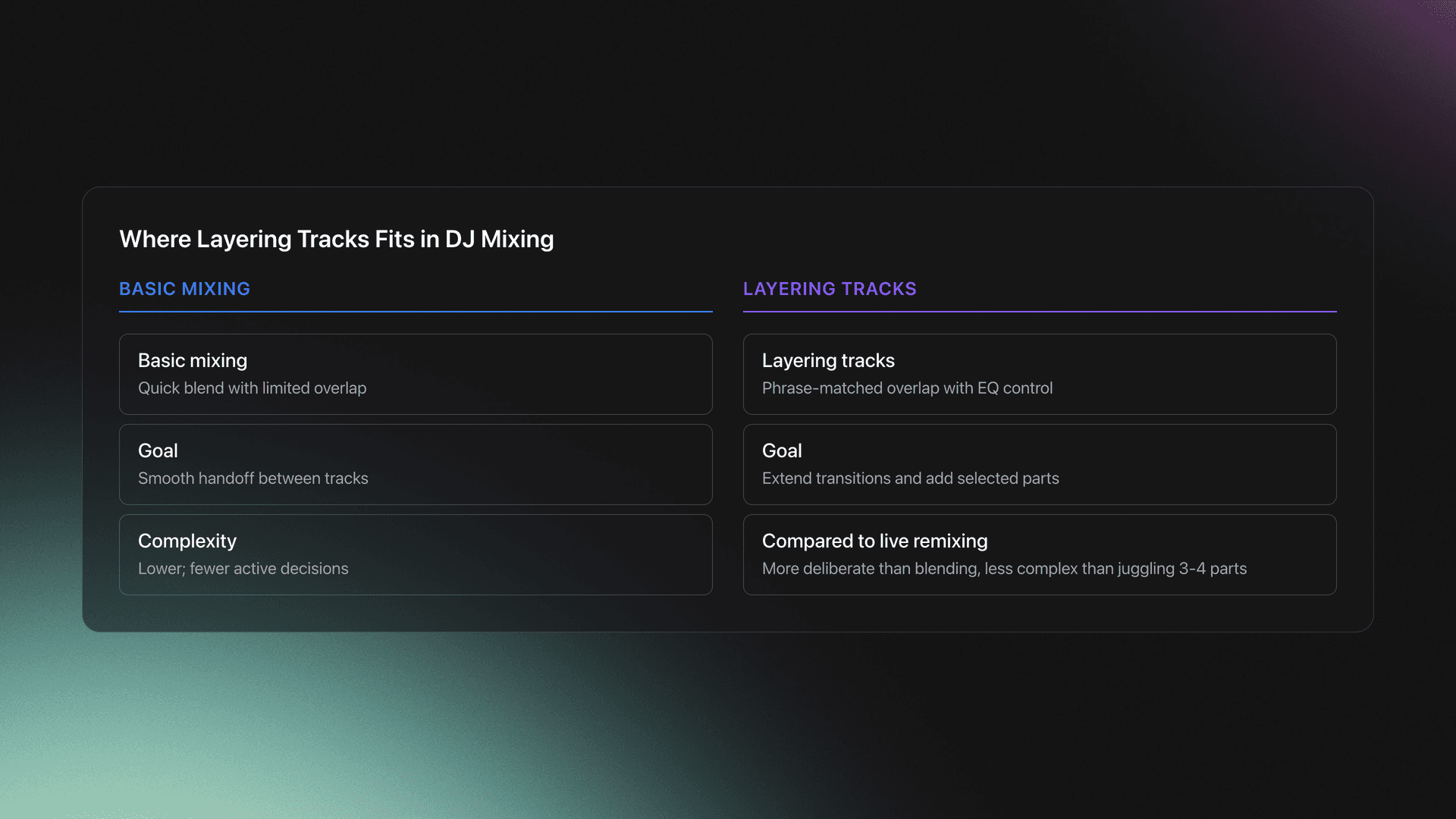
Why Layering Tracks Works
Layering tracks works because dance music is structured in repeated bars and phrases, which gives you predictable windows for overlap. The Digital DJ Tips sync mixing guide notes that many dance tracks are built around eight-bar phrases, and those phrase boundaries are where new elements tend to enter or leave.
This means you can make the outgoing track reduce while the incoming track grows. If both changes happen on the same phrase line, the audience hears one musical idea evolving rather than two records fighting.
It also works because you do not need every element from both tracks. One strong kick, one main bassline, one lead vocal, and one layer of percussion is often enough. The rest should either stay low, stay filtered, or stay out.
- Extends transitions without losing momentum
- Creates fuller energy during intros, outros, and breakdowns
- Makes acapellas, loops, and percussion tools more usable
- Helps you shape tension before a drop or bass swap
- Builds a more signature mixing style over time
Equipment for Layering Tracks
You only need core DJ gear to start layering tracks. Two decks, a mixer with EQ, and reliable headphones are enough for long blends and bass swaps.
Optional tools widen your options. A third deck gives you room for an acapella or percussion loop. Hot cues help you launch useful sections fast. Filters and echo can smooth an exit, though they should support the blend rather than hide poor timing.
Prepared edits can help too. The Crossfader article on mixing three songs notes that acapella intro edits create easy windows for layering a vocal over another instrumental before a full transition. That does not replace skill, but it gives you cleaner raw material for practice.
How to Start Layering Tracks
Start layering tracks by keeping the task small. Pick two tracks with similar groove, simple intros and outros, and minimal conflicting vocals. If you still struggle with phrase timing, first learn phrase mixing for cleaner entries.
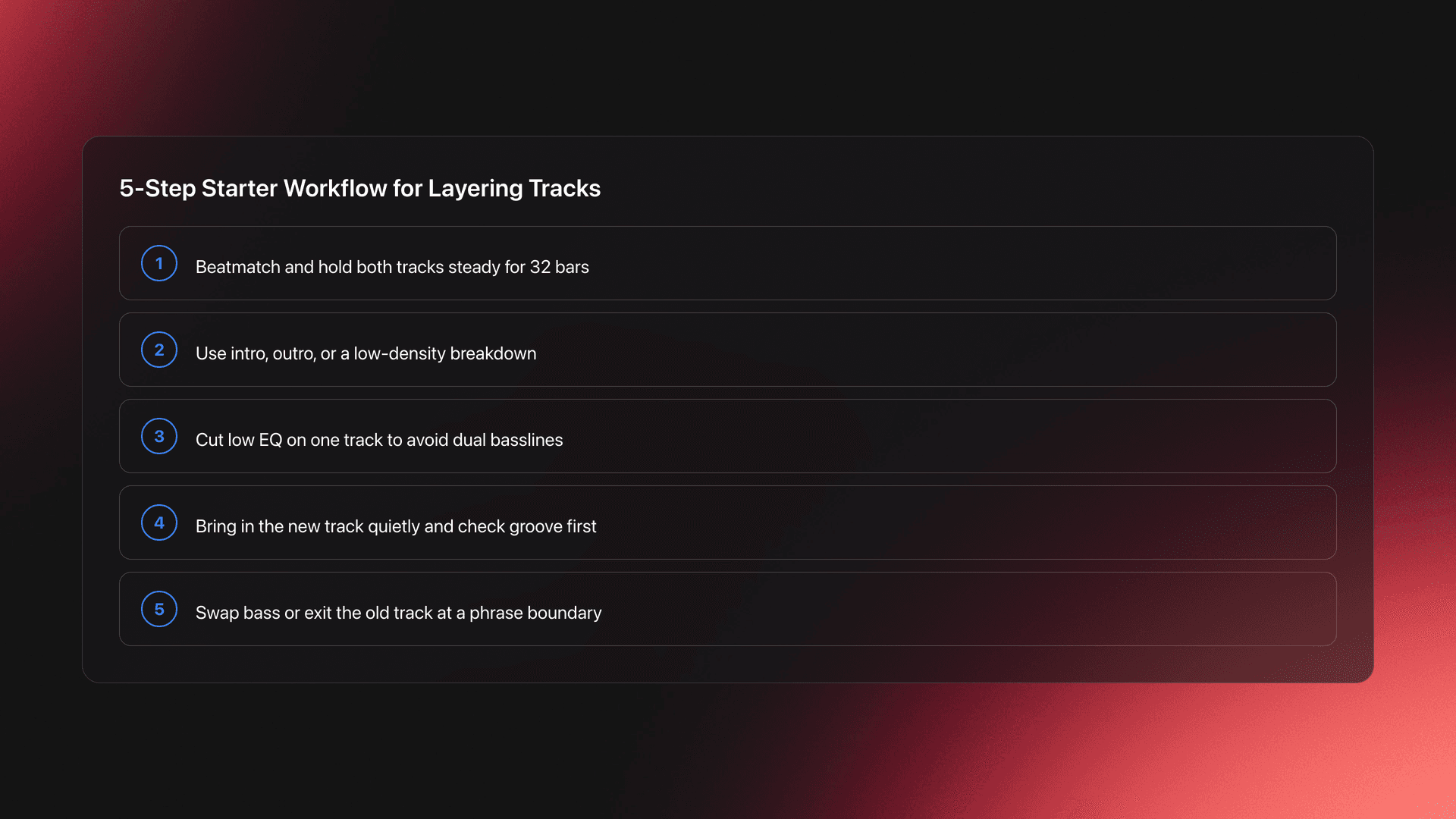
First, beatmatch both tracks and confirm they stay locked for at least 32 bars. If the timing drifts, the whole layer will feel unstable.
Second, identify an overlap zone. Good choices are the outgoing outro, the incoming intro, or a breakdown where one track has less low-end information.
Third, decide which track owns the bass. The Digital DJ Tips sync mixing guide stresses avoiding duplicated basslines and suggests switching kick and bass presence at phrase boundaries. That single decision prevents most muddy mixes.
Fourth, bring in the new track quietly. Keep the low EQ reduced at first. Let the audience hear the groove and timing before they hear the full weight.
Fifth, listen to the mids. Vocals, chords, synth stabs, and snare energy often collide there. If both tracks feel busy, reduce one mid band or shorten the overlap.
Finally, complete the handoff at a phrase line. Swap the bass, exit the old track, or leave one useful element running for another eight bars.
| Step | Action | Key Point |
|---|---|---|
| 1 | Beatmatch both tracks | Hold timing for at least 32 bars |
| 2 | Choose an intro or outro overlap | Use low-density sections first |
| 3 | Cut low EQ on one track | Avoid dual basslines |
| 4 | Bring in the new track gradually | Check groove before full volume |
| 5 | Swap energy on a phrase boundary | Make the transition sound intentional |
Phrase Timing and Musical Compatibility
Phrase timing is the backbone of layering tracks. The first paragraph of any good explanation should be simple: start the incoming section so its musical change happens when the outgoing section changes too.
The Crossfader phrasing lesson describes this clearly. One song breaks down while the other builds. That is why a blend can feel clean even before you add creative tricks.
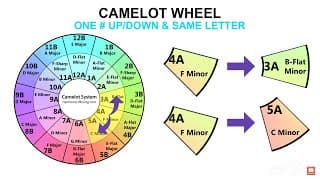
Compatibility matters just as much. The Pioneer DJ genre mixing overview notes that house and garage mixes can clash when vocals, chords, or fuller arrangements overlap too heavily. If a layer sounds tense in the wrong way, shorten it or use harmonic mixing to avoid key clashes.
In other words, do not judge only by BPM. Two tracks can be perfectly aligned and still sound wrong because both demand attention in the same frequency range or harmonic space.
Common Layering Patterns
Most successful layering tracks follow a few repeatable patterns. You do not need endless theory. You need a handful of reliable templates.
The safest pattern is intro-over-outro. One track is reducing information while the other is adding it. This is where most DJs should begin.
Next is bass swap layering. You keep one groove running, then trade low-end ownership on the next phrase. This works especially well in house and techno.
Then there is acapella-over-instrumental layering. The Pioneer DJ acapella layering tips highlights looping short vocal phrases and treating them almost like effects during builds and breaks. This is powerful, but only if the key and lyric density fit the moment.
A more advanced version uses loops to extend a small section while the next track arrives. If that interests you, advance into creative looping transitions after you can already control basic overlaps.
Practice Drills for Layering Tracks
Practice layering tracks in short, repeatable sessions. Through daily 15-minute practice sessions over several years, I found that one focused transition goal improves faster than marathon practice where every mix tries to do something different.
Start with two nearly compatible tracks and repeat the same transition five to ten times. Change only one variable each round: phrase entry, low EQ timing, or exit point.
For drill material, an organized mini-crate helps more than a huge library. In Vibes, you can group practice tracks by energy level, vocal density, and transition type so you rehearse specific layering problems instead of searching through your whole collection.
A useful weekly structure is simple. Spend one week on percussion-only layers, one on bass swaps, and one on vocal overlays. Measure progress over 2–4 week cycles by asking whether your blends stay cleaner for longer and need fewer emergency EQ moves.
Common Mistakes in Layering Tracks
Most problems in layering tracks come from trying to overlap too much material for too long. Why do most beginners struggle here? Because the blend sounds exciting in headphones for two bars, then turns crowded once the full arrangement arrives.
| Mistake | Why It Happens | Solution |
|---|---|---|
| Two basslines at full level | Both tracks keep low-end ownership | Cut the low EQ on one track before the overlap |
| Vocals colliding | Both tracks have lyrical or melodic leads | Use instrumentals, shorter loops, or a faster exit |
| Entering off phrase | The new track starts on the wrong bar cycle | Count 8 or 16 bars before pressing play |
| Overlong blend | The DJ keeps both full tracks active too long | Choose a clear handoff point and commit to it |
Another common issue is overusing effects to hide structural problems. Echo and filter can help, but they should decorate a transition, not rescue a bad one. Before adding FX, practice EQ mixing to make room in the blend.
Troubleshooting a Messy Layer
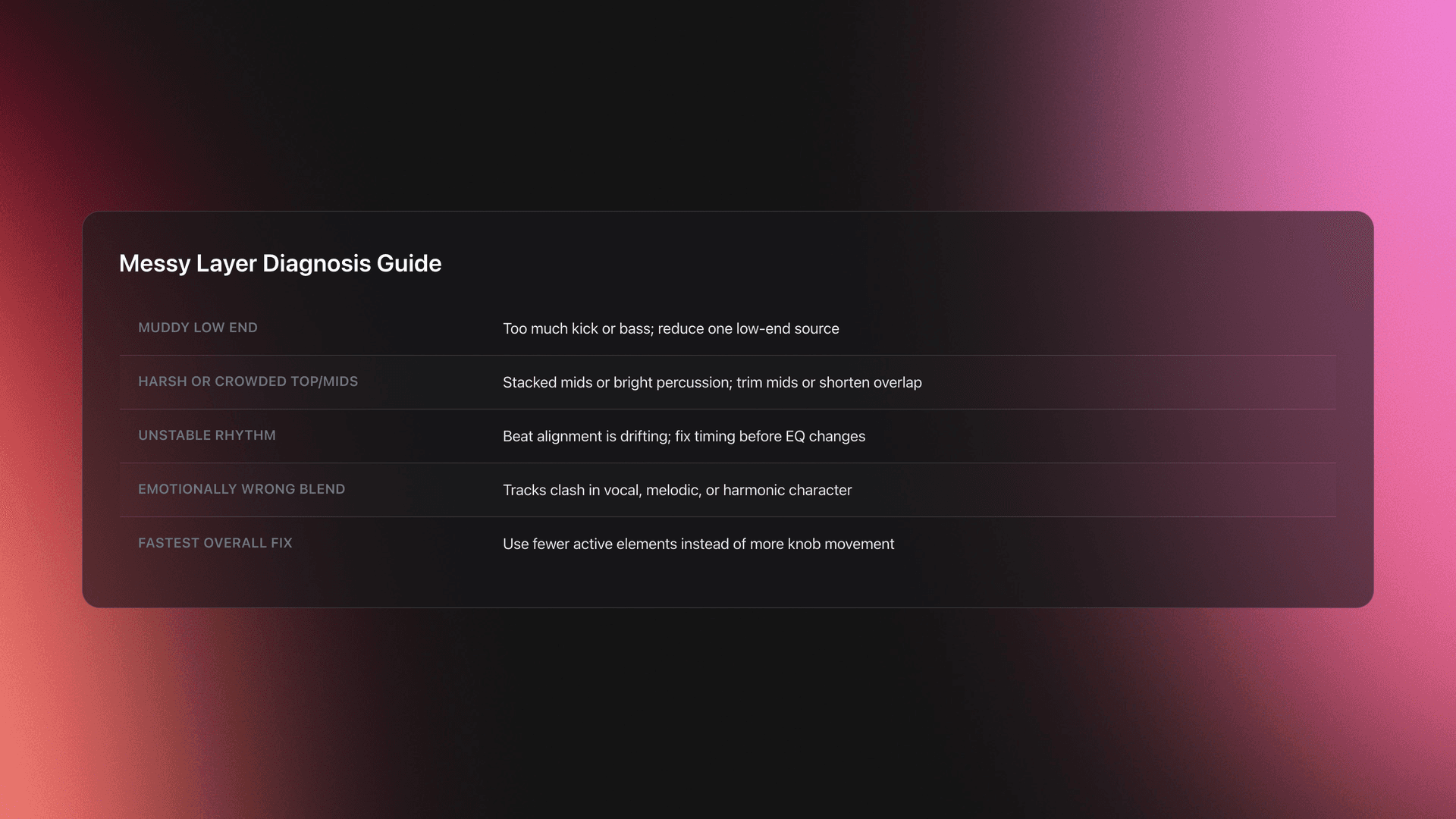
If a layered mix sounds muddy, identify which range is overloaded first. Low-end mud means too much kick or bass. Harshness usually means stacked mids or bright percussion.
If the rhythm feels unstable, check beat alignment before anything else. Layering tracks amplifies timing errors because both grooves are audible at once.
If the blend sounds emotionally wrong rather than technically wrong, the likely issue is musical character. One track may be too vocal, too melodic, or too harmonically tense for the other. Shorten the overlap and try a more neutral section.
This is where it clicks. Cleaner layering usually comes from fewer active elements, not more knob movement.
Where Layering Tracks Fits in a DJ Progression
Layering tracks is best learned after you can beatmatch confidently and before you chase flashy live remix tricks. It builds the listening habits that make later techniques easier.
Experienced practitioners typically progress in this order: phrasing, EQ control, layered blends, harmonic awareness, then three-deck or loop-based creativity. That sequence keeps the fundamentals stable while your mixes become more expressive.
In real sets, the biggest benefit is confidence. Once you know how to overlap tracks cleanly, you can control pacing better, rescue thin intros, and create more intentional transitions under pressure.
Layering Tracks Summary
Layering tracks helps a DJ turn separate records into one flowing story. The technique works best when timing is phrase-accurate, low-end space is controlled, and only the useful parts of each track stay active.
Key takeaways:
- Count phrases first, then overlap on purpose
- Let only one track own the bass at a time
- Short, repeated drills build cleaner blends faster than random practice
Start with simple intro-over-outro mixes, then move into bass swaps and light vocal overlays. Once that feels stable, the next useful step is combining layering with harmonic control and loops for more expressive transitions.
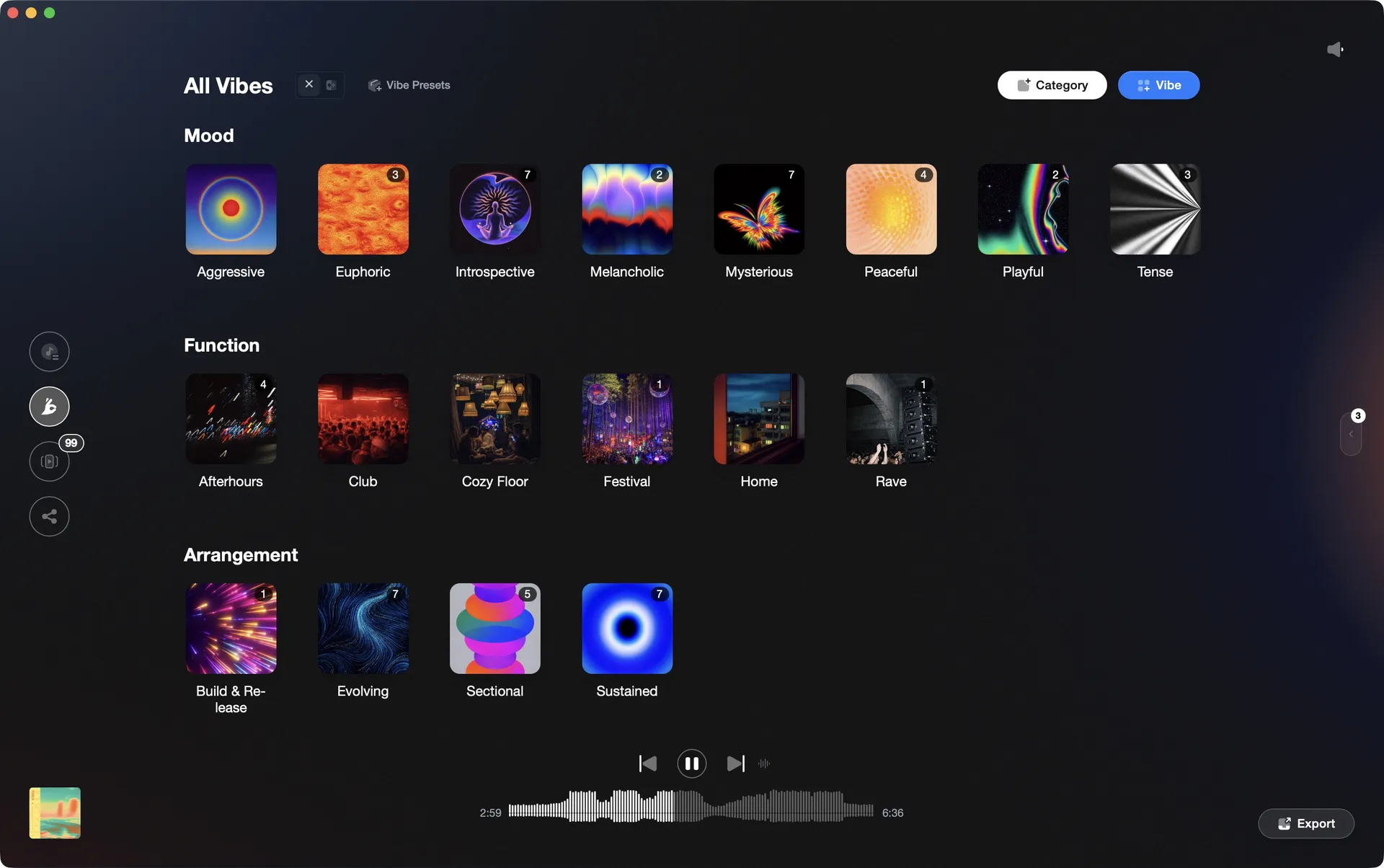
Organize your DJ library visually.
Tag tracks by vibe. See everything at once. Export to any DJ software.
A visual system for organizing your DJ library.