EQ Adjustment
6 Tutorials•5,298,990 Total Views
EQ adjustment helps DJs shape frequency balance so transitions sound cleaner, clearer, and more controlled.
EQ adjustment helps DJs shape frequency balance so transitions sound cleaner, clearer, and more controlled.
EQ Adjustment Tutorials
EQ Adjustment is the DJ technique of changing low, mid, and high frequencies so two tracks can share space without sounding crowded. Learn EQ Adjustment well and your transitions become cleaner, your bass swaps land harder, and your mixes feel more intentional instead of accidental.
For most DJs, EQ Adjustment is the point where basic blending turns into real control. It helps when two kicks fight, when vocals overlap, or when one track feels brighter or heavier than the other. If you can already build reliable beat matching control, EQ Adjustment is one of the next skills worth practicing.
EQ Adjustment is the process of changing frequency bands on a mixer or controller to balance two tracks during a transition. In practice, DJs use it to reduce clashes, swap basslines, shape energy, and make one track enter without overwhelming the other.
Most DJ mixers split EQ into lows, mids, and highs. Some mixers add low-mid and high-mid for finer control. Crossfader explains that these bands are essential for seamless blends, while DJ TechTools notes that EQ choice is both technical and creative because it changes how tracks coexist in the mix.
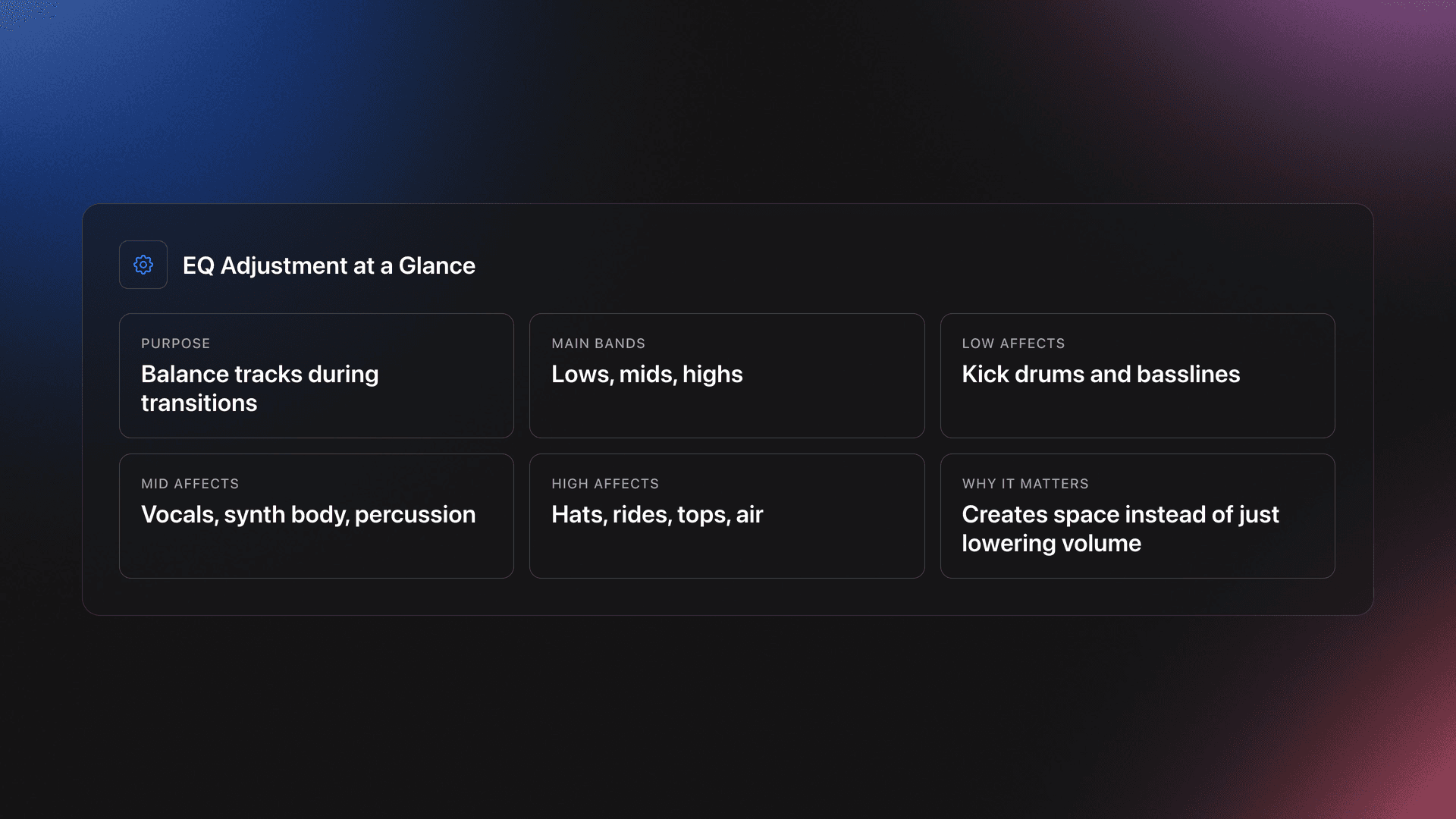
The low band usually affects kick drums and basslines. The mid band often shapes vocals, synth body, percussion, and musical detail. The high band tends to affect hats, rides, tops, and air. Native Instruments gives a similar practical map when describing how DJs clean up mixes and swap bass during transitions.
This matters because two full tracks playing together usually sound louder and denser than one. EQ gives you a way to make room instead of just lowering volume. That is why EQ Adjustment sits at the center of clean club mixing.
EQ Adjustment matters because it solves the biggest transition problem in DJing: too much happening in the same frequency space. When the low end stacks, the room gets muddy. When mids pile up, vocals and melodies blur. When highs fight, the mix turns harsh.
Used well, EQ Adjustment gives you three benefits. First, cleaner transitions. Second, stronger control over tension and release. Third, more freedom to mix tracks from different eras, genres, or production styles.
It also improves confidence. You stop hoping two tracks will work together and start shaping why they work together. That shift is what moves a DJ from basic playback to active performance.
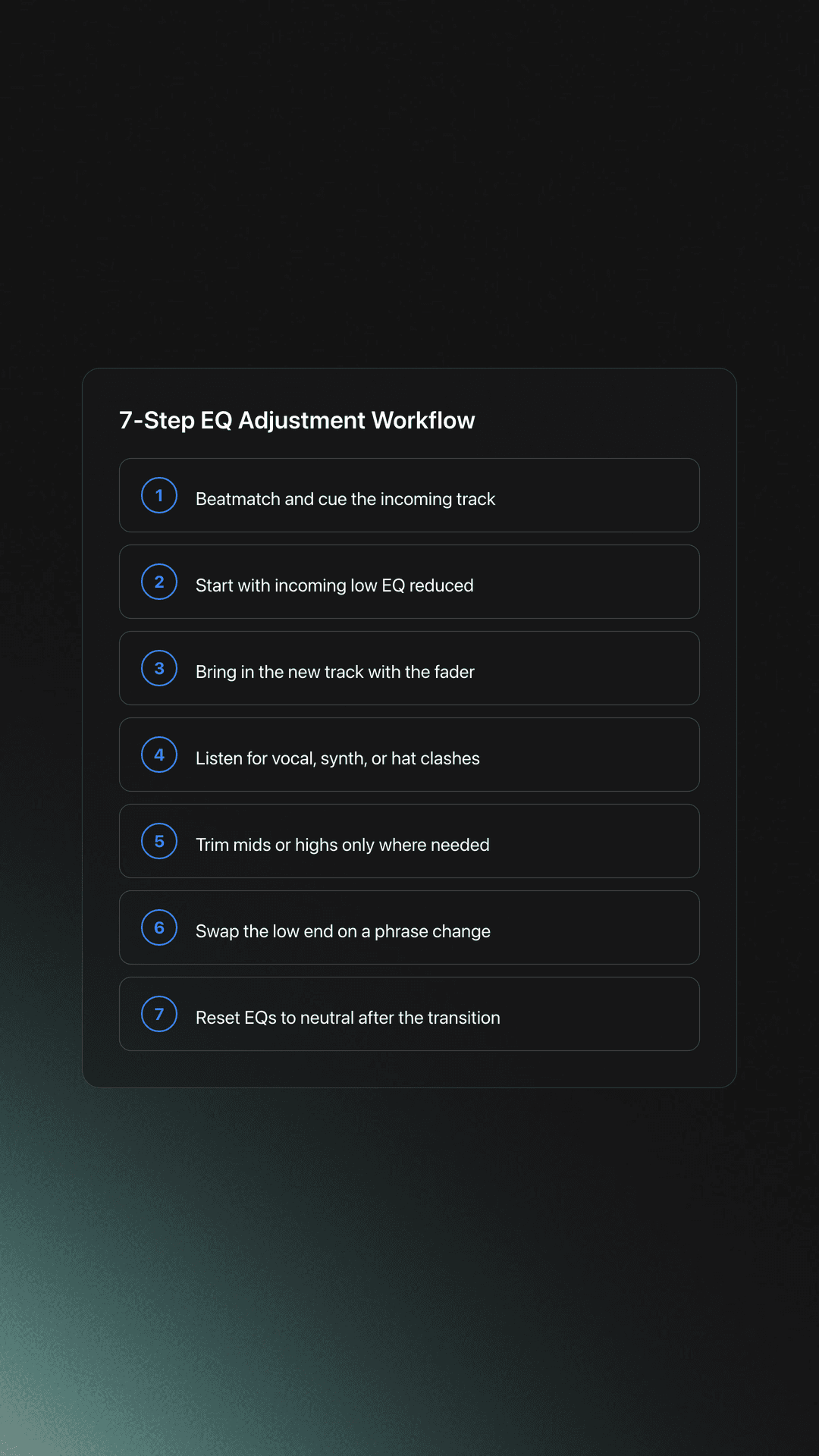
The core rule is simple: if one track is entering, it rarely needs every frequency band at full strength. Start by deciding which elements should lead. Then cut or reduce the bands that would compete with the track already playing.
A common beginner move is the bass swap. Bring in the new track with its low EQ reduced. Let the listener hear its rhythm, vocal, or texture first. Then switch the bass presence from the outgoing track to the incoming one at a phrase boundary.
DJ TechTools describes this as making room for the incoming bassline because low frequencies carry a large share of the track’s energy. Native Instruments gives nearly the same practical advice: lower the low EQ on the incoming track, then trade basslines during the transition.
Midrange control is more subtle. If one track has a strong vocal, lead, or riff, reduce mids on the other track slightly. Do not cut them blindly. Too much mid reduction can make a track sound hollow and disconnected.
High EQ is usually about brightness and texture. Slightly reducing highs can tame hats and sizzle when two tracks feel sharp together. Small moves work best here. Harsh changes in the top end are easy to hear.
| Band | What It Often Controls | Typical DJ Use |
|---|---|---|
| Low | Kick drum, bassline, sub energy | Swap basslines and stop low-end buildup |
| Mid | Vocals, synth body, percussion detail | Make room for lead elements |
| High | Hi-hats, rides, air, brightness | Soften harshness or reveal sparkle |
EQ Adjustment works best when it follows phrasing. Start the incoming track at a logical point, usually the start of an 8-bar or 16-bar phrase. If you need help with that timing, learn phrase mixing for cleaner entry points before pushing EQ moves too hard.
The reset step matters. Many beginners finish a mix with one band still cut, then wonder why the next track sounds thin. Always return the active channel to a neutral starting point unless you are making a deliberate creative choice.
Some mixers use full-kill EQ, which can mute a band almost completely. Others shape more gently. Pioneer and AlphaTheta documentation for mixers and mixer features show that EQ behavior can vary by model, including switchable EQ or isolator behavior on some units. That means your hand movement should adapt to your hardware.
In practice, use small adjustments first. A quarter turn can be enough. Big cuts sound dramatic, but subtle balance usually sounds more professional.
Most DJs end up relying on three EQ Adjustment methods. The first is the bass swap. The second is the vocal or melody blend. The third is tone matching between tracks with different production styles.
Bass swap is the most foundational. One track owns the low end while the other enters with reduced bass. At the right phrase, you trade ownership. This is common in house and techno because long transitions depend on a stable groove.
Vocal or melody blend uses mid and high control. If track A has drums and groove but track B has the phrase you want the crowd to hear, reduce mids on A just enough to let B speak. DJ TechTools describes this as making room for the vocal rather than cutting blindly.
Tone matching is useful when tracks come from different eras, labels, or formats. Older tracks, vinyl rips, and some edits may feel duller or thinner. Small EQ moves can help them sit more naturally next to modern, louder material.
EQ Adjustment also works better when the tracks are musically compatible. It cannot fully fix key clashes. For that, use harmonic mixing to reduce melodic clashes alongside your EQ decisions.
You do not need expensive gear to learn EQ Adjustment. You need a mixer or controller with usable EQ knobs, stable cueing, and clear monitoring. Even entry-level controllers can teach the core movement patterns.
What changes with better mixers is the feel and response. Some EQ knobs are smoother. Some bands are broader. Some mixers let you switch between standard EQ and isolator curves. Crossfader notes that many controllers use the standard low, mid, high layout, while some devices split the mids into two bands.
Headphones matter more than many beginners expect. Good cueing lets you hear whether the incoming track needs less bass, less high end, or no EQ change at all. If your monitoring is unclear, you will over-correct.
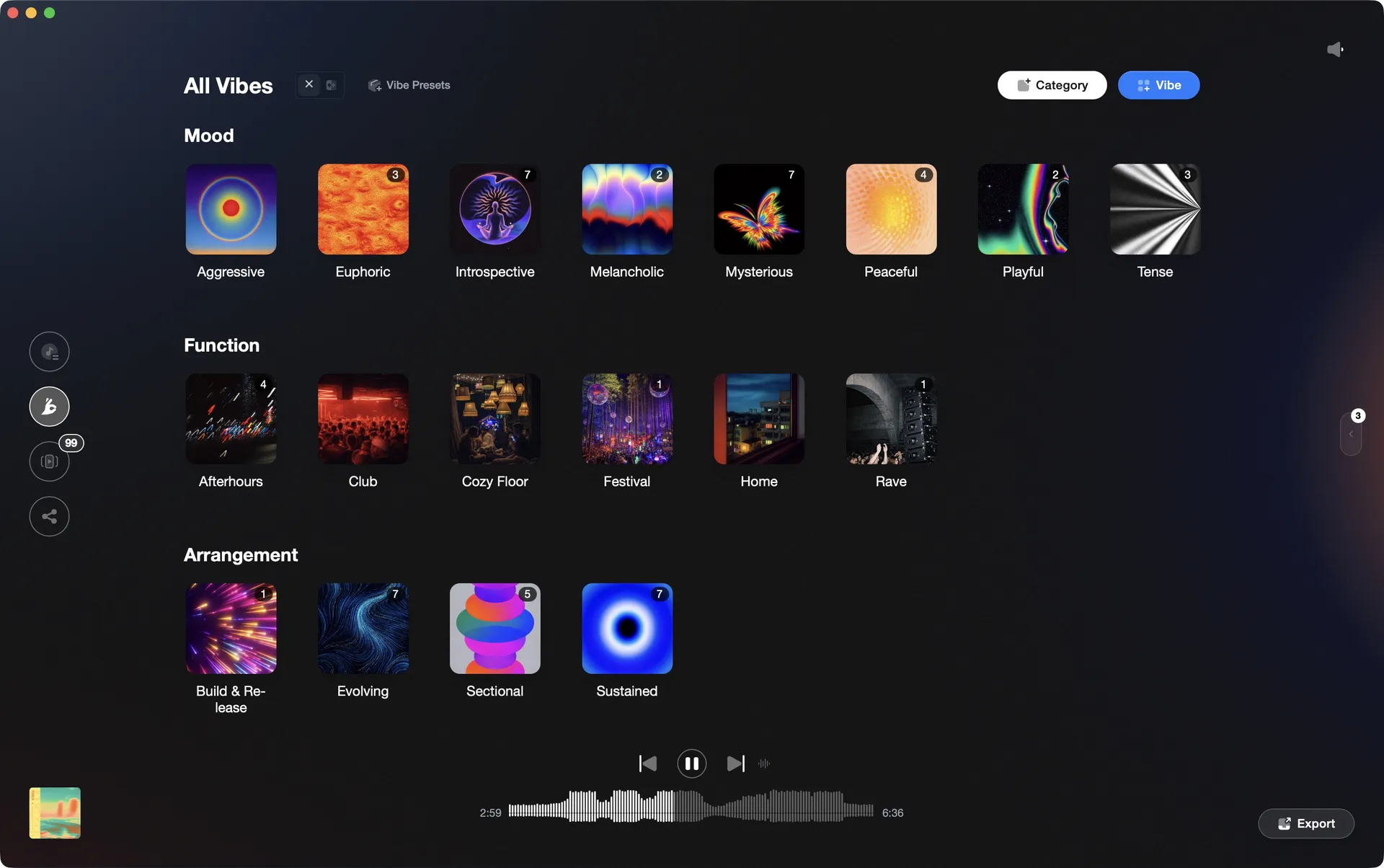
A well-organized practice library helps too. In Vibes, you can group tracks by bass weight, vocal intensity, and energy level so your drills compare similar problems on purpose instead of by chance.
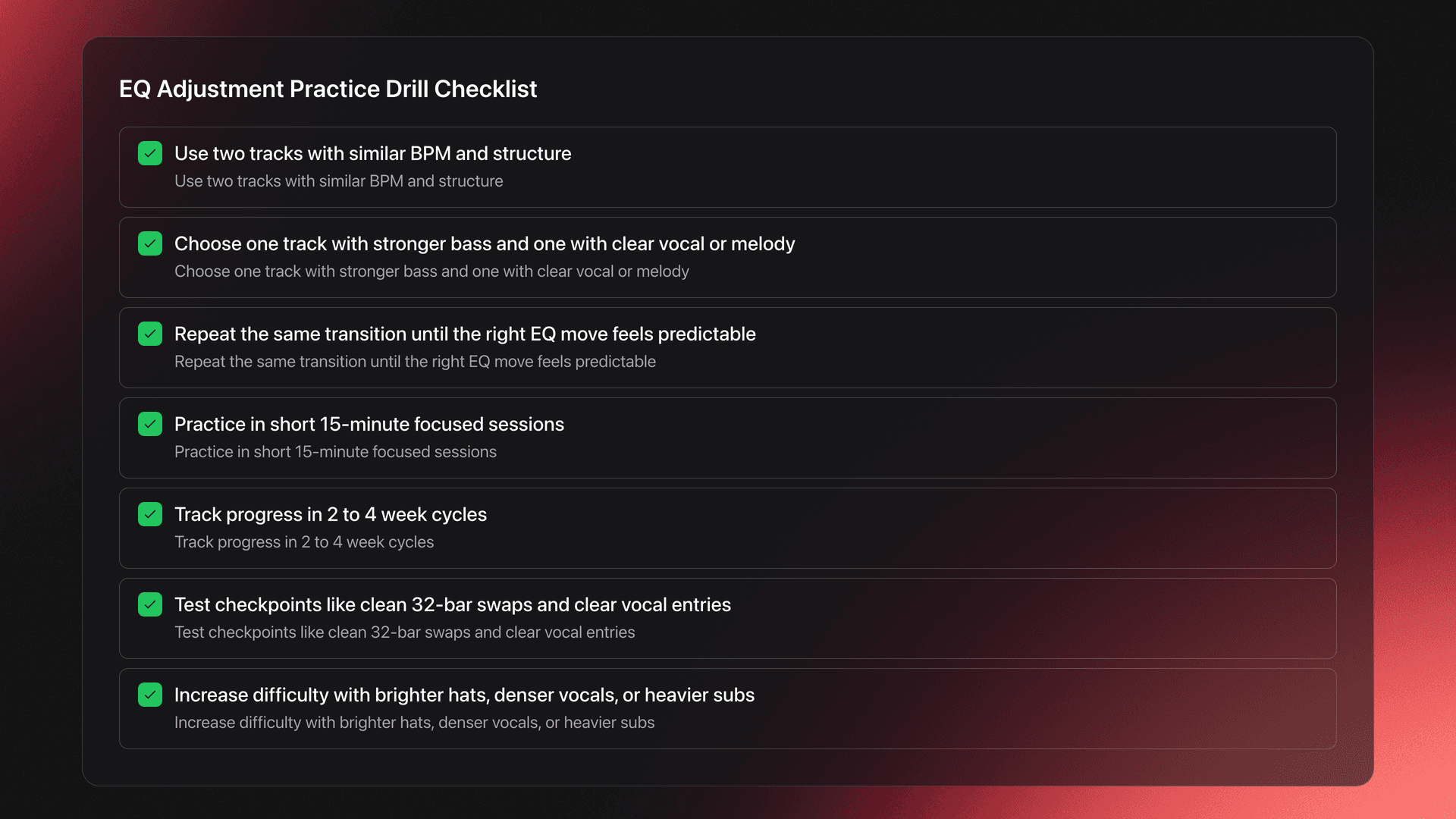
The fastest progress comes from short, repeatable drills. Through daily 15-minute practice sessions over several years, I found that focused EQ drills build control faster than long, unfocused mixes. Small cycles let you hear what changed and why.
Start with two tracks that share BPM range and structure. One should have a stronger bassline. The other should have a clear vocal or melodic hook. Repeat the same transition until you can predict the right EQ move before you touch the knob.
Track your progress in 2 to 4 week cycles. Aim for measurable wins, not vague improvement. Can you hold a 32-bar transition without muddy low end? Can you make a vocal enter clearly without gutting the outgoing track? Those are useful checkpoints.
Once you can repeat clean swaps on similar tracks, widen the challenge. Try mixes with brighter hats, denser vocals, or heavier subs. That is where EQ Adjustment becomes musical judgment, not just knob movement.
Most EQ Adjustment mistakes come from moving too much, too late, or for the wrong reason. The fix is usually simpler than DJs think: listen for conflict, make one small change, then evaluate.
| Mistake | Why It Happens | Fix |
|---|---|---|
| Cutting too much midrange | Trying to remove clashes fast | Reduce only enough to reveal the lead element |
| Stacking both basslines | Incoming track enters with full low EQ | Start with low EQ reduced and swap on the phrase |
| Leaving EQs altered after the mix | No reset habit | Return knobs to neutral as soon as the transition ends |
| Using EQ to fix bad track pairing | Tracks clash harmonically or structurally | Choose better combinations and improve phrasing first |
Why do most beginners struggle here? Because EQ Adjustment is not only about sound. It is also about timing, track selection, and restraint. If those parts are weak, the EQ move feels random.
In house and techno, EQ Adjustment often supports long blends. DJs may let both tracks run together for many bars, using bass swaps and tiny mid corrections to keep the groove intact. Pioneer DJ’s genre-mixing guide points to phrase-based moments like introducing the next track and swapping bass EQ as core events in dance music transitions.
In open-format or hip-hop, transitions are often shorter. That means EQ moves may be more decisive. You might cut lows quickly, let a vocal line flash through, then change tracks before frequency buildup becomes obvious.
In multi-deck mixing, EQ Adjustment becomes even more important because three layers can overload the spectrum fast. Pioneer DJ’s multi-deck guide notes that careful EQ and volume control become crucial once a third track enters.
Safe EQ practice starts with safe monitoring. CDC and NIOSH state that 85 dBA averaged over 8 hours is a recommended exposure limit for occupational noise, and repeated loud exposure can damage hearing. DJs often work in environments above that level.
Keep booth monitors at the lowest practical level. Use isolating headphones or musician earplugs when needed. If you must raise your voice to speak to someone nearby, the environment may already be in a hazardous range.
This is not separate from technique. If your ears are fatigued, your EQ choices get worse. Cleaner monitoring usually leads to cleaner decisions.
EQ Adjustment is the skill of making space on purpose. It helps you avoid muddy transitions, highlight the right musical element, and move from simple blending to controlled performance.
Focus on three habits first. Swap bass at phrase boundaries. Use midrange cuts sparingly. Reset EQs after every transition.
Your next step is simple: choose two compatible tracks and rehearse one 16-bar bass swap until it sounds effortless. From there, expand into vocal blends and tone matching. That is where EQ Adjustment starts to feel musical.
Tag tracks by vibe. See everything at once. Export to any DJ software.
A visual system for organizing your DJ library.