Arrangement Techniques
Arrangement techniques help DJs read song structure, manage energy, and place transitions where tracks feel natural and intentional.
Arrangement Techniques Tutorials

Franchise Record Pool Guide for DJs
Arrangement techniques are the skills DJs use to read a track’s structure and place transitions where they feel natural. If your mixes often sound rushed, flat, or awkward even when the beatmatch is correct, arrangement techniques are usually the missing layer. Learn them well and you can control energy, avoid clashing sections, and make each handoff feel intentional.
For DJs, arrangement techniques matter because crowds react to timing as much as track choice. A strong transition does not only match BPM. It respects phrases, section changes, and the rise or release of tension. That is why arrangement skills sit right next to build solid beat matching control and learn phrase mixing with confidence in the core workflow of set building.
In practice, arrangement techniques help you answer simple but important questions. Where does the intro really begin? How long is the breakdown? Is the next drop arriving too early? Once you can hear those answers, your sets become easier to plan and easier to improvise.
What Are Arrangement Techniques?
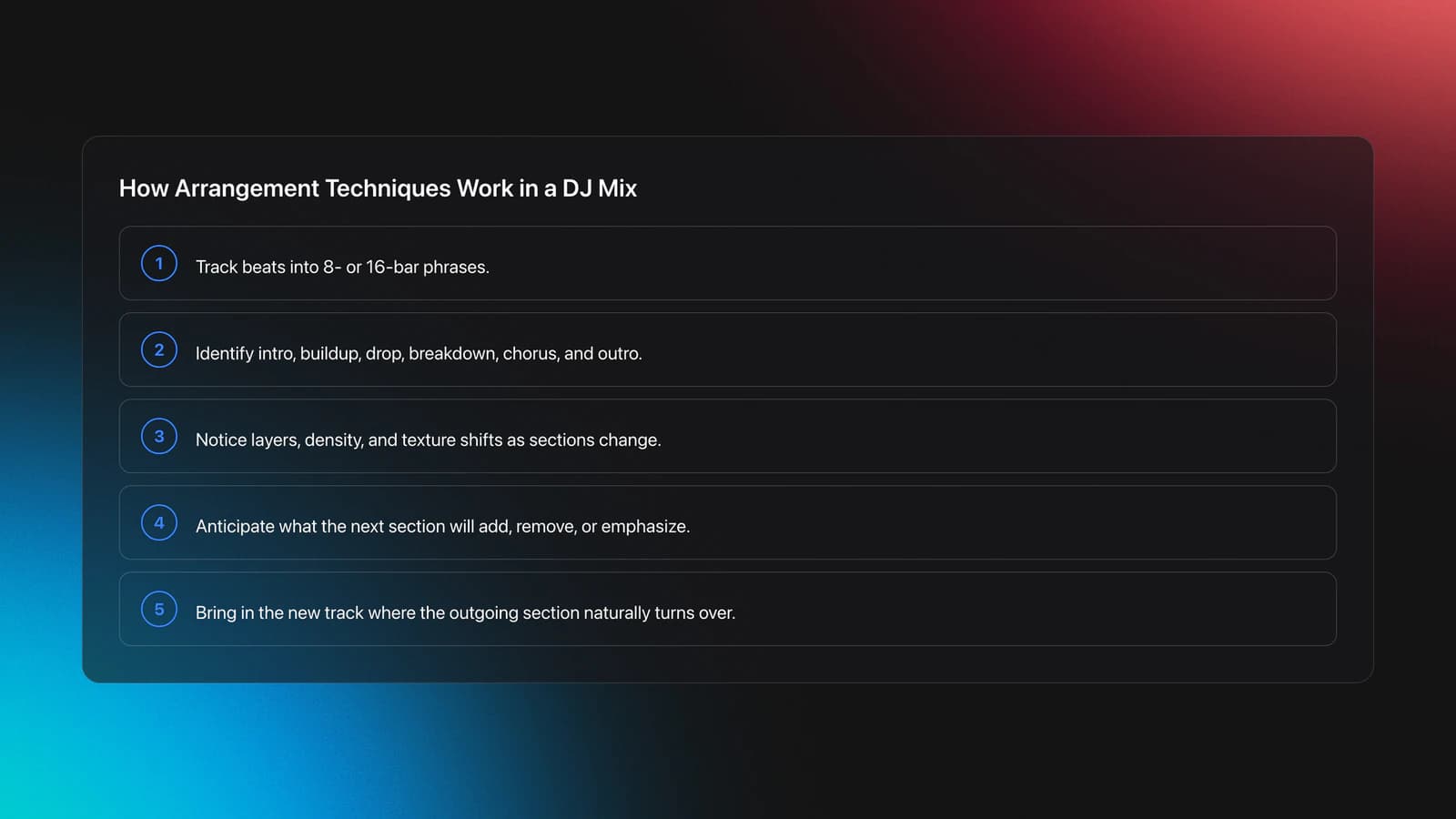
Arrangement techniques are methods for identifying and using the sections of a track, such as intro, buildup, drop, breakdown, chorus, and outro, so transitions support the music’s internal logic instead of fighting it.
That definition matters because many DJs treat arrangement like a producer-only concept. It is not. Native Instruments explains that phrases often run in 8- to 16-bar units, and tracks are built from larger sections such as intros, breakdowns, drops, and outros. DJs can use those sections as transition guides rather than mixing at random points.
In electronic music, arrangement often creates movement by adding or removing layers across repeated motifs. Native Instruments also notes that some dance tracks rely less on verse-chorus contrast and more on changes in density and energy. That means a DJ must listen for texture shifts, not only obvious melody changes.
This is where arrangement techniques become practical. You count bars, spot landmarks, and predict what the next section will do. Then you time the incoming track so the listener hears a clean change rather than a collision.
Why Arrangement Techniques Matter
Arrangement techniques matter because they turn a technically correct mix into a musically convincing one. When sections line up, the listener hears momentum, contrast, and release instead of confusion.
A beatmatched mix can still fail if one track drops into full energy while the other enters a breakdown. DJ-focused phrasing guides from Native Instruments and DJ TechTools both emphasize aligning the beginning of a new phrase with the outgoing track’s phrase structure. That alignment is what makes transitions feel logical.
Arrangement awareness also improves set pacing. iZotope recommends marking major sections and even smaller changes every four to eight bars because those changes define how listeners perceive progression. For a DJ, those markers are the roadmap for when to blend, cut, loop, or hold back.
- Prevents transitions from landing in the wrong section
- Helps you manage tension and release across a set
- Makes improvised mixing feel more intentional
- Improves cue placement and transition planning
- Supports cleaner phrase mixing across genres
Core Arrangement Signals to Hear
The core job is to hear where one section ends and another begins. In most DJ-ready music, those boundaries are marked by drum fills, crash hits, added percussion, removed bass, vocal entry, or a sudden change in texture.
DJ TechTools describes common phrase clues as new instruments, big crashes, fills, and notable drum pattern changes. Those are the audible signs that a phrase has turned over. If you miss them, your transition timing becomes guesswork.
Start with four levels of listening. First, count beats and bars. Second, count groups of bars into 8, 16, or 32. Third, label the section you are in. Fourth, predict the next section before it arrives.
Once that becomes automatic, arrangement techniques stop feeling abstract. You hear an outro opening up, or a buildup approaching, and you already know which kind of blend will work.
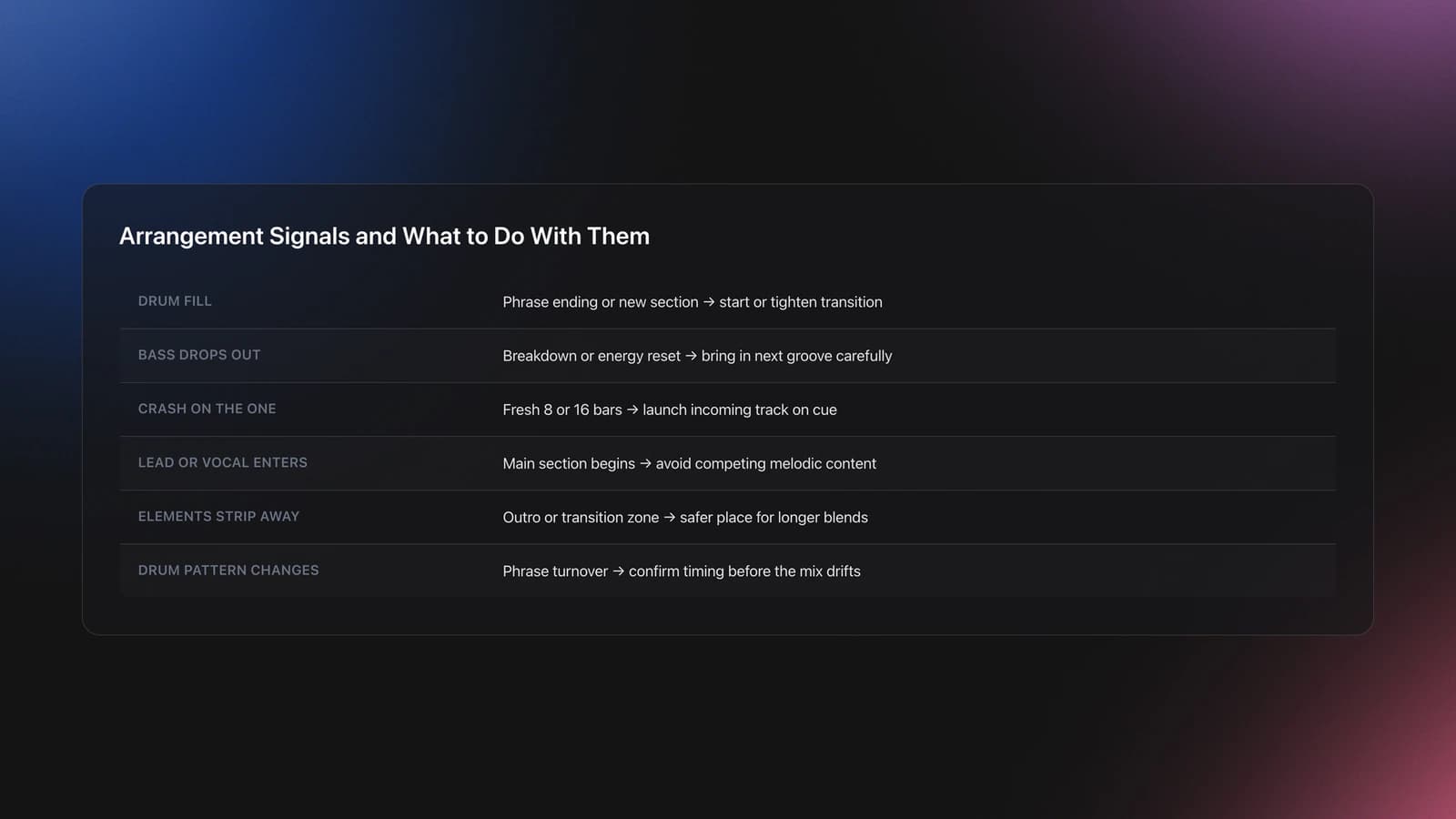
| Signal | What It Usually Means | DJ Use |
|---|---|---|
| Drum fill | Phrase ending or new section | Start or tighten transition |
| Bass drops out | Breakdown or energy reset | Bring in next groove carefully |
| Crash on the one | Fresh 8 or 16 bars | Launch incoming track on cue |
| Lead or vocal enters | Main section begins | Avoid competing melodic content |
| Elements strip away | Outro or transition zone | Safer place for longer blends |
How to Use Arrangement Techniques
To use arrangement techniques, identify the active section, count its phrase length, choose the target section in the next track, and launch the incoming track so both structures land together.
Step one is analysis. Listen through both tracks and mark intros, first drops, breakdowns, second peaks, and outros. Native Instruments recommends setting cue points at the beginning of phrases. That gives you visual and tactile reference points instead of relying on memory.
Step two is counting. Most club music is in 4/4, so count bars in groups of four until you can feel 8- and 16-bar blocks without effort. If the outgoing track has 16 bars left before a breakdown, you can launch the incoming track at the start of its 16-bar intro.
Step three is role matching. Intro-to-outro blends are the easiest. Buildup-to-buildup blends can work if the energy shape matches. Drop-to-breakdown combinations are risky unless you want hard contrast.
Step four is transition choice. Long blend, quick cut, loop roll, or echo out should match the arrangement problem in front of you. If two tracks both become busy at the same moment, shorten the overlap. If one track opens up, you have more room for a gradual handoff.
Step five is evaluation. Record the mix and listen back for four things: early drop arrival, empty energy gap, melodic clash, or overlong overlap. Those are arrangement problems first, not only mixing problems.
If your fundamentals are still unstable, improve them alongside build solid beat matching control. If the structure lines up but the keys fight, combine structure with harmonic mixing becomes the next layer.
Practice Drills for Arrangement Techniques
The best way to learn arrangement techniques is with short, repeatable drills using the same small track pool until your timing becomes automatic. In practice, repeating one transition goal across a 2-week cycle builds faster timing than marathon sessions with constant track switching.
Drill 1 is pure counting. Play one track and count bars out loud through the intro, first phrase, and first major section change. Your only goal is to call the change before it happens.
Drill 2 is phrase launch timing. Set a cue at the start of a 16-bar intro on Track B. Start Track B exactly 16 bars before Track A reaches its outro or breakdown. Repeat until you can hit the launch point three times in a row.
Drill 3 is section labeling. During playback, say the section names as they pass: intro, groove, buildup, drop, breakdown, outro. This sounds basic, but it trains faster recognition under pressure.
Drill 4 is energy mapping. Use five tracks and rank them from warm-up to peak-time. Then practice only transitions that preserve that rise. This teaches arrangement as a set-level skill, not only a track-level skill.
For this kind of repetition, organized practice crates help. In Vibes, you can group tracks by intro length, peak intensity, and transition role so each drill uses comparable material instead of random selections.
Common Mistakes With Arrangement Techniques
Most arrangement mistakes come from hearing beats but ignoring sections. The fix is usually not a fancier transition. It is better structural timing.
| Mistake | Why It Happens | Fix |
|---|---|---|
| Mixing mid-phrase | You start by feel instead of count | Launch only on phrase starts during practice |
| Two drops collide | You did not map section roles | Pair a buildup or outro against the incoming drop |
| Transition feels empty | Both tracks lose energy together | Keep one groove active while the other resets |
| Blend runs too long | You ignore arrangement density | Shorten overlap when vocals or hooks enter |
| Every track mixed the same way | You rely on one formula | Choose transition type by section and energy shape |
Another common issue is overtrusting waveforms. Visual tools help, but they do not replace listening. Ableton’s arrangement teaching materials focus on how clips and song structure sit on the timeline, yet the musical decision still comes from hearing what changes and why.
Examples in Real DJ Workflows
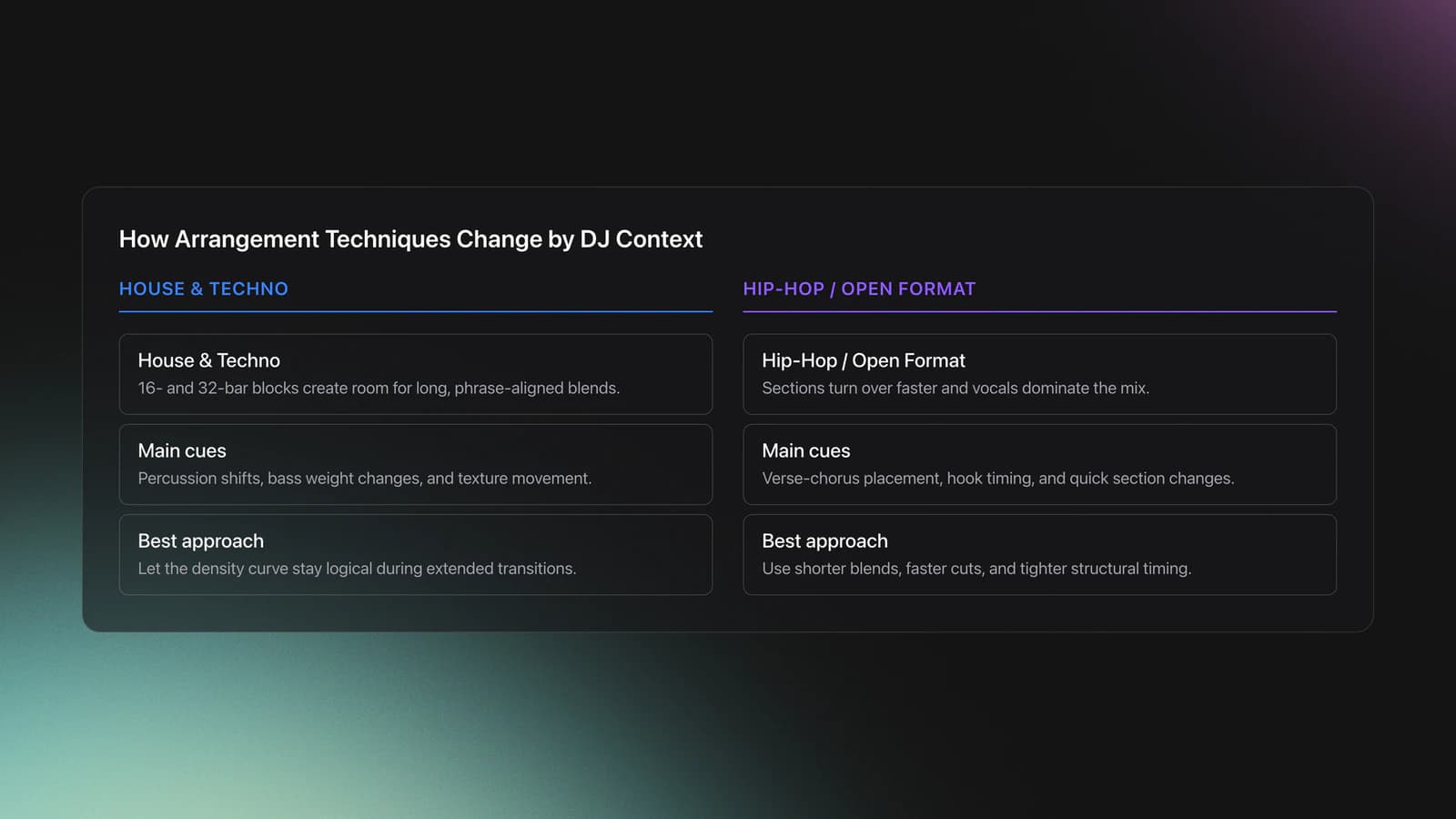
Arrangement techniques show up differently in different contexts, but the principle stays the same. Read the section, predict the next change, and transition with intent.
In house and techno, arrangement often revolves around 16- and 32-bar blocks with changes in percussion, bass weight, and texture. That gives you space for long blends, but only if the density curve makes sense.
In hip-hop and open-format sets, sections can change faster and vocals dominate the mix. That often calls for shorter transitions, quicker cuts, and sharper awareness of chorus and verse placement.
In multi-genre sets, arrangement techniques become the glue between methods. You may use a fast cut between vocal hooks, a phrase-aligned blend between dance tracks, then combine structure with harmonic mixing when moving into a more melodic section of the night.
MusicRadar’s arrangement advice is useful here: sections should feed off one another, and transitions deserve deliberate attention. For DJs, that means every incoming record should solve a structural problem, not create a new one.
Troubleshooting Arrangement Problems
If arrangement techniques still feel slippery, isolate the exact failure point. Usually the issue is count accuracy, section recognition, or poor track pairing.
If you lose the phrase count, simplify the material. Practice with tracks that have long intros and obvious drum fills. If you can only count correctly while staring at the screen, close the laptop and train your ears first.
If transitions sound messy even when your count is right, compare track roles. A dense vocal chorus layered over another dense chorus is an arrangement mismatch. The count did not fail. The pairing did.
If your sets feel flat, inspect energy shape. iZotope recommends using markers and an energy map to understand progression. Do the same with a recorded set and note where intensity stalls or spikes too hard.
Equipment and Track Prep
You do not need advanced gear to practice arrangement techniques, but you do need tracks with clear structure and a workflow that supports repeat listening.
Essential tools are simple: headphones, decks or DJ software, and tracks with usable intros and outros. Optional tools such as hot cues, memory cues, and color waveforms make section mapping faster, but the real skill is still recognition.
For deeper preparation, build mini libraries around one transition problem at a time. Group tracks by long intro, short intro, vocal-heavy drop, tool track, or high-energy outro. That makes practice more controlled and exposes what each arrangement type allows.
If you later want to expand beyond structural timing, pair this foundation with learn phrase mixing with confidence and then move into EQ decisions or key-based transitions.
Wrap-Up
Arrangement techniques give DJs a way to move beyond mixing by tempo alone. When you can hear phrases, label sections, and predict energy shifts, transitions stop feeling lucky and start feeling controlled.
Key takeaways:
- Count phrases before you try to improvise around them
- Match section roles, not just BPM
- Practice short drills until structural timing becomes automatic
Start with ten tracks, mark their core sections, and rehearse one clean 16-bar transition pattern until it feels easy. From there, expand into more complex pairings and related skills.
The visual way to organize your DJ library
Tag tracks by vibe. See everything at once. Export to rekordbox, Serato, Traktor or Engine DJ.
14-day free trial. Full access, no strings attached.
or see how it works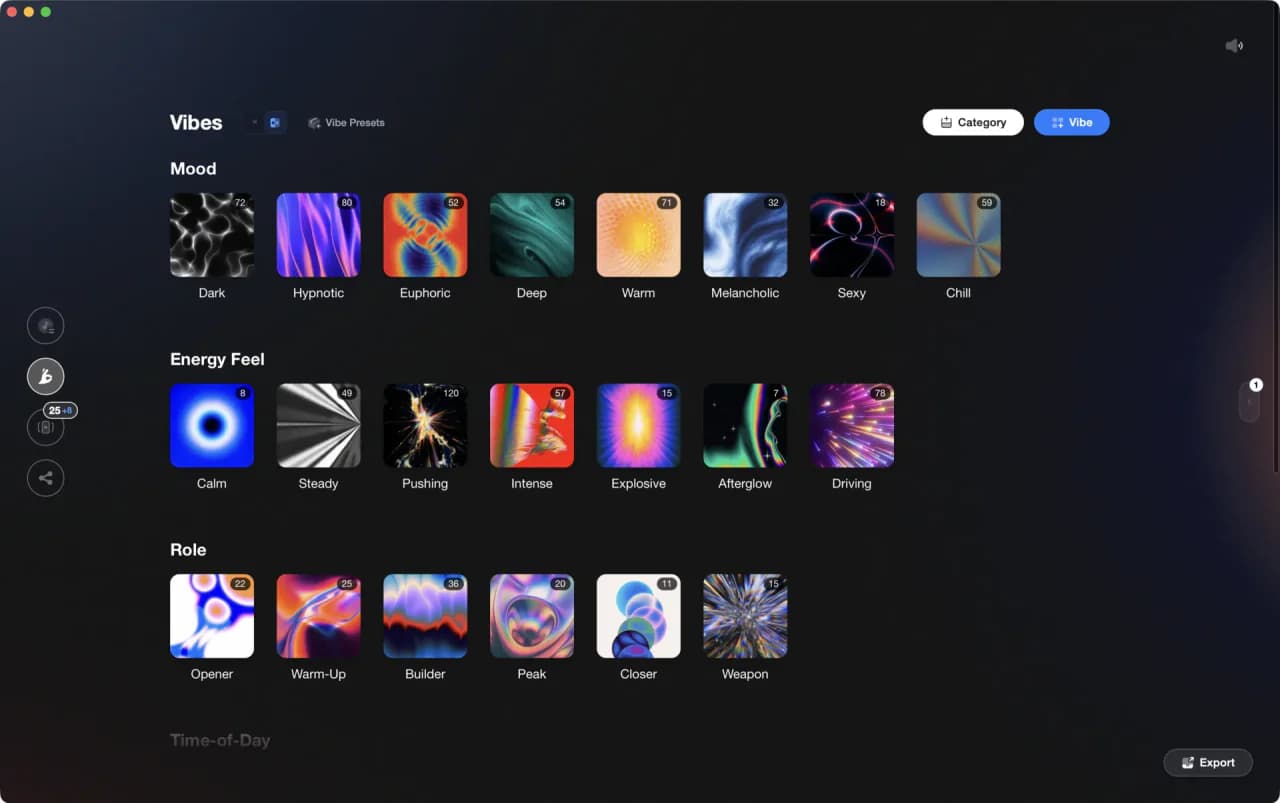
Frequently Asked Questions

Hey, it's Ben Modigell 👋
I DJ and produce as so I so: downtempo, minimal, dub house, tech house, and techno (releases on Spotify and SoundCloud, links above). Everything I write here comes from my own gigs, studio sessions, and library cleanups: the rules I follow, the failure modes I have actually hit, and the workflow I use when nobody is watching. If a technique did not earn its place in my own sets, it does not make it into a tutorial.