
Music Arrangement
Music arrangement turns loops and ideas into a structured track with clear sections, movement, and usable energy flow.
Music Arrangement Tutorials

How to Put Songs Together to Make One Song
Music arrangement is the skill of turning a good loop into a complete track. If you can make strong ideas but struggle to finish songs, music arrangement is often the missing piece. Good music arrangement gives your track shape, contrast, and momentum so listeners stay engaged from intro to outro.
For DJs and electronic producers, this matters fast. Better arrangement makes tracks easier to mix, easier to remember, and easier to trust in a set. It also helps you decide what should happen next instead of endlessly adding layers.
The goal is not complexity. The goal is intention. Once you understand section length, energy movement, and when to add or remove parts, your arrangements start feeling like full records instead of repeated loops.
If your timing is still loose, start by mastering learn phrase alignment for cleaner section changes. That skill makes arrangement decisions easier because you begin hearing where changes should land.
What Is Music Arrangement?
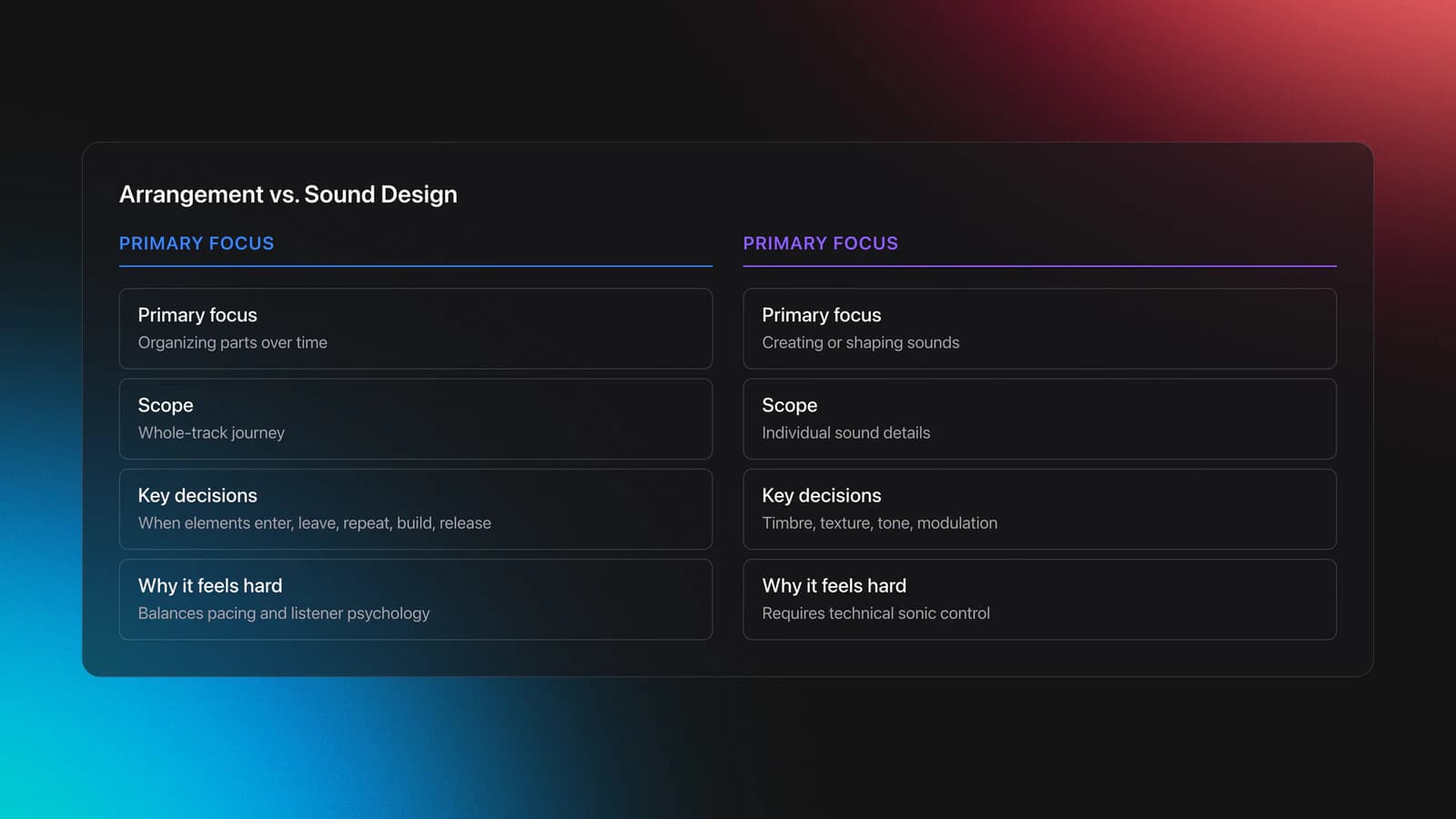
Music arrangement is the process of organizing musical parts over time so a track develops clearly from one section to the next. In practice, that means deciding when elements enter, leave, repeat, build tension, or release energy across a linear timeline.
Ableton defines Arrangement View as the place where you structure a song on a linear timeline, while Sound On Sound and ICON Collective describe arrangement as laying musical ideas out into a finished form. Those views line up well with standard producer practice.
In other words, arrangement is where composition, pacing, and listener psychology meet. It is less about making new sounds and more about choosing the right moment for each sound.
This is why arrangement often feels harder than sound design. Sound design is local. Arrangement is global. You are shaping the whole journey.
Why Music Arrangement Matters
Music arrangement matters because it controls attention. A strong section map tells the listener where to focus, when to expect change, and when a payoff is coming.
It also affects the mix. Mastering.com makes the useful point that arrangement creates space before EQ or compression ever starts. If too many parts fight in the same moment, the mix feels crowded no matter how polished your processing is.
For DJ-focused music, arrangement has another job. It creates dependable entry points, transitions, breakdowns, and exits. That makes a track easier to blend in real performance conditions.
- Creates contrast between sections
- Improves energy flow and tension
- Makes tracks easier to mix and play
- Reduces clutter before mixing
- Helps loops become finished songs
Core Music Arrangement Process
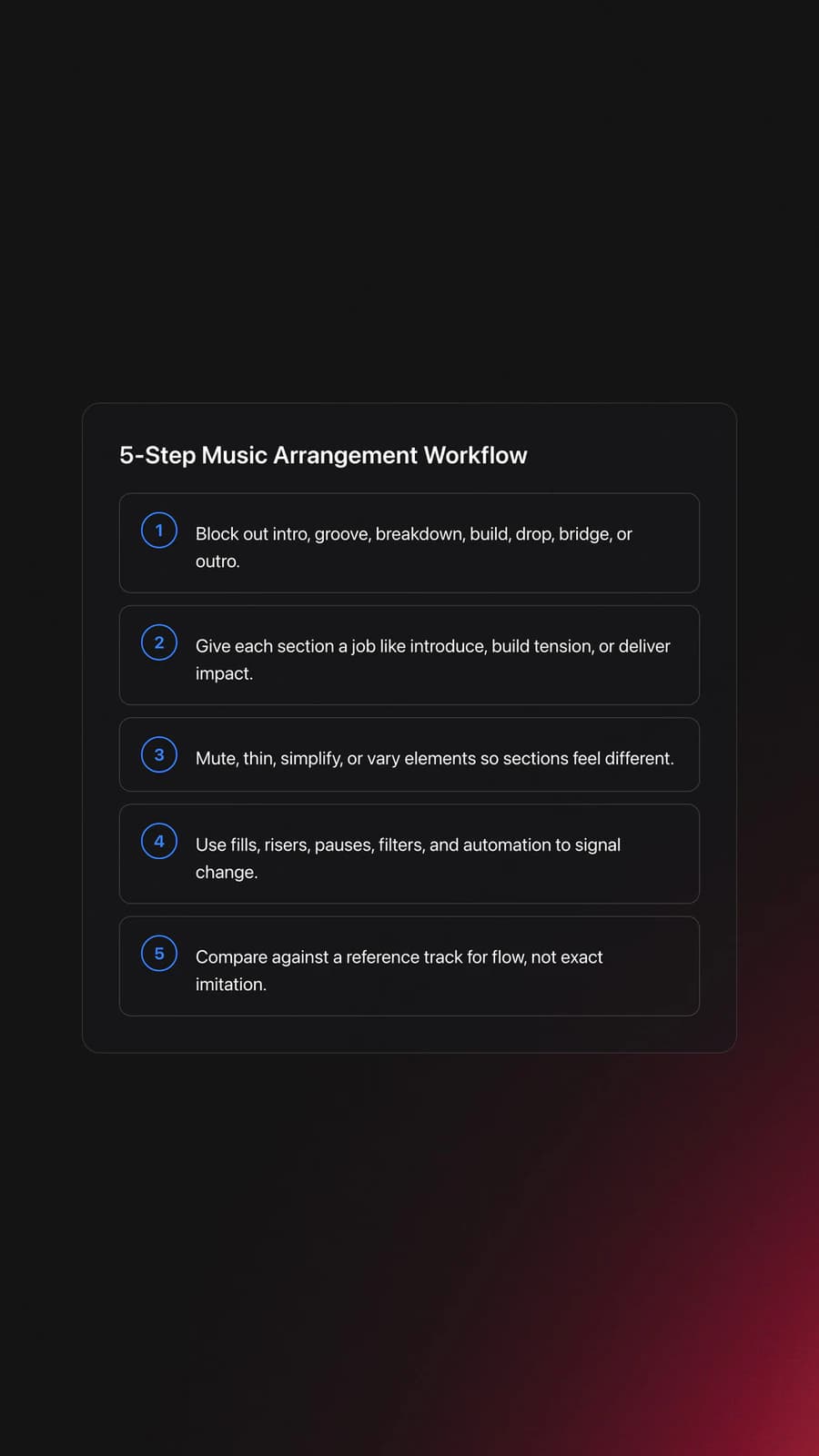
The core process is simple: define the main sections, assign each section a purpose, and control change with subtraction, variation, and transition detail. Most educators cover some version of this, whether they use markers, blank clips, reference tracks, or subtractive arranging.
Start with the biggest blocks first. Mark intro, main groove, breakdown, build, drop, bridge, or outro. EDMProd recommends skeleton arrangements with markers or blank MIDI clips, and Ableton teaching materials use a similar timeline-first approach.
Next, define what each section does. One section introduces the groove. Another creates tension. Another delivers maximum density. Once each section has a job, arrangement decisions become easier.
Then shape contrast. This usually means muting parts, changing register, thinning drums, simplifying harmony, or shifting automation. Ableton's subtractive arranging example is useful here because it shows how copying a full idea across the timeline and removing elements can create structure quickly.
Finally, polish the handoffs. Small fills, risers, pauses, filter moves, and automation cues tell the ear that a new section is arriving. This is where arrangement starts to feel intentional instead of accidental.
| Step | Action | Key Point |
|---|---|---|
| 1 | Map sections on the timeline | Think in broad blocks first |
| 2 | Assign each section a role | Every section should change the story |
| 3 | Remove or vary elements | Contrast beats constant layering |
| 4 | Refine transitions | Small cues make changes feel natural |
| 5 | Test against a reference track | Check pacing, not exact copying |
How to Practice Music Arrangement
The best way to practice music arrangement is to separate arranging from sound hunting. Work with limited material so you can focus on structure, pacing, and contrast instead of chasing better presets.
In practice, short arrangement drills beat marathon sessions almost every time. You improve faster when you repeat one structural problem for two weeks than when you keep restarting unfinished tracks.
A strong first drill is arrangement analysis. Load a reference track, mark every section, and write down what changes every 4, 8, 16, or 32 bars. EDMProd explicitly recommends deconstructing many tracks this way, and it remains one of the fastest ways to build instincts.
A second drill is subtractive arrangement. Build one full 8 or 16 bar loop, duplicate it across three to five minutes, then mute elements to create an intro, breakdown, and outro. This keeps the harmonic and sonic material consistent while you learn section design.
A third drill is transition-only practice. Keep the sections fixed and spend one session creating fills, automation curves, and one-bar changes between them. If you also want cleaner handoffs in DJ sets, build stronger transition design skills.
Organized references help here. A simple workflow in Vibes can group tracks by energy, function, and section style so you can compare intros, breakdowns, or peak-time drops without hunting through random folders.
Keep the sessions measurable. For example, spend 15 minutes marking one reference, 15 minutes building a skeleton arrangement, then 15 minutes refining only one transition type. That kind of narrow focus compounds quickly over a 2–4 week cycle.
Equipment and Session Setup
You do not need special gear to learn music arrangement. A DAW with a timeline view, a few reference tracks, and reliable monitoring are enough.
What matters more is visual clarity. Ableton's documentation and teaching materials both emphasize linear arrangement work, markers, clips, and automation on the timeline. Those features matter because arrangement is easier when sections are visible.
Reference tracks are also essential. Use them as pacing guides, not templates to copy. They help you judge whether your intro is too long, your build arrives too early, or your drop lacks contrast.
Monitor at sensible levels. The CDC advises turning volume down, taking breaks, and moving away from loud sound when needed. For longer sessions, this protects both hearing and judgment.
Common Music Arrangement Mistakes
Most music arrangement problems come from sameness. The loop may sound good, but nothing important changes, so the listener stops anticipating what comes next.
Another common issue is overfilling every section. If every instrument plays all the time, there is no room for tension or payoff. Arrangement guides from Mastering.com, LANDR, and EDMProd all point back to this same principle: contrast creates impact.
| Mistake | Why It Happens | Fix |
|---|---|---|
| Loop repetition | No clear section plan | Map section roles before editing details |
| Overcrowded sections | Adding instead of choosing | Mute parts that do not add a new function |
| Weak drops or choruses | No buildup contrast | Thin earlier sections and save density for payoff |
| Messy transitions | Sections switch without cues | Use fills, automation, pauses, or transitional FX |
| Arranging while sound browsing | Too many decisions at once | Limit the palette and finish the structure first |
Troubleshooting Arrangement Problems
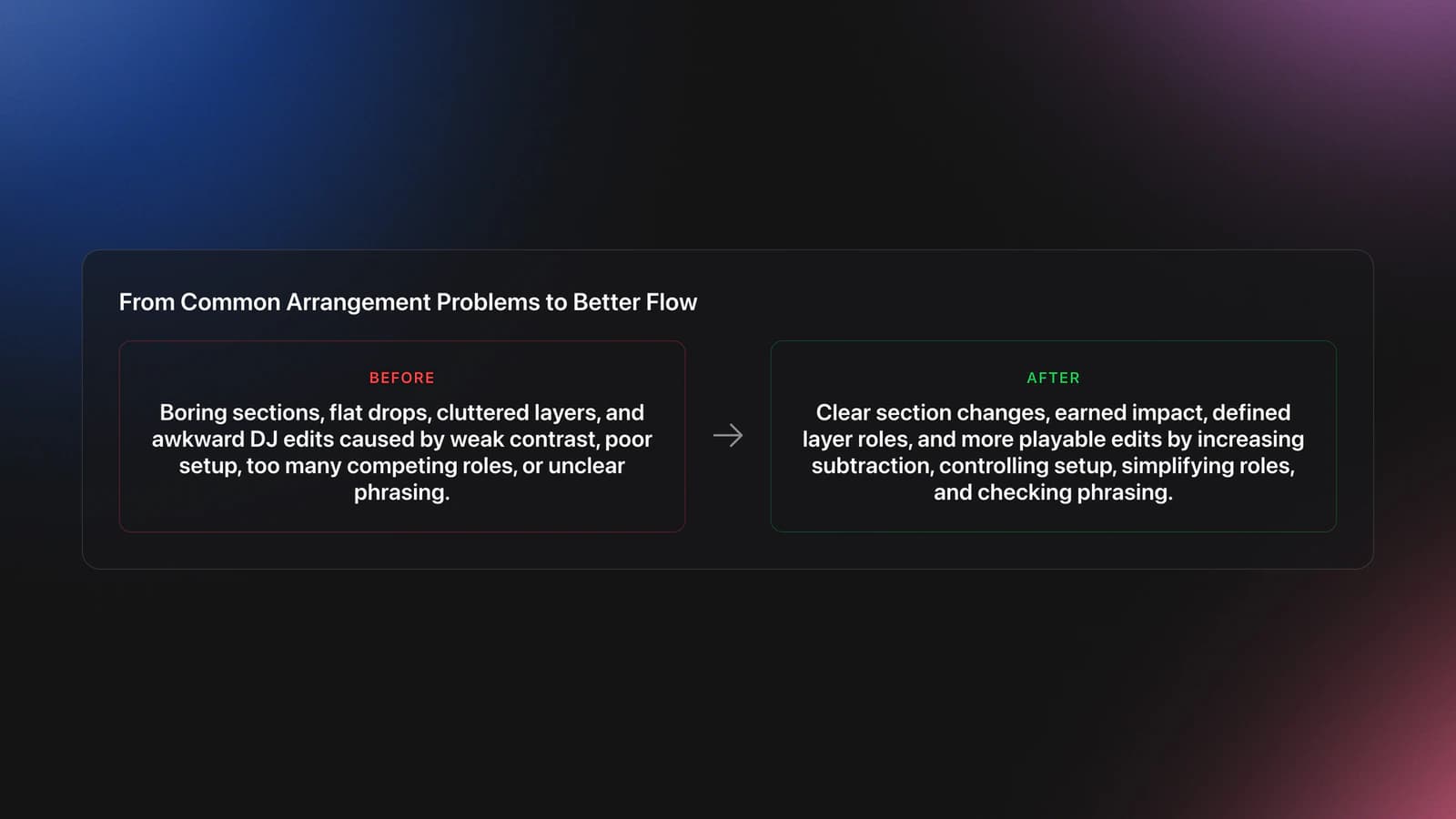
If the track feels boring, ask one question first: what actually changes between sections? If the answer is only a louder riser, the arrangement probably needs stronger subtraction or a clearer new focal point.
If the drop feels flat, compare it to the section before it. A payoff only feels big when the setup is controlled. Reduce drum density, harmonic weight, or stereo width before the impact section so the return feels earned.
If the arrangement feels cluttered, go role by role. Keep one main low-end source, one lead focus, one rhythmic support layer, and one texture layer at a time. This mirrors the space-first approach many arrangement and mixing educators recommend.
If your DJ edits feel hard to play, check phrasing and section predictability. From there, use harmonic mixing to plan smoother energy shifts so key movement supports the structural flow.
Real-World Arrangement Examples
Arrangement choices vary by genre, but the principles stay stable. House and techno often rely on gradual layer changes, extended intros, and DJ-friendly phrasing. Pop and melodic EDM usually push stronger verse-chorus contrast with clearer hooks and denser payoff sections.
Attack Magazine's deconstruction pieces are useful because they show how different tracks build identity through arrangement rather than through sound selection alone. Even unusual records still create expectation, variation, and release.
That is the bigger lesson. Good arrangement is not about copying one structure. It is about giving each section a reason to exist.
Music Arrangement Learning Path
A practical learning path starts with analysis, moves into skeleton drafting, then adds section contrast and transition detail. This order matters because most arrangement issues are structural before they are decorative.
Week one should focus on deconstructing references. Week two should focus on arranging with limited sounds. Weeks three and four should focus on building stronger transitions and more confident section contrast.
If you already finish tracks but they feel predictable, shift into advanced work. Study asymmetry, fake drops, delayed payoffs, or call-and-response changes between sections. Those tools make arrangements feel more alive without making them confusing.
Key Takeaways
Music arrangement gives your track direction. It decides how ideas unfold, where tension rises, and when energy lands. Once you stop treating arrangement as an afterthought, finishing songs becomes far more repeatable.
Keep these points in mind:
- Start with section roles before detailed edits
- Use subtraction and contrast more than constant layering
- Practice with references and short focused drills
Your next step is simple. Take one finished loop, map a full timeline, and arrange it with only muting, section labels, and transition cues. From there, the progression becomes clear.
The visual way to organize your DJ library
Tag tracks by vibe. See everything at once. Export to rekordbox, Serato, Traktor or Engine DJ.
14-day free trial. Full access, no strings attached.
or see how it works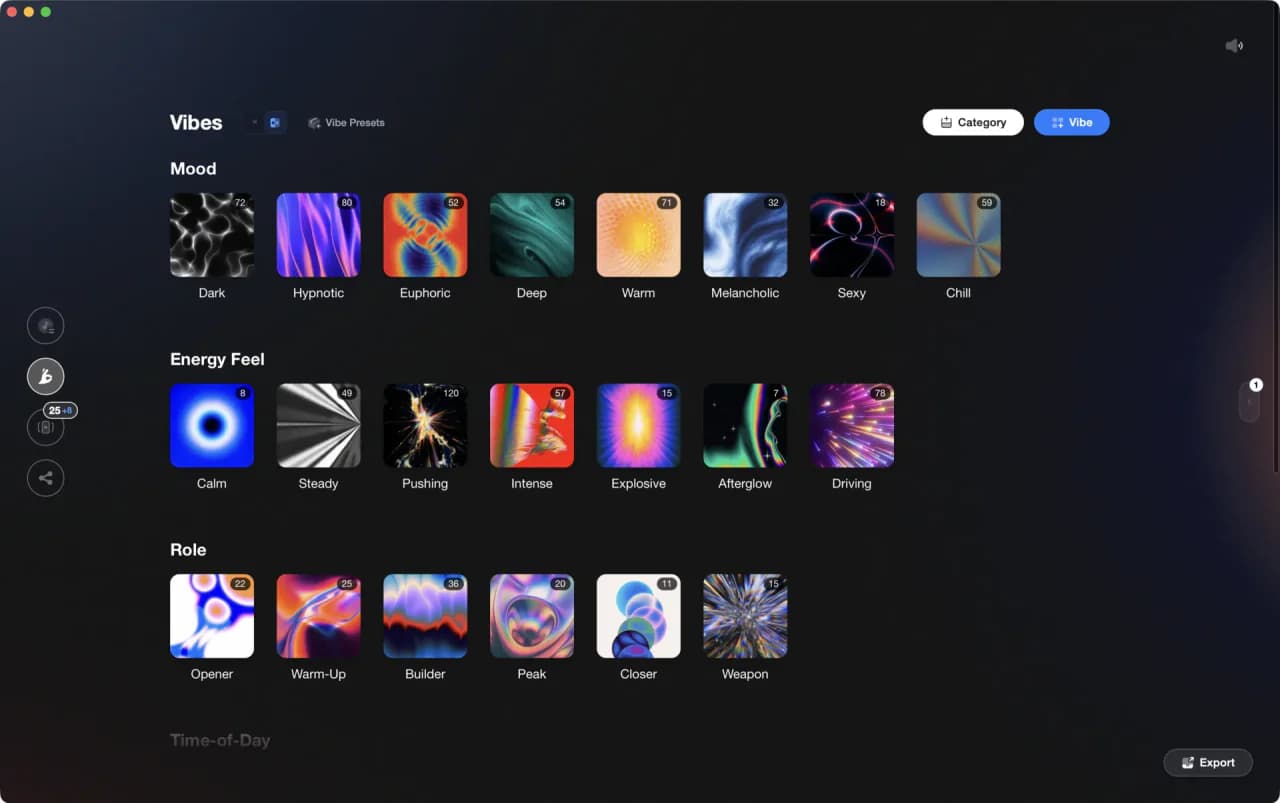
Equipment You'll Need
Frequently Asked Questions

Hey, it's Ben Modigell 👋
I DJ and produce as so I so: downtempo, minimal, dub house, tech house, and techno (releases on Spotify and SoundCloud, links above). Everything I write here comes from my own gigs, studio sessions, and library cleanups: the rules I follow, the failure modes I have actually hit, and the workflow I use when nobody is watching. If a technique did not earn its place in my own sets, it does not make it into a tutorial.