Mock Trial
Mock Trial builds courtroom advocacy skills through simulated cases, witness examinations, objections, and persuasive storytelling under formal rules.
Mock Trial Tutorials
Mock Trial is a structured courtroom simulation where students argue a case, question witnesses, raise objections, and persuade a judge or scoring panel. If you want sharper speaking, faster thinking, and better control under pressure, Mock Trial is one of the most practical ways to build those skills.
For beginners, Mock Trial can feel like acting, debate, and legal analysis all at once. That is exactly why it works. You learn to read closely, organize facts, and speak with purpose. Over time, Mock Trial also teaches timing, restraint, and how to stay calm when the other side tries to disrupt your plan.
Most competitions follow a fixed order with attorney roles, witness roles, and strict procedural rules. National high school competition rules are updated by the National High School Mock Trial Championship, with amendments adopted in July 2025, while many college events use AMTA-style rulebooks and role structures. National High School Mock Trial rules overview and the American Mock Trial Association rulebook show how formal those frameworks can be.
What Is Mock Trial?
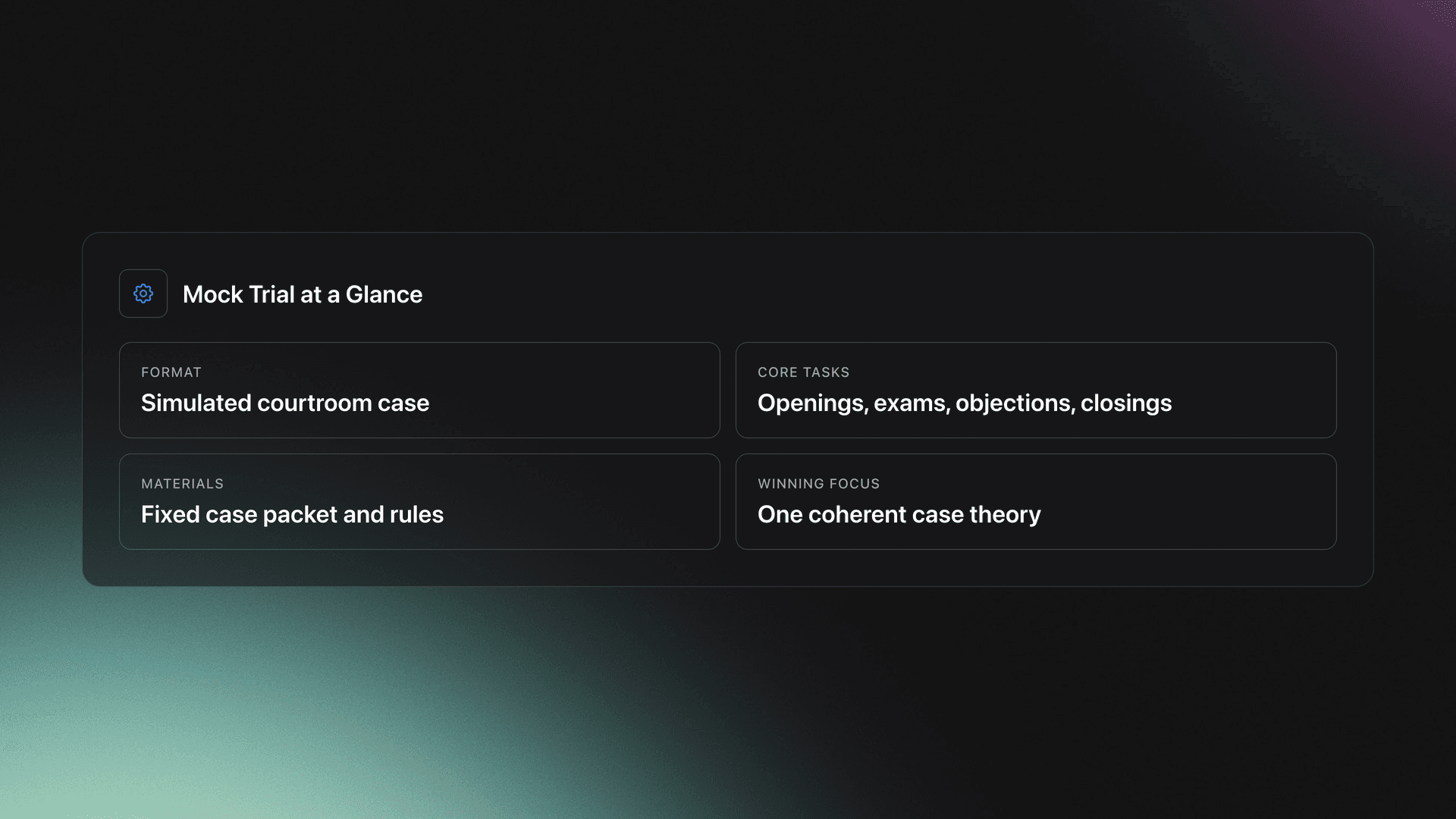
Mock Trial is a competitive or instructional simulation of a courtroom case. Teams present openings, direct examinations, cross-examinations, objections, and closings using a fixed case packet and a defined set of rules. The goal is not only to know the facts, but to present them clearly, strategically, and persuasively.
In practice, Mock Trial teaches case theory. That means every question, answer, and argument should support one coherent story.
The strongest teams do not just memorize lines. They understand why each fact matters, where each witness fits, and how each examination moves the judge toward a conclusion.
The American Bar Association describes mock trials as educational courtroom exercises with simplified steps and rules for students, while competition organizations formalize timing, roster rules, and trial procedure for tournament settings. American Bar Association mock trial resources give the broad educational view, and the National High School Mock Trial rules overview provides the competition framework.
Why Learn Mock Trial
Mock Trial improves more than legal knowledge. It trains delivery, listening, structure, and decision-making under time pressure.
- Build confident courtroom-style speaking.
- Learn to turn facts into a persuasive story.
- Practice fast reactions during objections and cross.
- Develop close reading and evidence control.
- Improve teamwork through role-based preparation.
This is why Mock Trial helps students beyond competition season. The same skills carry into interviews, presentations, debate, negotiation, and any role that requires calm communication under scrutiny.
Mock Trial Fundamentals
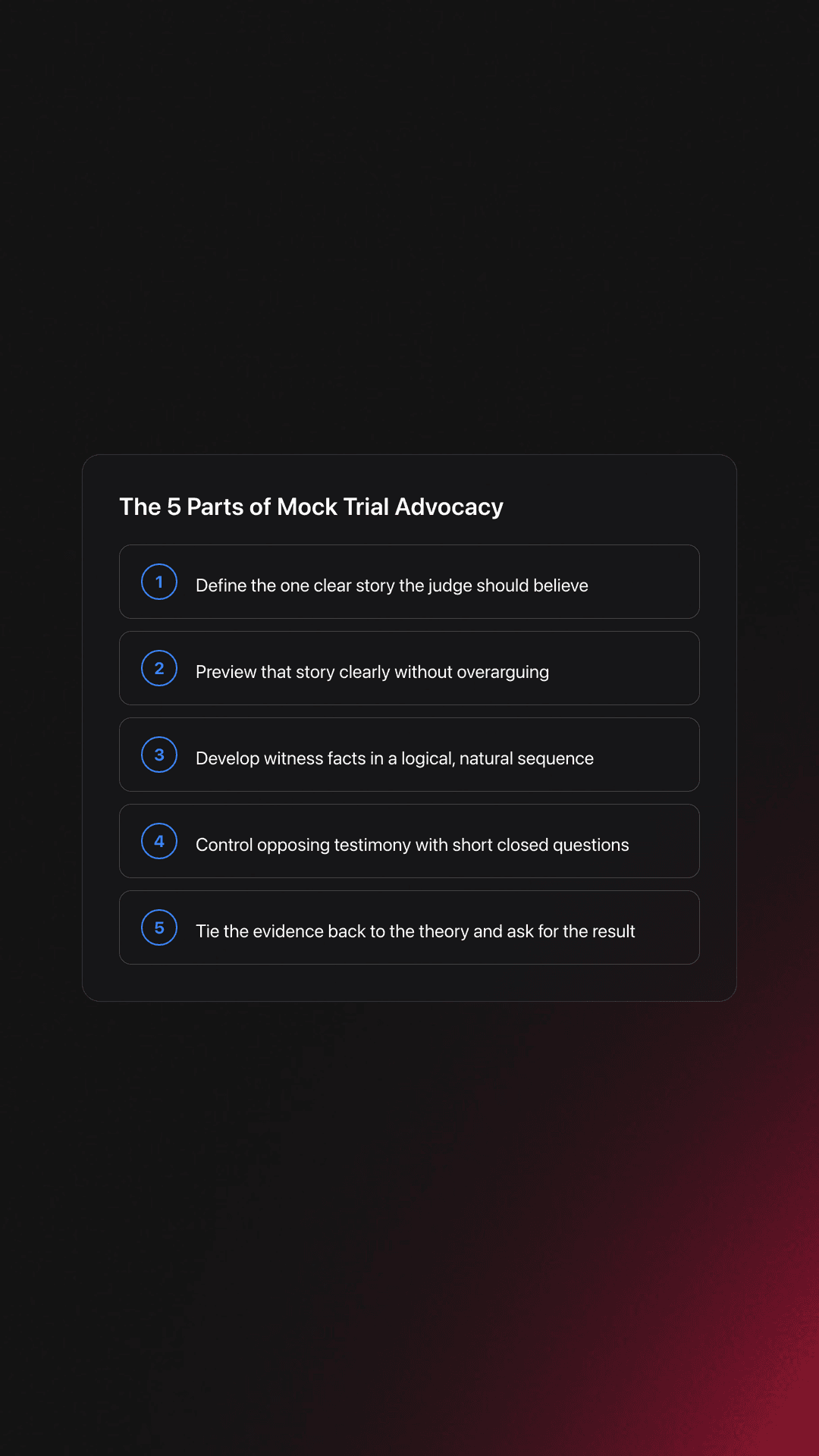
Mock Trial works best when you break it into five parts: case theory, opening statement, direct examination, cross-examination, and closing argument. Each part has a different job, but all five must point to the same theme.
Start with the case theory. This is your short answer to one question: why should the judge believe your side? If your theory is weak or vague, every later section becomes harder.
From there, build your opening. A strong opening previews the story without arguing too hard. The Mock Trial Nerd opening statement guide emphasizes relatability, structure, and avoiding alienating phrasing.
Next comes direct examination. Direct should feel clear and logical. The attorney guides the witness so the facts land in the right order, and the witness sounds natural instead of recited. The Mock Trial Nerd direct examination guide stresses outlining testimony first, then practicing out loud early.
Cross-examination has a different purpose. You control the witness with short, closed questions and limit room for explanation. The Mock Trial Nerd cross-examination guide recommends closed-ended questions and a confident, non-argumentative tone.
Finally, the closing argument ties everything together. You explain what the evidence showed, why the other side fell short, and what result the judge should reach.
If you are new to structured advocacy, it helps to first build stronger public speaking fundamentals and shape a clear opening statement before trying to master the full event.
| Phase | Main Goal | Key Habit |
|---|---|---|
| Case theory | Define your story | Reduce the case to one clear theme |
| Opening | Preview the story | Speak clearly without overarguing |
| Direct | Develop your witness | Use logical sequencing |
| Cross | Control opposing testimony | Ask short closed questions |
| Closing | Explain why you win | Tie facts back to the theory |
How to Practice Mock Trial
The fastest way to improve at Mock Trial is to isolate skills instead of running full scrimmages every day. Practice one role at a time, one objective at a time, then combine them.
Through daily 15-minute practice sessions over several years, I found that short, repeatable drills improve performance faster than marathon rehearsals. In Mock Trial, that usually means one opening drill, one examination drill, and one objection drill in the same session.
Start with a 5-minute theory summary. Each teammate explains the case in plain language without notes. If two summaries sound different, the team is not aligned yet.
Then run a direct examination drill. Attorneys should ask only the questions needed to unlock the witness's facts. Witnesses should answer in a natural voice, not by reciting the packet line by line.
After that, do cross-examination reps. Use a timer. Ask twelve to fifteen closed questions in a row, keeping each one narrow.
Finish with objections and redirects. This forces the room to think about rule triggers, recovery, and composure.
Most instructors recommend speaking out loud early, rather than outlining for days. That matches the direct examination guidance in the Mock Trial Nerd direct examination guide, which argues that real progress comes from early run-throughs and evaluation.
Once those drills feel stable, add a half trial. Then graduate to full rounds with scoring.
Equipment and Materials
What you need for Mock Trial is simple, but the setup matters. You need the case packet, the current rules, a timer, and a way to organize questions, exhibits, and impeachment material.
Essential materials should stay lean. If your notes are too long, you will read instead of advocate.
Optional tools can still help. A color-coded binder, printed witness statements, and recorded practice rounds make feedback much easier.
Because competition formats vary, always confirm your governing rules before final prep. High school teams often rely on state or national championship rules, while college teams commonly use AMTA frameworks and role allocations.
Common Mistakes in Mock Trial
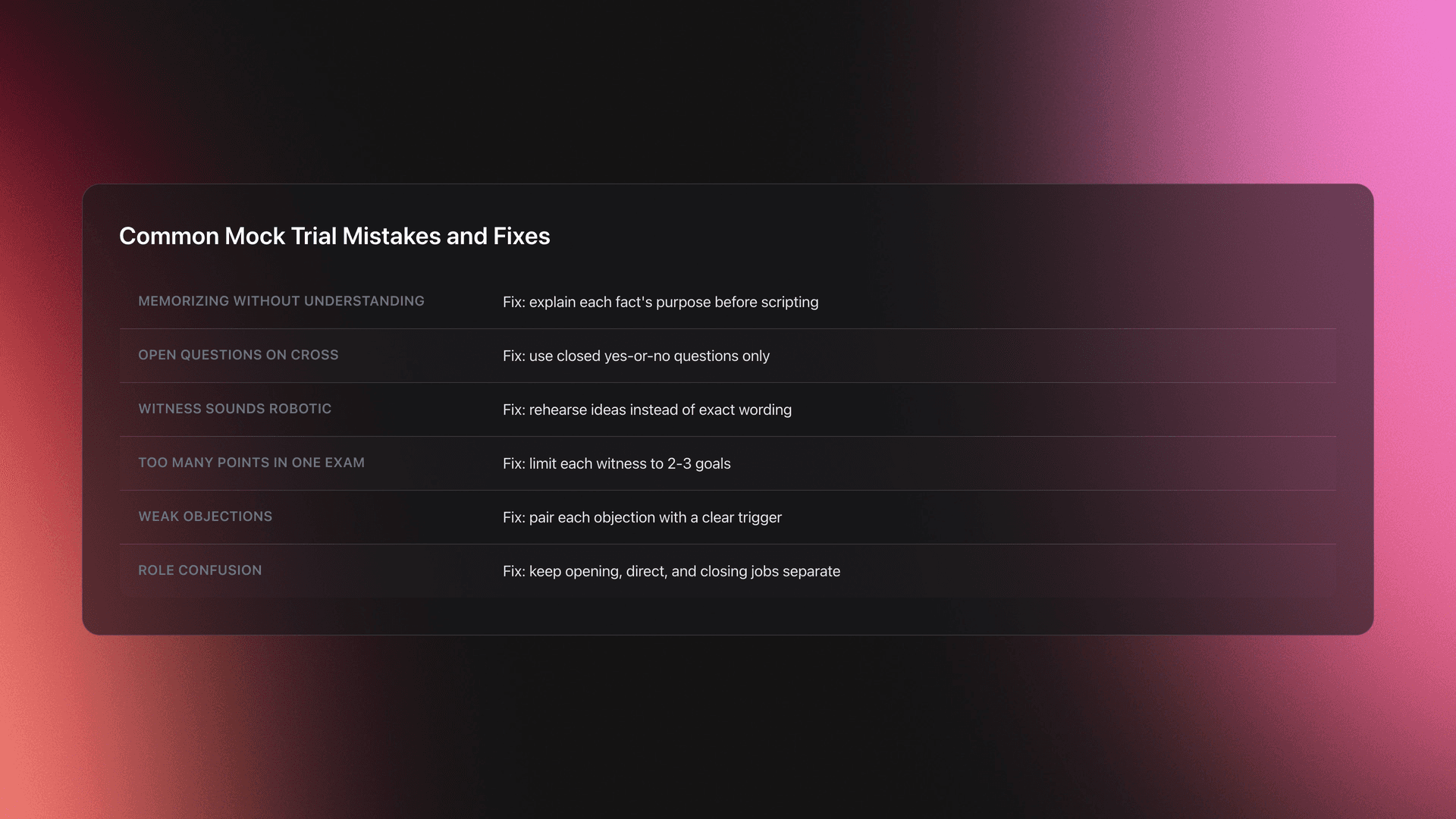
Most Mock Trial losses come from structural mistakes, not lack of effort. Teams either lose control of the story, waste time, or ask questions that open the door for damaging answers.
| Mistake | Why It Happens | Fix |
|---|---|---|
| Memorizing without understanding | Students learn lines before theory | Explain each fact's purpose before scripting |
| Open questions on cross | Attorney slips into direct style | Use closed yes-or-no questions only |
| Witness sounds robotic | Answers are memorized word for word | Rehearse ideas, not exact wording |
| Too many points in one exam | Attorney tries to cover everything | Pick 2 to 3 goals per witness |
| Weak objections | Students know names but not timing | Pair each objection with a clear trigger |
Why do most beginners struggle with cross-examination? Because cross feels aggressive, so they speed up and stop listening.
In practice, better cross is usually slower cross. Ask one fact at a time. If the witness escapes, reset and narrow the next question.
Another common issue is role confusion. An opening should preview. A closing should argue. A direct should develop testimony. When those jobs blur, the round loses shape.
Troubleshooting Performance Problems
If your Mock Trial round feels flat, diagnose the exact failure point. Do not just say the team lacked energy.
If attorneys are losing control, shorten the questions. If witnesses are rambling, rehearse answer length. If objections feel late, drill recognition before delivery.
If the case theory keeps changing mid-round, return to one sentence that every teammate can repeat. That sentence should define motive, weakness, or reasonable doubt, depending on the case.
If your direct examinations feel dull, use sequencing and contrast. Move from background to key event to significance, and make the witness sound like a person instead of a document.
If cross-examinations keep failing, spend a week on nothing but control. This is where it clicks. Ask only questions that already imply the answer, then practice controlled cross-examination sequences until pacing feels automatic.
For objection-heavy rounds, it also helps to learn common courtroom objections separately before trying to execute them under full trial pressure.
Learning Timeline and Checkpoints
A realistic Mock Trial timeline depends on role difficulty and team support, but most students can become basically competition-ready in four to eight weeks of focused work.
Week 1 should center on reading the packet and building team theory. By the end of that week, every member should explain the case in under 30 seconds.
Weeks 2 and 3 should focus on role execution. Openings, directs, crosses, and witness character work need separate reps.
Weeks 4 and 5 should shift toward timing, objections, and adaptation. You are no longer learning content. You are learning control.
Through repeated 2 to 4 week practice cycles, I found that measurable checkpoints keep teams honest. Instead of saying a witness is getting better, test whether they can answer hostile cross calmly for three straight minutes without breaking character.
Useful checkpoints include delivering an opening from memory in under five minutes, completing a direct without missing a required fact, and sustaining a clean cross built from closed questions only.
What Comes After Mock Trial Basics
Once basic Mock Trial skills are stable, the next layer is refinement. That means better phrasing, smarter witness control, tighter themes, and stronger transitions between facts and argument.
From there, progression becomes clear. You can develop persuasive closing argument skills, deepen impeachment technique, or train for more advanced evidentiary objections.
The best next step is usually the role that scares you most. If cross feels chaotic, train cross. If openings feel stiff, rewrite and deliver ten versions.
Mock Trial Summary
Mock Trial teaches structured persuasion under pressure. It combines case analysis, witness control, public speaking, and teamwork into one demanding but highly transferable skill set. If you approach it with short focused practice sessions, clear role goals, and measurable checkpoints, progress comes faster than most beginners expect.
Key takeaways:
- Build one clear case theory before polishing delivery.
- Practice roles in isolation before running full rounds.
- Measure progress through timing, control, and consistency.
Start with theory, opening, and one clean examination. Then expand outward. Once those foundations hold, Mock Trial becomes far more strategic and far less intimidating.
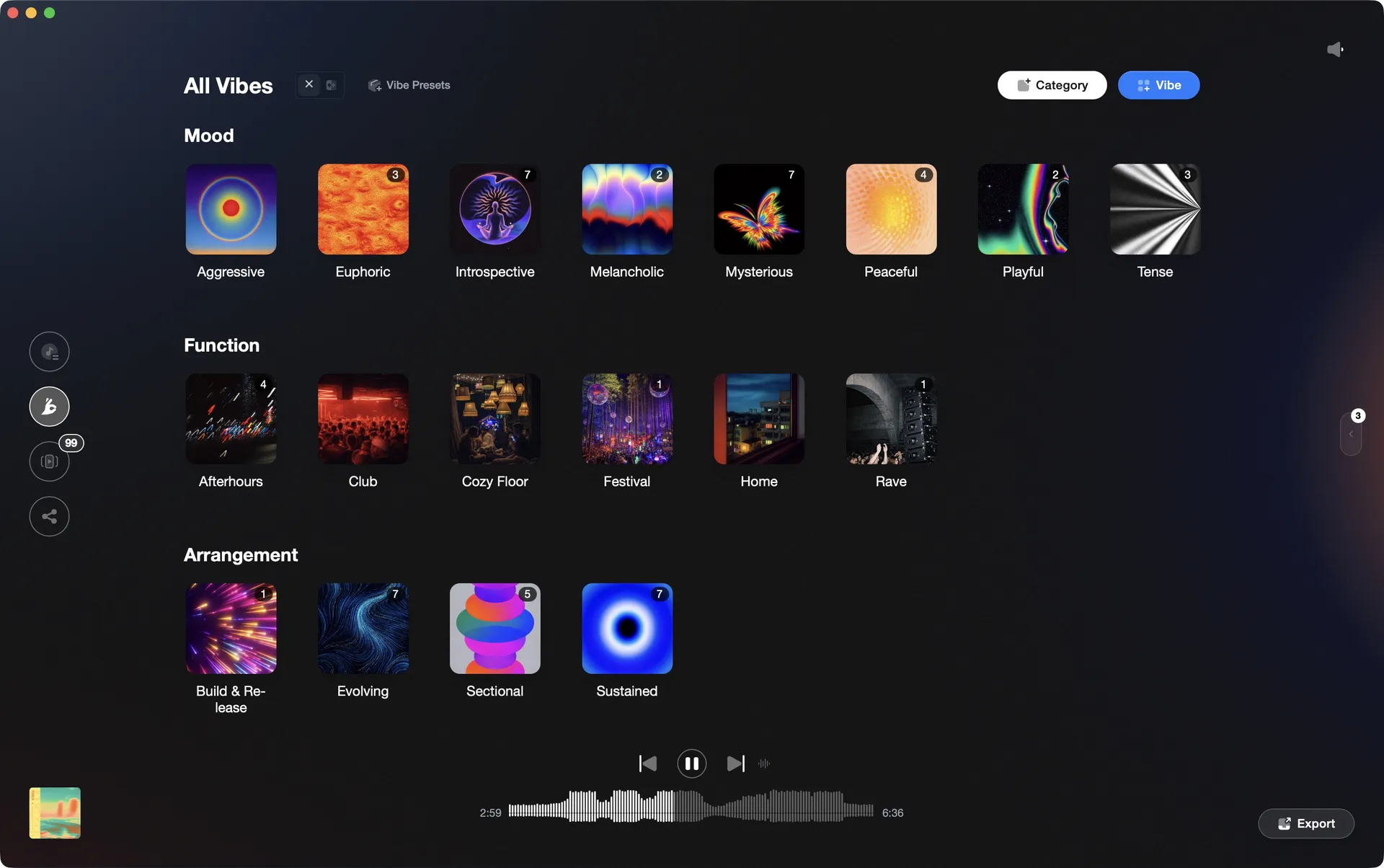
Organize your DJ library visually.
Tag tracks by vibe. See everything at once. Export to any DJ software.
A visual system for organizing your DJ library.